Shiitake
13 tips in Species Guides
By Andrew Langevin · Founder, Nature Lion Inc · Contributing author, Mushroomology (Brill, 2026)
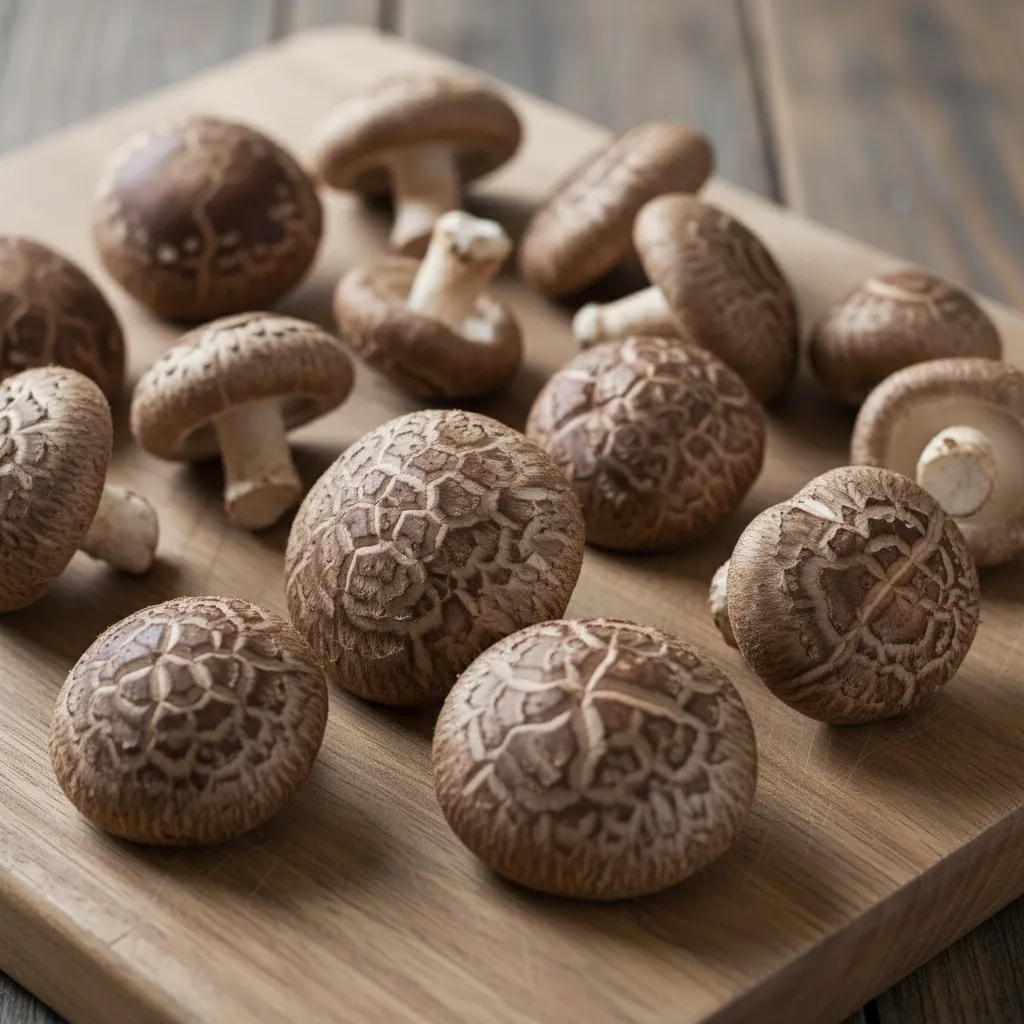
Shiitake (Lentinula edodes) is the second most cultivated mushroom in the world after button mushrooms, prized for its rich umami flavor and impressive nutritional profile. Native to East Asia, shiitake has been cultivated for over 1,000 years on hardwood logs in China and Japan.
In modern cultivation, shiitake grows on both natural logs (outdoor, slow method) and supplemented hardwood sawdust blocks (indoor, faster method). What sets shiitake apart from other gourmet species is its colonization behavior — shiitake mycelium fully colonizes and then forms a protective brown skin (browning) on the block surface before it is ready to fruit. This browning phase is unique to shiitake and often confuses beginners who expect fruiting to begin immediately after colonization.
Shiitake also has the longest shelf life of any fresh gourmet mushroom at 7-10 days refrigerated, making it the most commercially practical species for small farms and farmers markets.
Shiitake is one of the slowest colonizers in common cultivation, and this is completely normal. On supplemented hardwood sawdust blocks, full colonization takes 6-8 weeks. On natural logs, colonization takes 6-12 months.
This extended timeline exists because shiitake mycelium grows methodically, producing dense enzymatic networks that thoroughly break down lignin in hardwood — a much more complex biochemical process than the rapid cellulose digestion that oyster mushrooms perform.
During this long colonization, the block goes through visible stages:
- Weeks 1-3: white mycelial coverage
- Weeks 3-5: thickening and consolidation
- Weeks 5-8: browning
The colonization environment should be 20-24°C with no light and minimal disturbance. Do not open, squeeze, or move blocks unnecessarily during this phase.
The patience pays off — properly colonized shiitake blocks produce multiple flushes over 3-4 months with excellent mushroom quality.
Browning is a unique phase in shiitake cultivation where the fully colonized mycelium forms a dark brown, leathery skin on the surface of the sawdust block. This is NOT contamination — it is an essential developmental stage.
The brown skin (technically a melanized mycelial mat) serves as a protective barrier that prevents moisture loss and contamination during fruiting. Browning typically begins 4-5 weeks after inoculation and completes by week 6-8.
The block transitions through these stages:
- Solid white to patchy brown
- Patchy brown to uniform chocolate-brown exterior
- Final texture is firm and slightly rubbery with a distinctly mushroomy, earthy aroma
Some white patches may remain, which is fine. Blocks with less than 50% browning are not ready to fruit. Attempting to fruit before browning results in weak, small mushrooms and increased contamination susceptibility.
Once browning is complete, the block is ready for cold shocking to initiate fruiting. Well-browned blocks can actually be stored at room temperature for several weeks before fruiting if needed.
Shiitake fruiting parameters vary by strain, but the general ranges are:
- Temperature: 10-22°C (50-72°F) — cold-weather strains fruit best at 10-16°C, warm-weather strains at 16-22°C
- Humidity: 80-90%, notably lower than lion's mane or oyster requirements
- FAE: moderate — good airflow but not the aggressive ventilation oyster mushrooms demand
- Light: 12 hours of indirect ambient light daily helps trigger pinning and directs growth
Shiitake produces individual mushrooms scattered across the block surface rather than dense clusters. Pins appear 3-7 days after cold shocking and reach harvest size in 5-7 additional days. The fruiting chamber should maintain steady conditions without large swings — shiitake is more sensitive to environmental fluctuation than oyster mushrooms.
After harvest, rest the block for 2-3 weeks at room temperature, soak in cold water for 12-24 hours, and repeat for the next flush. Expect 3-5 flushes per block over 3-4 months.
Cold shocking is the primary fruiting trigger for shiitake mushrooms, mimicking the natural autumn temperature drops that signal the fungus to fruit in the wild.
Once your block is fully browned, submerge it completely in cold water at 4-10°C (39-50°F) for 12-24 hours. Use a cooler with ice water or a refrigerator. The block will float, so weigh it down with a clean plate or bag of water. The sudden temperature drop combined with rehydration triggers a hormonal cascade in the mycelium that initiates primordia formation.
After soaking, remove the block, let excess water drain for 30 minutes, then place it in fruiting conditions. Pins should appear within 3-7 days.
If no pins appear after 10 days, the cold shock may not have been dramatic enough — try again with colder water (add ice) or a longer soak. Some growers also slap the block firmly on a table several times before soaking, which mimics the physical trauma of falling branches in the forest — another natural fruiting trigger.
Cold shocking is not optional for most shiitake strains grown on sawdust blocks.
Both methods work well, but they serve different purposes.
Sawdust blocks (supplemented hardwood, pressure sterilized) produce mushrooms faster — first harvest in 8-12 weeks from inoculation — and offer more control over growing conditions. They are ideal for year-round indoor production and consistent yields. Expect 1-1.5 lbs per 5 lb block over 3-5 flushes. Blocks are used up in 3-4 months.
Log cultivation uses freshly cut hardwood logs (oak is ideal, 10-15cm diameter) inoculated with plug spawn or sawdust spawn. Logs take 6-12 months to colonize but then produce mushrooms for 3-6 years, making them extremely productive long-term. Log-grown shiitake are considered superior in flavor and texture by many chefs. Logs fruit naturally in spring and fall when rain and temperature changes trigger them, or can be force-fruited by soaking in cold water.
The tradeoff is clear: blocks for speed and control, logs for longevity and hands-off production. Many growers use both — blocks for immediate gratification and logs as a long-term investment that produces for years with minimal effort.
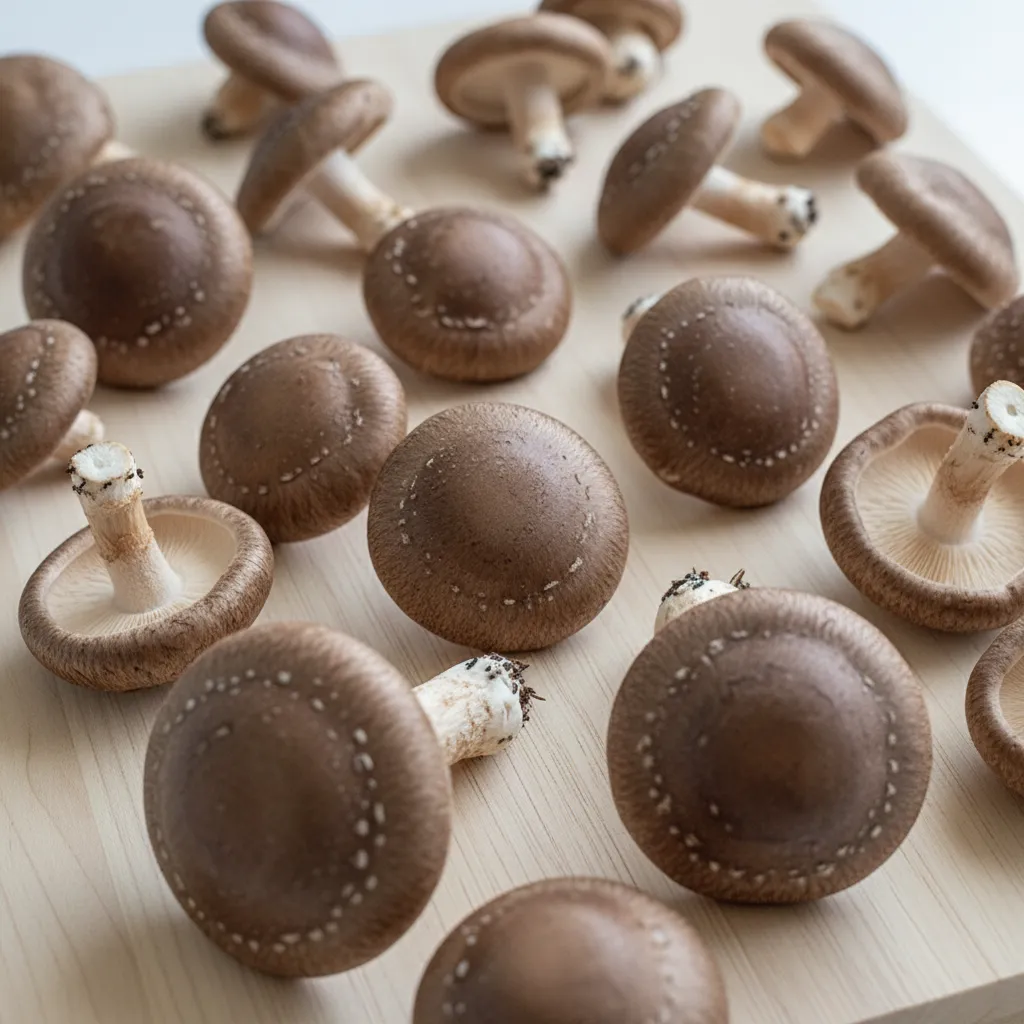
Shiitake strains are broadly categorized by their fruiting temperature preference, and choosing the right strain for your climate is essential.
- Cold-weather strains (like 3782 or Cold Weather) — fruit best at 10-16°C (50-60°F), require a strong cold shock, produce thick-capped dense mushrooms with crackled tops (donko style) prized in Asian cuisine. Ideal for unheated spaces, garages, or outdoor grows in temperate climates.
- Warm-weather strains (like 3790 or Wide Range) — fruit at 16-24°C (60-75°F), more forgiving with temperature, some fruit without cold shocking at all. Produce thinner caps with a smoother surface but fruit more easily and reliably indoors.
- Wide-range strains — attempt to span both categories at 10-24°C, but typically produce best quality at the middle of this range.
For beginners, a wide-range strain is most forgiving. For maximum quality, match the strain to your actual growing temperature.
Shiitake uses a higher spawn rate than oyster mushrooms: 20-25% by weight of wet substrate is recommended. For a 5 lb (2.3 kg) block, use 1-1.25 lbs (450-570g) of grain spawn. This higher rate is necessary because shiitake colonizes slowly — doubling the spawn rate roughly halves colonization time and dramatically reduces contamination risk during the long 6-8 week colonization period.
For log cultivation:
- Plug spawn: 1 plug per 15cm of log length, with rows spaced 10-15cm apart around the circumference. A 1-meter log gets approximately 30-50 plugs.
- Sawdust spawn in logs: pack tightly into drilled holes (8-12mm diameter, 5cm deep) and seal with cheese wax or beeswax.
Under-inoculating logs is the most common mistake — logs that take too long to colonize get claimed by wild fungi before shiitake can establish dominance. Over-spawning is rarely a problem with shiitake, so when in doubt, use more spawn rather than less.
Shiitake yields from supplemented sawdust blocks are moderate compared to oyster mushrooms. A standard 5 lb (2.3 kg) block produces 0.75-1.5 lbs (340-680g) total across 3-5 flushes, translating to 60-100% biological efficiency.
- First flush: the largest, producing 4-8 individual mushrooms totaling 200-400g
- Subsequent flushes: progressively smaller but can continue for 3-4 months with proper care
Log cultivation yields are harder to predict but remarkably productive over time — a single well-inoculated oak log produces 1-2 lbs of mushrooms per year for 3-6 years, with peak production in years 2-4.
Factors that boost yield: proper browning before first fruiting, aggressive cold shocking, thorough rehydration between flushes, and keeping blocks in a stable environment. Masters Mix significantly outperforms plain hardwood sawdust. Temperature affects quality vs. quantity: cooler temps produce fewer but thicker, denser mushrooms; warmer temps produce more but thinner caps.
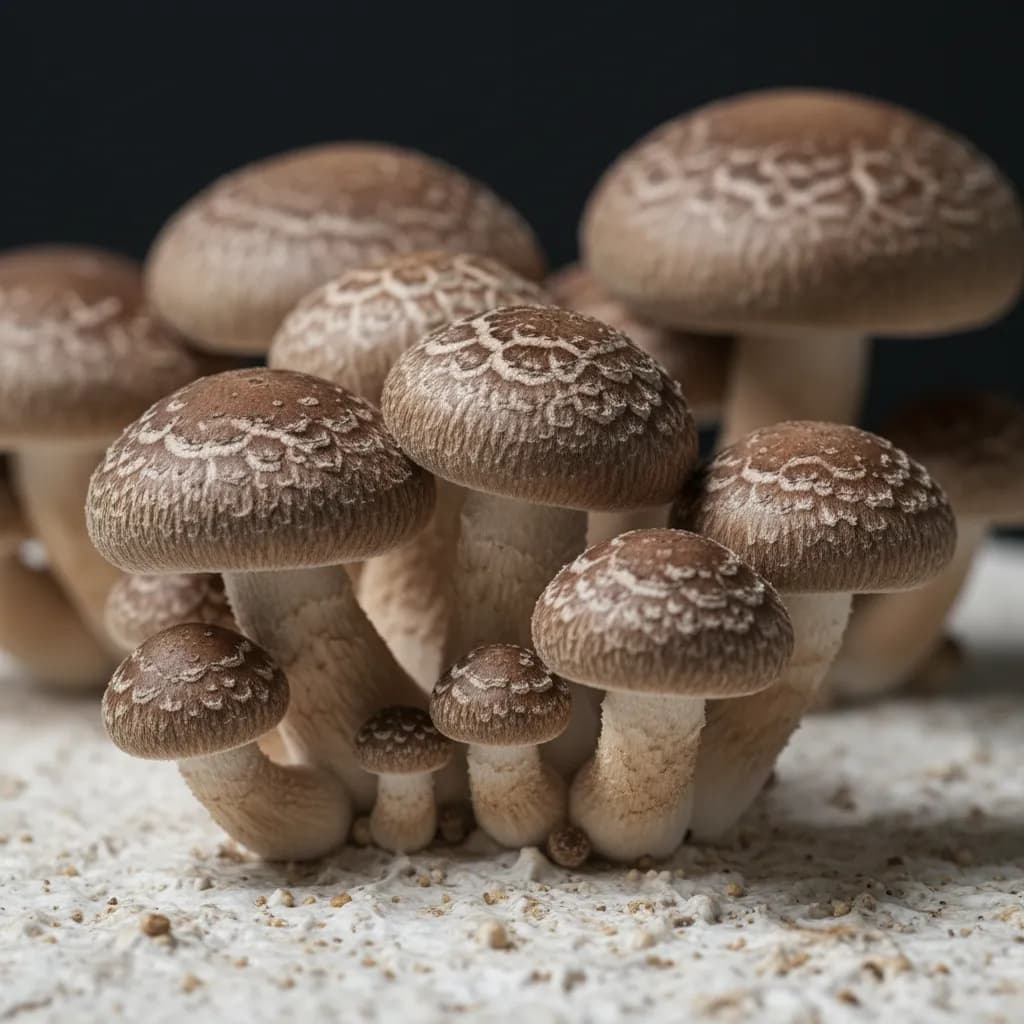
Harvest shiitake mushrooms when the caps are 70-80% open — the edges have uncurled from the stem but the cap is still slightly convex (dome-shaped), not fully flat. At this stage, the gills underneath are visible but the cap edge still curves slightly downward. The cap should feel firm and springy when gently pressed.
Harvest by twisting the mushroom at the base and pulling gently, or cut with a clean knife flush with the block surface. Leave no stump — remnant tissue can rot and attract contamination.
Unlike oyster mushrooms that come in clusters, shiitake fruit individually or in small groups scattered across the block, so you may harvest over 2-3 days as mushrooms reach maturity at different rates.
If the cap is fully flat or the edges turn upward, the mushroom is past peak — still edible but with reduced flavor and shorter shelf life. Shiitake caps that crack on top (forming a star pattern) are called *donko* and are especially prized — this happens in cool, dry fruiting conditions.
Shiitake mushrooms have the longest shelf life of any commonly cultivated gourmet species, lasting 7-10 days refrigerated in a paper bag at 2-4°C. This is roughly double the shelf life of oyster mushrooms (3-5 days) and lion's mane (3-5 days).
The longevity comes from shiitake's dense cap structure and lower moisture content compared to other gourmet species. Shiitake caps are thick and firm, with a natural waxy cuticle on the top surface that resists moisture loss. This makes shiitake the most practical species for farmers market sales and restaurant supply, where shelf life directly impacts profitability.
To maximize storage life:
- Harvest at the right maturity (slightly domed caps)
- Never wash before storing
- Place in a paper bag in the refrigerator
- Avoid stacking heavy items on top that crush the caps
Dried shiitake is a pantry staple that lasts 1-2 years — slice to 6mm and dehydrate at 50-60°C for 6-8 hours. The drying process actually intensifies umami flavor through enzymatic conversion of glutamic acid.
Shiitake tests every grower's patience because its timeline is dramatically longer than beginner-friendly species like oyster mushrooms. Where blue oyster goes from inoculation to first harvest in 3-4 weeks, shiitake takes 8-12 weeks minimum on sawdust blocks and 6-12 months on logs.
Every stage is slower:
- Colonization: 6-8 weeks (vs. 2 weeks for oyster)
- Browning: adds another 1-3 weeks
- Individual flushes: 7-14 days to develop
New growers frequently make impatient mistakes: opening blocks too early to check progress (introducing contaminants), trying to fruit before browning completes (producing tiny mushrooms), or giving up on blocks that look inactive but are actually developing normally.
The reward for patience is substantial. A properly managed shiitake block produces 3-5 flushes over 3-4 months. Log cultivation yields mushrooms for 3-6 years. The flavor and quality of properly grown shiitake is outstanding, and the long shelf life means less waste. Start shiitake blocks alongside faster species like oyster mushrooms — the oysters satisfy your need for quick results while the shiitake develops at its own pace.
Indoor shiitake cultivation on sawdust blocks is the fastest way to produce shiitake at home, yielding first harvest in 8-12 weeks compared to 6-12 months for log cultivation.
Step-by-step indoor method:
- Prepare substrate — mix 78% hardwood sawdust (oak preferred), 20% wheat bran, and 2% gypsum. Hydrate to 60-63% moisture. Alternatively, use Masters Mix for higher yields.
- Bag — fill 5 lb autoclavable bags with filter patches. Pack firmly to remove air pockets.
- Sterilize — pressure cook at 15 PSI for 2.5 hours. Cool to room temperature (8-12 hours).
- Inoculate — add grain spawn at 10-15% by weight using sterile technique. Seal bags.
- Colonize — incubate at 21-24°C in darkness for 6-8 weeks. Shiitake colonizes slowly — do not open or disturb.
- Wait for browning — after full colonization, the block surface develops a brown, leathery skin over 1-3 weeks. This is essential — do not fruit before browning occurs.
- Initiate fruiting — remove the block from the bag, soak in cold water (10-15°C) for 12-24 hours to trigger pinning. Place in fruiting chamber at 13-18°C, 80-90% humidity, with moderate FAE.
- Harvest — shiitake are ready when caps are 70-80% open with edges still slightly curled under. Cut at the stem base.
Critical differences from other species:
- The browning phase is mandatory — skipping it produces tiny, poor-quality mushrooms
- Cold-water soaking is the primary fruiting trigger (not just temperature drop)
- Shiitake prefers lower humidity (80-90%) than lion's mane or oyster
- Oak sawdust produces significantly better flavor than mixed hardwood
- Expect 3-5 flushes over 3-4 months with cold-water soaking between each flush
Need more help? Dr. Myco can answer follow-up questions about shiitake based on thousands of real growing experiences.
Ask Dr. MycoMore in Species Guides
Oyster Mushrooms
15 tips
Lion's Mane
13 tips
King Oyster
12 tips
Reishi
13 tips
Chestnut & Other Gourmet
15 tips
Mushroom Health & Medicinal Benefits
17 tips
Cooking & Preparation
16 tips
Enoki, Maitake & Cordyceps
14 tips
Mushroom Alternate Names & Varieties
17 tips
Mushroom Supplement Guide
18 tips
Common Mushroom Varieties
20 tips
Rare & Specialty Cultivatable Species
16 tips