Mushroom Fruiting Conditions by Species
14 tips in Fruiting & Harvest
By Andrew Langevin · Founder, Nature Lion Inc · Contributing author, Mushroomology (Brill, 2026)
Species quick reference
Fruiting conditions must be measured where the mushrooms are growing
Use these ranges as starting points, then follow strain-specific supplier guidance and measured crop response. A sensor above the humidifier or beside an intake does not describe conditions at a lower-shelf fruiting surface.
| Species | Temperature | RH | CO₂ planning range | Fresh air | Light | Common failure |
|---|---|---|---|---|---|---|
| Blue OysterPleurotus ostreatus var. columbinus | 10–18°C | 85–95% | <800–1,000 ppm | very high | 500–1,000 lux, indirect | Long stems and small caps from excessive CO₂. |
| Pink OysterPleurotus djamor | 18–30°C | 85–95% | <800–1,000 ppm | very high | 500–1,000 lux, indirect | Cold damage; do not refrigerate live pink oyster culture or spawn. |
| Lion's ManeHericium erinaceus | 16–21°C | 90–95% | <800–1,000 ppm | high | 500–1,000 lux, indirect | Coral-like growth or elongated teeth from high CO₂; yellowing from age or dry air. |
| ShiitakeLentinula edodes | 12–20°C | 80–90% | <1,000 ppm | moderate | 500–1,000 lux | Poor browning or premature fruiting when incubation temperature and timing are unstable. |
| King OysterPleurotus eryngii | 12–18°C | 85–90% | 1,000–2,000 during stem development ppm | moderate | 500–1,000 lux | Small caps or deformed clusters from incorrect CO₂ timing and crowding. |
| ChestnutPholiota adiposa | 13–20°C | 85–95% | <1,000 ppm | high | 500–1,000 lux | Slow or uneven pin sets when temperatures remain too warm. |
| ReishiGanoderma lucidum complex | 21–29°C | 80–90% | High for antlers; <1,000 for conks ppm | moderate | 500–1,000 lux | Unwanted antler or conk form caused by the wrong fresh-air regime. |
| MaitakeGrifola frondosa | 13–18°C | 85–95% | <1,000 ppm | high | 500–1,000 lux | Failure to form dense primordia when temperature and humidity triggers are inconsistent. |
Diagnose fruiting conditions from crop symptoms
Use logged trends and shelf location. Do not chase a single sensor reading by changing several controls at once.
| Crop symptom | Likely environmental issue | What to verify or adjust |
|---|---|---|
| Long stems and undersized caps | CO₂ is too high or fresh-air distribution is poor | Measure at crop level; increase indirect exhaust or improve air mixing without drying blocks |
| Fuzzy growth around stem bases | Stagnant, CO₂-rich boundary layer | Increase gentle fresh-air exchange near the crop and verify exhaust reaches lower shelves |
| Dry, cracked or brittle caps | Low RH, direct airflow or rapid environmental swings | Remove direct fan exposure, stabilize RH and verify the sensor is not reading a wetter location |
| Pins form, darken and stop | Surface drying, temperature excursion, water shortage or contamination | Check block moisture, RH history and temperature alarms; isolate if odor, slime or color is abnormal |
| Slimy caps or persistent wet spots | Condensation, direct misting or insufficient evaporation | Stop wetting fruit bodies, improve drainage and allow controlled evaporation while maintaining RH |
| Lion's mane grows coral-like | Often excessive CO₂, though genetics and opening geometry matter | Measure CO₂ at the fruit, improve fresh air and compare with the strain's normal form |
| Oyster caps curl or clusters deform | Fresh-air, humidity, crowding or harvest timing problem | Review CO₂ and RH trends, block spacing and crop age rather than changing one snapshot reading |
| Uneven performance by shelf | Air, mist or temperature distribution problem | Map sensors and crop observations by rack level; do not rely on one room-average sensor |
Place sensors at crop level
Use representative shelf locations and keep probes away from direct mist, walls, doors, heaters and air inlets unless those locations are the measurement target.
Log trends, not snapshots
Record temperature, RH and CO₂ with timestamps, room, sensor and location. Compare deviations with pinning, morphology, yield and grade by batch.
Change one control at a time
After a safe adjustment, allow the chamber and crop to respond. Simultaneous fan, humidity and temperature changes make the cause impossible to identify.
Most cultivated mushroom species fruit best at 85-95% relative humidity (RH). Below 80%, primordia dry out and abort before developing into mature fruit bodies. Above 95%, surfaces stay too wet and bacterial blotch, green mold, and other contaminants thrive. The sweet spot for most species is 88-92% RH.
Humidity preferences by species:
- Oyster mushrooms — most tolerant, fruiting acceptably at 80-90% RH, though cap quality improves at 85%+
- Lion's mane — prefers 90-95% RH because its toothed structure has high surface area and dries out faster
- Shiitake — can fruit at slightly lower humidity, 80-90%, especially on logs where the wood retains moisture
- King oyster — sensitive, produces best at 85-90% RH with good FAE
- Reishi — tolerates wider humidity swings, 70-90%, since it forms a hard, lacquered surface that resists drying
Measure humidity with a digital hygrometer placed at the level of your fruiting blocks, not at the top of the chamber where warm, moist air accumulates and gives a falsely high reading. Calibrate your hygrometer periodically using the salt test method (a sealed bag with saturated salt water should read 75% RH). Even a 5% error in your sensor can mean the difference between perfect pins and a tray of aborts.
Maintaining humidity requires balancing moisture input with air exchange. The approach varies by chamber type:
- Shotgun fruiting chamber — damp perlite provides passive evaporation; supplement with hand-misting 2-3 times daily
- Monotubs — the substrate itself is the humidity source; a properly hydrated substrate at field capacity keeps the enclosed tub at 90%+ with no misting needed during early fruiting
- Martha tents and grow tents — an ultrasonic humidifier connected to a humidity controller is the standard approach; set the controller to turn on at 87-88% RH and off at 92-93%
Use distilled or RO water in ultrasonic humidifiers to avoid mineral dust that coats your mushrooms with a white film. Cool-mist humidifiers work well but produce larger droplets. Reptile foggers are inexpensive but have small reservoirs that need frequent refilling. For budget setups, a damp towel draped over shelving or a tray of water with an aquarium air stone provides gentle humidification.
In dry climates (below 30% ambient RH), you may need to seal your chamber more tightly, reduce exhaust fan run time, or add a second humidifier. Always prioritize consistent humidity over occasional spikes: mushrooms respond better to steady 88% than wild swings between 70% and 99%.
Proper misting technique makes a significant difference in mushroom quality and contamination rates. Use a fine-mist spray bottle that produces a fog-like spray, not a stream. The key rule: mist the walls and lid of the chamber, not directly onto the mushrooms or substrate surface. Direct misting onto developing pins and caps causes water to pool on the tissue, which leads to bacterial blotch (dark, slimy spots), discoloration, and in severe cases complete abort of the flush.
When you mist the walls, the water evaporates gradually and raises ambient humidity without wetting the fruit bodies.
Misting by chamber type:
- SGFCs — mist the perlite and all interior walls, then fan gently for 30-60 seconds to exchange air
- Monotubs — a light mist on the lid underside is usually sufficient
- If you must mist the substrate surface — hold the bottle 18-24 inches away and mist upward so the droplets settle like dew
Mist with clean water only, never tap water that has been sitting in the bottle for weeks as it can harbor bacteria. Mist frequency depends on your setup: SGFCs need 2-4 times daily, monotubs rarely need misting, and automated setups handle it continuously. Reduce misting as mushrooms approach harvest to improve texture and shelf life.
FAE stands for fresh air exchange, the replacement of stale, CO2-rich air inside a fruiting chamber with fresh, oxygen-rich air from outside. Mushrooms are aerobic organisms: they consume oxygen and release carbon dioxide, just like animals. FAE is what tells the mushroom it has reached the open air and should produce a proper fruit body.
During fruiting, a dense block of mycelium and developing fruit bodies can generate substantial CO2. If that CO2 accumulates, it signals to the mushroom that it is still underground or in a confined space, and the fungus responds by growing long, thin stems reaching for air rather than developing full, broad caps.
In nature, wind and convection provide constant FAE. In a fruiting chamber, you replicate this with:
- Passive holes (SGFC, polyfill holes in monotubs)
- Active ventilation (exhaust fans in Martha tents)
The goal is to keep CO2 below 800-1000 ppm for most species. Oyster mushrooms are especially sensitive to CO2 and need aggressive FAE; king oysters are an exception where moderate CO2 produces desirably thick stems. Balancing FAE with humidity is the central challenge of mushroom cultivation: more air exchange lowers CO2 but also lowers humidity.
The amount of FAE needed depends on species, chamber volume, and how many blocks are fruiting. A general guideline is to exchange the full air volume of your chamber 4-6 times per hour. For a 60-quart monotub, passive polyfill holes and a cracked lid typically achieve this. For a Martha tent holding 10+ blocks, an exhaust fan running 1-2 minutes every 15-20 minutes provides adequate exchange.
FAE requirements by species:
- Oyster mushrooms (Pleurotus spp.) — need the most FAE; many growers run the fan 2-3 minutes every 10-15 minutes; insufficient FAE results in dramatically elongated stems and tiny caps
- Lion's mane — moderate FAE; too much causes the fruit body to branch into multiple small clusters rather than forming one large pom-pom
- Shiitake — moderate FAE on supplemented sawdust, similar to lion's mane
- King oyster — benefits from slightly restricted FAE (higher CO2 around 2000-3000 ppm) during stem elongation, then increased FAE for cap development
If you have a CO2 meter, aim for below 800 ppm for oysters, below 1000 ppm for shiitake and lion's mane, and 1500-3000 ppm for king oyster stem elongation. Without a CO2 meter, observe mushroom morphology: tall thin stems and small caps mean more FAE is needed.
The most recognizable sign of insufficient FAE is fuzzy feet, a dense mat of white, cottony mycelial growth at the base of mushroom stems. This aerial mycelium forms because high CO2 near the substrate surface stimulates vegetative growth rather than fruiting. The mushroom is essentially trying to grow more mycelium upward to escape the CO2 layer.
Other signs include:
- Elongated, spindly stems (especially obvious in oyster mushrooms, where stems may grow 4-6 inches long with caps barely the size of a coin)
- Small or underdeveloped caps relative to stem length
- Caps that curl upward rather than flattening out
- A general etiolated (stretched, pale) appearance
- In severe cases, strange coral-like formations rather than typical cap-and-stem shapes
- A stale, slightly sweet or fermented smell inside the chamber
Fuzzy feet on their own are cosmetic and do not affect edibility, but they indicate suboptimal conditions that reduce overall yield and quality. To fix it, increase FAE by widening lid gaps, loosening polyfill, increasing exhaust fan run time, or adding more ventilation holes. Changes show results within 24-48 hours as new growth reflects the improved conditions. Already-formed fuzzy bases will not disappear, but new growth above them will look normal.
Excessive FAE drives humidity down too fast and causes mushrooms to lose moisture faster than they can uptake it. The most visible symptom is cracking caps: the cap surface develops radial splits or a crackled, dry, scaly appearance because the outer tissue dries and shrinks faster than the inner tissue expands. Shiitake with cracked caps are sometimes sold as donko or flower mushroom at premium prices in Asian markets, but in most species cracking indicates stress.
Other signs of too much FAE:
- Caps with curled, dried edges
- Stunted growth where pins form but fail to size up
- A dry substrate surface that has pulled away from the edges of the container
- Overall reduced yield
- In extreme cases, primordia abort entirely because they cannot maintain hydration
- Oyster mushroom caps may become wavy and brittle rather than smooth and flexible
The fix is to reduce FAE: pack polyfill tighter, reduce lid gaps, shorten exhaust fan run times, or increase humidifier output. In a SGFC, tape over some of the holes temporarily. If your ambient environment is very dry (below 35% RH), you may need to add a humidifier even in a monotub setup. The goal is always balance: enough FAE to keep CO2 low, but not so much that you cannot maintain 85%+ humidity.
Fruiting temperature varies significantly by species and strain. Always check the specific strain information from your spawn supplier, as different isolates within a species may have different temperature optima.
Fruiting temperature ranges:
- Blue oyster (Pleurotus ostreatus) — 55-65F (13-18C), struggles above 75F
- Pearl oyster — 60-75F (16-24C)
- Pink oyster (Pleurotus djamor) — 70-85F (21-29C), tropical, will not fruit below 65F
- Yellow/golden oyster — 65-80F (18-27C)
- King oyster — 55-65F (13-18C) for primordia, then 60-70F (16-21C) to finish
- Lion's mane (Hericium erinaceus) — 60-75F (16-24C), best quality at 65-70F
- Shiitake — varies by strain: cold-weather 50-65F (10-18C), warm-weather 60-80F (16-27C); most benefit from a 10-15F drop to trigger pinning
- Reishi (Ganoderma lucidum) — 75-85F (24-29C)
- Maitake (hen of the woods) — 55-65F (13-18C)
- Chestnut mushroom (Pholiota adiposa) — 60-70F (16-21C)
- Pioppino — 60-65F (16-18C)
Growing at the lower end of the range typically produces denser, higher-quality mushrooms with better shelf life, while the upper end promotes faster growth but sometimes lower quality.
Yes, most cultivated mushrooms need some light to fruit properly, though their requirements are very different from plants. Mushrooms do not photosynthesize; they use light as a directional and developmental cue. Light tells the mycelium it has reached an open surface where spore dispersal is possible, triggering the transition from vegetative growth to fruiting.
Without any light, many species will still produce fruit bodies, but they tend to be pale, malformed, with small caps and elongated stems searching for a light source. Oyster mushrooms are the most light-responsive: in total darkness, they produce long stems with tiny caps. Lion's mane and shiitake are less affected but still benefit from light exposure.
The ideal light for mushroom fruiting:
- Indirect natural light or artificial light in the blue spectrum, around 6000-6500K color temperature
- A simple cool-white LED shop light, a CFL bulb, or even light from a nearby window
- Intensity of 50-200 lux (roughly the light needed to comfortably read a book)
- No need for grow lights, full-spectrum plant lights, or high-wattage fixtures
Mushrooms respond to the presence of light, not its intensity. Direct sunlight should be avoided as it can overheat and dry out your chamber.
A 12 hours on, 12 hours off light cycle is the standard recommendation for mushroom fruiting and works well for virtually all commonly cultivated species. This mimics the natural day-night cycle and provides consistent cues for fruit body development. Some growers report success with cycles as short as 8/16 or as long as 16/8, but 12/12 is the most widely used and reliably effective.
During the dark period, mushrooms continue growing; the light period primarily influences morphology and directionality. Mushrooms will orient their caps toward the light source, so position your light above or in front of the fruiting blocks for the best-looking clusters.
Practical lighting tips:
- Use a simple mechanical or digital timer to automate the cycle; consistency matters more than the exact ratio
- A $10 LED shop light or a single 6500K CFL bulb is more than adequate for a Martha tent or grow tent
- For monotubs, ambient room light from a window or overhead room lights on a normal schedule often provides enough
- If growing in a basement or closet with no natural light, add a small light on a timer
During colonization, no light is needed and the tub should be kept in low-light conditions to avoid triggering premature pinning before the substrate is fully colonized.
Carbon dioxide concentration is one of the most powerful environmental levers for controlling mushroom morphology. In fresh outdoor air, CO2 sits around 400-420 ppm. Inside a fruiting chamber with active mycelium, it can quickly climb to 2,000-10,000 ppm without adequate ventilation. As CO2 rises, mushrooms prioritize stem elongation over cap development.
This is an evolutionary adaptation: in nature, high CO2 means the mushroom is still underground or in a confined space, so it extends its stem to reach open air where spores can disperse.
CO2 effects by level and species:
- At moderate CO2 (800-1500 ppm), most species grow slightly longer stems than at ambient levels
- Above 2000 ppm, cap development is significantly suppressed
- Oyster mushrooms respond dramatically: at 1500+ ppm, stems may be 3-4x longer than caps are wide; at 5000+ ppm, coral-like clusters with barely any caps
- Lion's mane grown in high CO2 produces branching coral formations rather than single pom-pom shapes
- Reishi responds to high CO2 by growing elongated antler-like formations instead of the typical flat, shelf-like conk
Each response has its uses: some growers intentionally manipulate CO2. A CO2 meter (around $30-100 for an NDIR sensor) is one of the most useful diagnostic tools you can add to your grow setup.
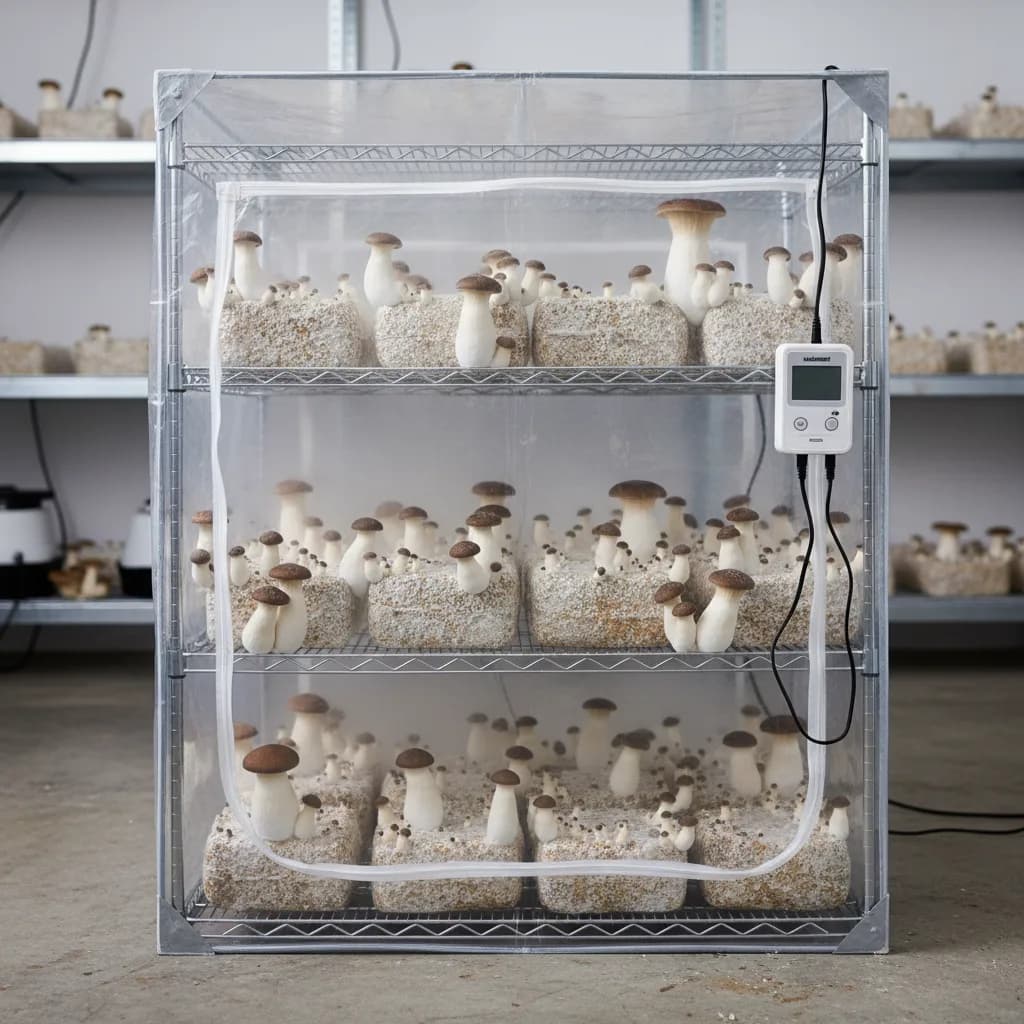
Intentional CO2 manipulation is an advanced technique used by experienced growers and commercial farms to produce specific mushroom forms. The principle is simple: high CO2 equals more stem, low CO2 equals more cap. A CO2 controller paired with a solenoid on your exhaust fan gives you precise control over this variable.
King oyster (Pleurotus eryngii) is the most common target:
- During primordia formation, CO2 is kept low (below 1000 ppm) with strong FAE to initiate pins
- Once pins form, FAE is reduced to let CO2 climb to 2000-3000 ppm, encouraging thick, elongated stems (the prized edible portion)
- When stems reach the desired length (typically 4-6 inches), FAE is increased again to promote cap expansion
- This staged approach produces the classic club-shaped king oyster seen in grocery stores
Reishi (Ganoderma lucidum) offers another example: in low-CO2, well-ventilated conditions, reishi grows flat, shelf-like conks with the characteristic red lacquered surface. In high-CO2 environments (3000+ ppm) with restricted FAE, reishi grows as antler-like formations — elongated finger shapes that many find more visually striking and are used for decoration. Antler reishi is also said to have higher triterpene content.
Some oyster mushroom growers intentionally restrict FAE early to produce longer stems preferred in certain Asian cuisines.
Managing airflow in a fruiting chamber means balancing CO2 removal with humidity retention — the central challenge of mushroom cultivation. Too much airflow strips humidity; too little allows CO2 to accumulate and deform your mushrooms.
Passive vs active FAE:
- Passive FAE — Relies on holes filled with polyfill, micropore tape, or open gaps in the lid. Works well for monotubs and shotgun fruiting chambers with 1-6 blocks. Simple, no electricity, but less controllable
- Active FAE — Uses exhaust fans on timers to pull stale air out while fresh air enters through filtered intake ports. Essential for Martha tents, grow tents, and any setup with more than 6 blocks
Fan placement and duct routing:
- Mount exhaust fans at the top of the chamber where CO2-rich warm air naturally rises
- Position intake openings at the bottom to create natural convection flow
- Never point fans directly at fruiting bodies — direct airflow desiccates mushrooms rapidly. Aim fans at walls or use baffles to create indirect circulation
- For Martha tents, route the exhaust duct from the top shelf area out through a port in the tent wall
Timer intervals by setup:
- Small monotub (1-2 blocks) — Passive FAE is usually sufficient; crack the lid
- Martha tent (4-10 blocks) — Run exhaust fan 1-2 minutes every 15-20 minutes
- Grow tent (10+ blocks) — Run exhaust 2-3 minutes every 10-15 minutes, adjusting based on CO2 readings
If you invest in one diagnostic tool, make it a CO2 meter. Target below 800 ppm for oyster mushrooms, below 1,000 ppm for shiitake and lion's mane, and 1,500-3,000 ppm for king oyster stem development.
The single most universal temperature range in mushroom cultivation is 21-24°C (70-75°F) for colonization, which works for nearly every commonly grown gourmet species. Fruiting temperatures vary more widely and are the key variable that determines which species you can grow in your space.
Colonization temperatures (nearly universal):
- 21-24°C (70-75°F) works for oyster, shiitake, lion's mane, king oyster, maitake, and chestnut mushrooms
- Pink oyster and reishi are exceptions that prefer warmer colonization at 24-30°C (75-86°F)
- Wine cap prefers slightly cooler colonization at 18-24°C (65-75°F)
Fruiting temperature quick reference:
- Blue oyster — 10-18°C (50-65°F). The most cold-tolerant common species
- Pearl oyster — 13-24°C (55-75°F). The most versatile temperature range
- Pink oyster — 18-30°C (65-86°F). Strictly tropical, will not fruit in the cold
- King oyster — 10-16°C (50-60°F). Needs cool temps for thick stems
- Shiitake — 10-22°C (50-72°F). Benefits from a cold shock to initiate pinning
- Lion's mane — 16-20°C (60-68°F). Moderate range but demands high humidity
- Reishi — 21-29°C (70-85°F). Another warm-loving species
Practical advice for home growers: If your home stays at 20-24°C year-round, pearl oyster and lion's mane are your most reliable choices. In winter, take advantage of cooler rooms for blue oyster and shiitake. In summer, grow pink oyster and reishi where the heat helps rather than hurts.
Need more help? Dr. Myco can answer follow-up questions about mushroom fruiting conditions by species based on thousands of real growing experiences.
Ask Dr. Myco