Enoki, Maitake & Cordyceps
14 tips in Species Guides
By Andrew Langevin · Founder, Nature Lion Inc · Contributing author, Mushroomology (Brill, 2026)
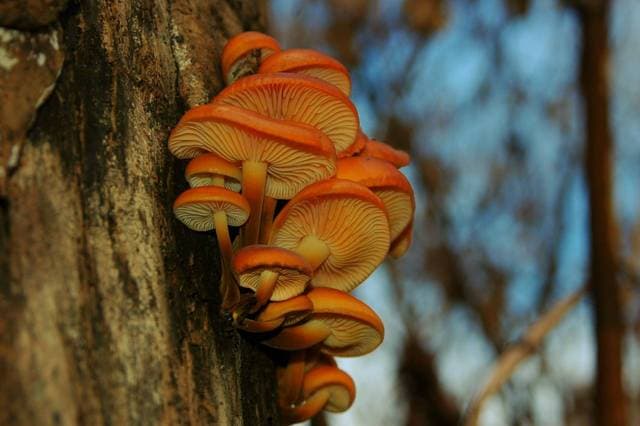
Growing enoki mushrooms (Flammulina velutipes) at home is achievable with basic equipment, though they require cold temperatures that set them apart from most cultivated species.
Basic method:
- Prepare substrate — enoki grows well on supplemented hardwood sawdust (90% hardwood sawdust, 10% wheat bran) or a simple mix of hardwood pellets hydrated to 60-65% moisture.
- Sterilize — pressure cook bags or jars at 15 PSI for 2-2.5 hours.
- Inoculate — add grain spawn at a 10% spawn rate in front of a still air box or flow hood.
- Colonize — incubate at 21-24°C (70-75°F) for 14-21 days until substrate is fully white.
- Fruit — move to a cold environment at 3-8°C (37-46°F) with 85-95% humidity, indirect light, and limited FAE.
The signature elongated stems of grocery store enoki are produced by fruiting inside a tall collar (a rolled newspaper or plastic sleeve placed around the bag opening). This restricts airflow and light, causing the mushrooms to stretch upward.
Without the collar, enoki will grow with shorter stems and larger caps — still delicious but visually different from the commercial product.
A spare refrigerator is the most practical fruiting chamber for home enoki cultivation, as maintaining temperatures below 8°C is essential for proper development.
Enoki mushrooms require the coldest fruiting temperatures of any commonly cultivated species, which is both their challenge and their advantage — few contaminants compete at these temperatures.
Temperature parameters by stage:
- Colonization: 21-24°C (70-75°F) — standard incubation temperature, full colonization in 14-21 days
- Primordia initiation: 3-8°C (37-46°F) — a dramatic temperature drop is the primary fruiting trigger
- Fruit body development: 5-10°C (41-50°F) — slightly warmer than initiation is acceptable during growth
- Maximum fruiting temperature: 15°C (59°F) — above this, stems become short and caps open prematurely
Why cold matters:
- At proper cold temperatures, enoki develops the characteristic long, thin, white stems with tiny caps that consumers expect.
- At warmer temperatures (above 12°C), the mushrooms produce short stems with wide brown caps — still edible but resembling wild enoki rather than the cultivated form.
- Wild enoki (also called winter mushroom or velvet foot) naturally fruits in late autumn and winter, even pushing through snow. This cold-weather biology is fundamental to the species.
Practical solutions for cold fruiting:
- Dedicate a mini fridge or spare refrigerator set to 5-8°C
- Fruit during winter months in an unheated garage, basement, or shed
- Use an insulated cooler with frozen water bottles rotated twice daily as a low-tech cold chamber
Enoki mushrooms are versatile decomposers that grow on several substrates, but the best results come from supplemented hardwood sawdust formulations that balance nutrition with contamination resistance.
Top substrates ranked by performance:
- Supplemented hardwood sawdust — 90% hardwood sawdust (or hydrated hardwood fuel pellets) with 10% wheat bran by dry weight. This is the industry standard and produces the most consistent yields. Must be pressure sterilized at 15 PSI for 2-2.5 hours.
- Masters Mix (50% hardwood pellets, 50% soy hull pellets) — produces higher yields than straight sawdust due to increased nitrogen from soy hulls. Also requires sterilization.
- Brown rice flour jars (BRF) — enoki colonizes BRF cakes readily. A good option for beginners already familiar with PF Tek, though yields are smaller.
- Straw — pasteurized straw works but produces lower yields and more contamination compared to sawdust-based substrates.
Substrate preparation tips:
- Moisture content should be 60-65% — squeeze a handful firmly and only a few drops of water should emerge.
- pH of 5.5-6.5 is ideal. Hardwood sawdust naturally falls in this range.
- Avoid softwood — pine, cedar, and other conifers contain antifungal resins that inhibit enoki growth.
For home growers, hydrated hardwood fuel pellets with 10% wheat bran in autoclavable bags or quart jars is the simplest high-performance approach.
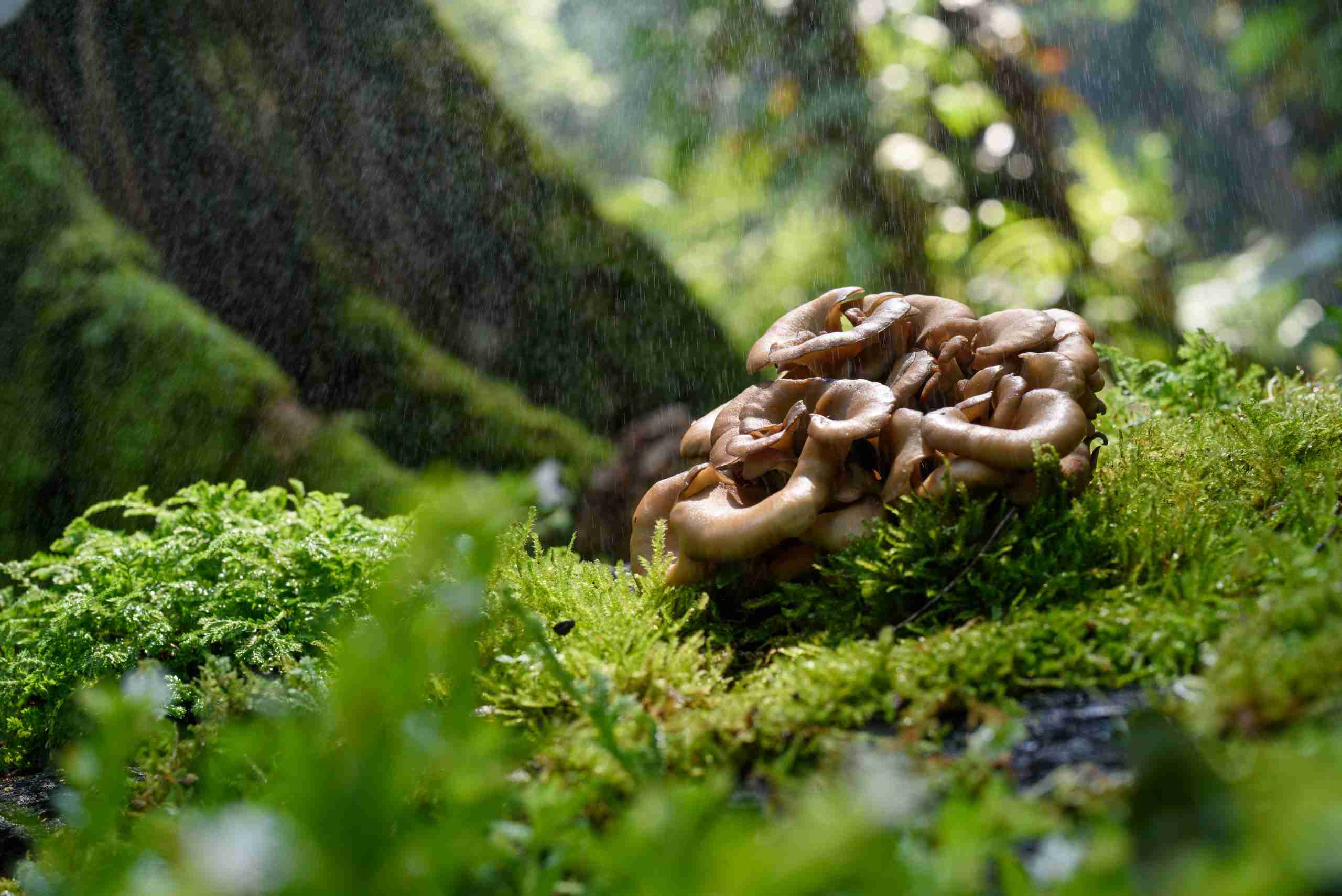
Maitake (Grifola frondosa), also known as hen of the woods, is a prized culinary and medicinal mushroom that can be cultivated on both logs and indoor substrates, though it requires more patience than oyster or shiitake.
Indoor cultivation on supplemented sawdust:
- Substrate: use 80% hardwood sawdust (oak preferred) and 20% wheat bran or rice bran, hydrated to 60-65% moisture.
- Sterilize at 15 PSI for 2.5 hours in autoclavable bags.
- Inoculate with grain spawn at 15-20% spawn rate — maitake is a slow colonizer, so higher spawn rates help outpace contamination.
- Colonize at 21-24°C (70-75°F) for 30-60 days. Maitake colonization is significantly slower than oyster or shiitake.
- Fruit at 15-21°C (59-70°F) with 85-95% humidity, moderate FAE, and indirect light.
Outdoor log cultivation:
- Use freshly cut oak logs (15-25cm diameter, 30-40cm long) inoculated with plug or sawdust spawn.
- Bury logs halfway in shaded soil — this is critical, as maitake in the wild fruits at the base of trees near the soil line.
- Logs take 12-24 months to begin producing, but continue for 3-6 years.
Key challenges: Maitake's slow colonization speed makes it more vulnerable to contamination than fast-colonizing species. Meticulous sterile technique and higher spawn rates are essential.
The reward is worth the patience — maitake commands $15-25 per pound at farmers markets and is considered one of the finest culinary mushrooms.
Both logs and sawdust blocks work for maitake cultivation, but each method has distinct advantages and trade-offs. Many serious maitake growers use both methods simultaneously to maximize production windows.
Sawdust block cultivation:
- Faster to first harvest: 3-5 months from inoculation to fruiting
- Higher spawn rate needed: 15-20% grain spawn by weight
- Substrate: supplemented hardwood sawdust (80% oak sawdust, 20% wheat bran) at 60-65% moisture
- Sterilization required: 15 PSI for 2.5 hours minimum
- Yields: 0.5-1 lb per 5 lb block, typically 1-2 flushes
- Best for: controlled indoor environments, year-round production, beginners wanting faster results
Log cultivation:
- Slower to first harvest: 12-24 months before first fruiting
- Log species: oak is strongly preferred — maitake has a natural affinity for oak
- Log preparation: cut fresh oak logs (15-25cm diameter), drill and inoculate with plug spawn, seal with wax
- Critical difference from shiitake logs: maitake logs should be partially buried vertically in soil, not stacked on racks. Maitake fruits from the base in nature.
- Yields: 1-3 lbs per log per year once established, producing for 3-6 years
- Best for: patient growers with outdoor space, long-term sustainable harvests
The hybrid approach: Start sawdust blocks for quick harvests while simultaneously inoculating logs for long-term production. By the time your logs begin producing, you will have refined your fruiting conditions using block experience.
Outdoor log cultivation is often the most successful method for maitake (Grifola frondosa), particularly for growers who struggle with contamination during the long indoor colonization period. In nature, maitake grows at the base of oak trees, and replicating this environment produces the most reliable results.
Step-by-step outdoor maitake log method:
- Select logs — use freshly cut oak (the preferred species), beech, or maple. Choose logs 15-25cm (6-10 inches) in diameter and cut to 30-40cm (12-16 inches) long. Cut in late winter while trees are dormant and sap sugars are highest.
- Inoculate — drill holes in a diamond pattern (every 15cm) and fill with sawdust spawn or plug spawn. Seal each hole with cheese wax or beeswax to prevent drying and contamination entry.
- Bury vertically — this is the critical difference from shiitake log cultivation. Bury logs halfway to two-thirds into the ground in a shaded location. Maitake naturally fruits at the base of trees near the soil interface, so the log must contact soil.
- Mulch — surround buried logs with wood chips or leaf litter to maintain consistent moisture and encourage beneficial soil microorganisms.
- Water — keep the area moist through dry spells. Maitake logs need consistent moisture but not waterlogging.
Timeline:
- Year 1: Colonization — mycelium spreads through the log (no visible fruiting)
- Year 2: First fruiting possible in early autumn (September-November in temperate climates)
- Years 3-6: Peak production — expect 1-3 lbs per log annually in autumn
Outdoor maitake requires patience but rewards growers with years of production from a single inoculation, minimal maintenance, and mushrooms that many consider superior in flavor to indoor-grown specimens.
Oak-based substrates produce the best maitake yields, reflecting the species' strong natural preference for oak in the wild. Grifola frondosa has evolved specific enzymes for breaking down oak lignin, and substrate performance drops significantly on non-oak hardwoods.
Best indoor substrate recipe:
- 80% oak sawdust (or hydrated oak fuel pellets)
- 20% wheat bran or rice bran (higher supplementation than typical species to support the slow colonization)
- Hydrate to 60-65% moisture content
- Sterilize at 15 PSI for 2.5 hours minimum — extend to 3 hours for bags over 5 lbs
Why oak matters:
- Maitake colonization speed on oak is 30-50% faster than on maple, beech, or mixed hardwood
- Yields are typically 20-40% higher on oak substrates
- Contamination rates are lower because faster colonization leaves less time for competitors
Spawn rate: Use 20-25% grain spawn by weight — significantly higher than most species. The slow colonization of maitake (30-60+ days) means a high spawn rate is essential to outcompete contaminants. This is not optional — it is the single most important factor in indoor maitake success.
Additional substrate tips:
- Adding 5% oak wood chips (not sawdust) to the mix provides structural integrity and air pockets that benefit maitake mycelium
- pH 5.5-6.0 is optimal — oak sawdust naturally falls in this range
- Some commercial producers add 1-2% calcium sulfate (gypsum) for improved structure
Maitake is one of the few species where substrate choice makes or breaks the cultivation attempt — do not substitute lesser hardwoods for oak if you want consistent results.
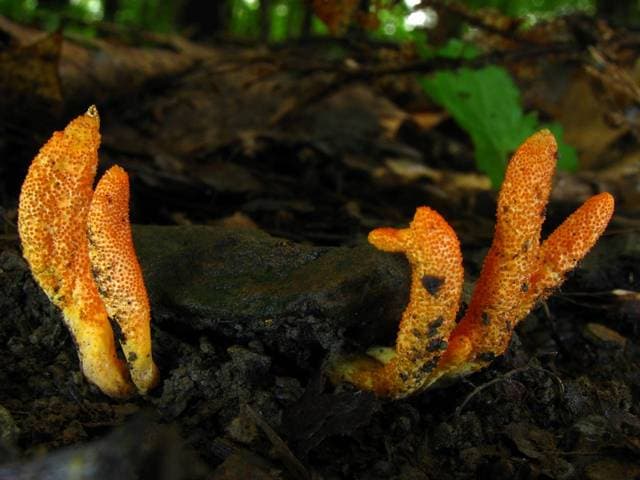
Cordyceps is a genus of parasitic fungi famous for infecting insects in the wild, but the species cultivated at home — Cordyceps militaris — is grown on grain substrate without any insects, making it accessible and fascinating for home growers.
What is cordyceps?
- In nature, wild cordyceps (Ophiocordyceps sinensis) parasitizes caterpillars in the Tibetan Plateau at high altitude. It is the most expensive mushroom in the world, selling for $20,000-50,000+ per kilogram in traditional Chinese medicine markets.
- Cordyceps militaris is a related species that produces the same key bioactive compound — cordycepin — and can be cultivated on simple rice substrate at home without insects.
Can you grow it at home? Yes!
- Cordyceps militaris is genuinely cultivable at home with basic equipment: pressure cooker, mason jars or polypropylene containers, rice, and a light source.
- It is more demanding than oyster mushrooms but less difficult than morels — consider it an intermediate-level project.
- The key requirements are sterile technique, specific light exposure (12-16 hours of light per day), and cool fruiting temperatures (18-22°C).
Why grow it:
- Dried cordyceps militaris sells for $50-150 per pound depending on quality
- The bright orange fruiting bodies are visually striking
- Cordycepin content in home-grown militaris is comparable to commercial products
Cordyceps militaris is one of the most rewarding specialty mushrooms for home growers willing to invest in proper sterile technique and lighting.
Growing Cordyceps militaris on rice substrate is the standard home cultivation method. The process is straightforward but demands meticulous sterile technique because the long colonization and fruiting period gives contaminants many opportunities to establish.
Step-by-step method:
- Prepare substrate — combine brown rice or white rice with water at a ratio of roughly 1 part rice to 1.2 parts water by weight. Some growers add 5% silkworm pupae powder or nutritional yeast to boost cordycepin production.
- Fill containers — use wide-mouth mason jars or polypropylene deli containers filled to about 1 inch depth. A shallow substrate layer is critical — cordyceps needs to sense the surface.
- Sterilize — pressure cook at 15 PSI for 90 minutes. Allow to cool completely.
- Inoculate — add liquid culture (not spores — cordyceps spores are unreliable) at 1-2ml per container. Spread evenly across the rice surface using sterile technique in a SAB or flow hood.
- Colonize — incubate at 20-25°C in darkness for 7-14 days until rice is covered in white mycelium.
- Initiate fruiting — expose to 12-16 hours of light daily (6500K LED or fluorescent), drop temperature to 18-22°C, and maintain 85-95% humidity with FAE.
- Harvest — orange club-shaped fruiting bodies emerge in 30-60 days after light exposure begins. Harvest when they reach 5-10cm tall and begin releasing spores (tips become fuzzy).
The entire cycle from inoculation to harvest takes approximately 60-90 days.
Cordyceps militaris has precise environmental requirements that differ significantly from typical gourmet mushrooms. Light is the most unusual requirement — unlike nearly all other cultivated species, cordyceps requires substantial light exposure to fruit.
Complete growing parameters:
- Colonization temperature: 20-25°C (68-77°F) in darkness for 7-14 days
- Fruiting temperature: 18-22°C (64-72°F) — slightly cooler than colonization
- Humidity: 85-95% during fruiting
- Light: 12-16 hours daily of bright light (500-1000 lux) at 6500K color temperature. This is mandatory — no light means no fruiting bodies. LED shop lights or daylight fluorescent tubes work well.
- FAE: moderate — enough to prevent CO2 buildup but not so much that humidity drops
- Substrate moisture: rice should be hydrated but not waterlogged — individual grains should be swollen but separate
Critical parameters often overlooked:
- Substrate depth matters — keep rice layers 1-2cm (0.5-1 inch) deep maximum. Deeper substrates produce poor or no fruiting.
- Light spectrum is important — blue-spectrum light (6500K) triggers fruiting; warm/yellow light does not work well.
- Temperature stability — fluctuations greater than 3-4°C can stall fruiting body development.
- Contamination window — the 60-90 day total cycle means sterile technique must be perfect at inoculation. There are no second chances.
A dedicated fruiting shelf with a timer-controlled LED light strip, small humidifier, and consistent room temperature is the minimum practical setup for reliable cordyceps production.
Wild cordyceps and cultivated cordyceps are different species with overlapping but distinct bioactive profiles, vastly different prices, and very different sustainability concerns.
Wild cordyceps (*Ophiocordyceps sinensis*):
- Grows exclusively on ghost moth caterpillar larvae in the Tibetan Plateau and Himalayan highlands above 3,500 meters elevation.
- Harvested by hand from alpine meadows — an increasingly unsustainable practice that has driven severe price inflation.
- Prices range from $20,000 to $50,000+ per kilogram for high-quality specimens, making it the most expensive fungus in the world.
- Contains adenosine and other bioactive compounds but cordycepin levels are actually low or undetectable in most tested samples.
- Cannot be commercially cultivated — all attempts to grow O. sinensis on artificial media have failed to produce fruiting bodies at scale.
Cultivated cordyceps (*Cordyceps militaris*):
- Grown on rice or grain substrate in controlled environments worldwide.
- Produces significantly higher cordycepin levels than wild O. sinensis — multiple studies confirm this.
- Costs $50-150 per pound dried — a fraction of wild cordyceps.
- Sustainable and scalable — no ecological impact from harvesting.
- The orange fruiting bodies are visually different from the brown, caterpillar-attached wild specimens.
From a bioactive compound standpoint, cultivated C. militaris is arguably superior for cordycepin content, while wild O. sinensis may contain unique compounds not found in militaris. However, the extreme price difference and sustainability concerns make cultivated cordyceps the practical choice for supplementation.
Elm oyster mushrooms (Hypsizygus ulmarius) are a cold-hardy, mild-flavored species that grows well on hardwood substrates. Despite the name, they are not true oyster mushrooms (Pleurotus) — they belong to a different genus and have distinct growing requirements.
Growing parameters:
- Colonization: 21-24°C (70-75°F) for 14-21 days
- Fruiting: 10-18°C (50-64°F) — elm oysters prefer cool conditions
- Humidity: 85-95% during fruiting
- FAE: moderate to high
- Light: indirect light, 12 hours daily
Substrate options:
- Supplemented hardwood sawdust (preferred) — 80-90% hardwood sawdust with 10-20% wheat bran, sterilized at 15 PSI for 2.5 hours
- Hardwood logs — elm, maple, beech, or oak logs inoculated with plug spawn
- Straw — pasteurized straw works but produces smaller yields than sawdust
Key differences from Pleurotus oysters:
- Slower colonization — elm oyster takes 14-21 days versus 7-14 for Pleurotus species
- Individual mushrooms rather than clusters — elm oysters tend to produce fewer, larger individual caps rather than dense shelf-like clusters
- Longer shelf life — harvested elm oysters stay firm for 7-10 days refrigerated, compared to 3-5 days for Pleurotus
- Milder flavor — subtle, slightly sweet, with a firm texture that holds up well in stir-fries and soups
Elm oyster is an excellent choice for growers in cool climates who want a species that fruits reliably through autumn and early winter.
Mini king oyster mushrooms are a specific cultivar or growing technique that produces smaller, more tender versions of the standard king oyster (Pleurotus eryngii). They have become increasingly popular in Asian markets and specialty grocery stores.
What makes them "mini":
- Standard king oysters are typically 10-15cm (4-6 inches) tall with thick, meaty stems. Mini king oysters are grown to 5-8cm (2-3 inches) and harvested earlier.
- The miniature size is achieved through a combination of genetics (specific strains selected for compact growth) and growing conditions — higher CO2 levels and earlier harvest timing.
- Some producers use a top-fruiting technique where multiple small mushrooms emerge from the surface of the block rather than individual large specimens from side holes.
Growing mini king oysters at home:
- Use the same supplemented hardwood sawdust or Masters Mix substrate as standard king oyster.
- Sterilize and inoculate identically.
- During fruiting, allow the bag or container to fruit from the top surface rather than cutting side slits. This encourages multiple small pins.
- Maintain slightly higher CO2 (by reducing FAE) to keep stems compact.
- Harvest when stems are 5-8cm — do not let them grow to full size.
Culinary advantages:
- More tender throughout — the smaller size means no woody core
- Cook faster and more evenly
- Ideal for grilling whole, roasting, or searing without slicing
Mini king oysters command a premium at market — typically $2-4 more per pound than standard king oysters.
Pioppino (Cyclocybe aegerita, formerly Agrocybe aegerita), also called black poplar mushroom or velvet pioppini, is a gourmet species prized by Italian and Asian cuisines for its crunchy texture and nutty, wine-like flavor that holds up exceptionally well to cooking.
Growing parameters:
- Colonization: 21-27°C (70-80°F) for 21-35 days — pioppino is a moderately slow colonizer
- Fruiting: 13-18°C (55-64°F) — cool temperatures are essential
- Humidity: 85-95% during fruiting
- FAE: high — similar to oyster mushrooms
- Light: 12 hours indirect light, needed for proper cap development and color
Substrate:
- Supplemented hardwood sawdust is the standard — 80% hardwood sawdust, 20% wheat bran, hydrated to 60-65% moisture.
- Masters Mix (50% hardwood pellets, 50% soy hull pellets) also works well and boosts yields.
- Must be pressure sterilized at 15 PSI for 2.5 hours — pioppino is not aggressive enough for pasteurized-only substrates.
- Hardwood logs (poplar, cottonwood, willow) can also be inoculated with plug spawn for outdoor production.
Fruiting tips:
- Pioppino benefits from a cold shock — dropping temperature to 10°C for 2-3 days after full colonization helps initiate pinning.
- Mushrooms grow in attractive clusters of long-stemmed, small-capped mushrooms. Harvest when caps are still slightly convex before they flatten.
- Multiple flushes are common — expect 2-4 flushes per block with a 10-14 day rest between flushes.
Pioppino is an underappreciated gourmet species that deserves more attention from home growers — its texture and flavor are unlike any other cultivated mushroom.
Need more help? Dr. Myco can answer follow-up questions about enoki, maitake & cordyceps based on thousands of real growing experiences.
Ask Dr. MycoMore in Species Guides
Oyster Mushrooms
15 tips
Lion's Mane
13 tips
Shiitake
13 tips
King Oyster
12 tips
Reishi
13 tips
Chestnut & Other Gourmet
15 tips
Mushroom Health & Medicinal Benefits
17 tips
Cooking & Preparation
16 tips
Mushroom Alternate Names & Varieties
17 tips
Mushroom Supplement Guide
18 tips
Common Mushroom Varieties
20 tips
Rare & Specialty Cultivatable Species
16 tips