Morel & Chanterelle Varieties
10 tips in Foraging & Wild ID
By Andrew Langevin · Founder, Nature Lion Inc · Contributing author, Mushroomology (Brill, 2026)
Yellow morels and black morels are both true Morchella species and prized edibles, but they differ in appearance, season timing, and preferred habitat in ways that directly affect your foraging success.
Yellow morel (*Morchella esculenta* group):
- Appearance: Pale yellow to honey-tan ridges with cream pits, rounder and more bulbous cap
- Season: Fruits 1-3 weeks later than black morels in the same region
- Habitat: Strongly associated with dying elm, ash, tulip poplar, and old apple orchards. Favors river bottoms and rich bottomland soils
- Size: Often larger, with specimens reaching 10-20cm (4-8 inches)
- Flavor: Milder, nuttier, and slightly sweeter
Black morel (*Morchella elata* group):
- Appearance: Dark brown to black ridges with grey-brown pits, more conical and elongated cap
- Season: Fruits first in spring, often before trees have fully leafed out
- Habitat: Prefers conifer forests, disturbed ground, wood chip beds, and burned areas
- Size: Generally smaller, typically 5-12cm (2-5 inches)
- Flavor: More intense, earthy, and robust
Hunt black morels early in the season in conifer forests, then shift to hardwood bottomlands for yellows as temperatures warm.
The "early morel" most commonly refers to Verpa bohemica, also called the half-free morel. It appears 1-3 weeks before true morels in the same area, serving as a signal that the real morel season is approaching.
Identifying Verpa bohemica:
- Cap attachment: The cap is attached only at the very top of the stem, hanging like a thimble over a finger. True morels have caps fused to the stem along their full length
- Cap surface: Wrinkled and brain-like rather than the honeycomb pits of true morels
- Stem interior: Stuffed with cottony fibers rather than completely hollow
- Size: Generally 5-12cm tall with a proportionally small cap relative to the long stem
Is it edible? Verpa bohemica is conditionally edible — some people eat it without issues, while others experience GI symptoms including nausea and loss of coordination. Most experienced foragers recommend eating only small quantities and never consuming it raw.
The most important takeaway: When you find early morels, it means true morels (Morchella species) will be fruiting in the same area within 1-3 weeks. Mark the location and return.
"Black sponge mushroom" is an informal common name for the black morel (Morchella elata group). The name comes from the mushroom's distinctive appearance — the dark, honeycomb-pitted cap looks remarkably like a natural sponge.
Why people call it a sponge:
- The cap surface is covered in deep, irregular pits separated by dark ridges, creating a pattern that closely resembles a sea sponge
- The entire fruiting body is hollow from cap to stem base, reinforcing the sponge comparison
- When found dried and weathered, the resemblance to a dark bath sponge is even more striking
Identifying black sponge mushrooms in the field:
- Cap: Conical, 3-8cm long, with dark brown to black ridges and lighter grey-brown pits
- Stem: Pale white to cream, hollow, slightly granular texture
- Habitat: Conifer forests, burned areas, disturbed ground, wood chip mulch
- Season: Early to mid-spring, typically April-May in temperate North America
All true morels must be cooked before eating — raw morels contain hydrazine compounds that are destroyed by heat. Soak in lightly salted water for 30 minutes to remove insects, then sauté in butter.
The blue chanterelle (Polyozellus multiplex) is a rare and striking mushroom that is not actually a true chanterelle at all. Despite the common name, it belongs to a different taxonomic order than Cantharellus species.
Key facts about the blue chanterelle:
- Appearance: Deep violet-blue to nearly black clusters of fan-shaped, spoon-like caps with blunt, forked ridges underneath
- Size: Individual caps 3-8cm across, growing in fused clusters that can reach 15-25cm in total diameter
- Taxonomy: Polyozellus multiplex is in the order Thelephorales, while true chanterelles are in Cantharellales
- Habitat: Found under spruce and fir trees in montane conifer forests, primarily in the Pacific Northwest, Japan, and Korea
- Season: Late summer to fall
Edibility: The blue chanterelle is edible and considered good by those lucky enough to find it. The flavor is mild and slightly peppery. It can be sautéed, dried, or pickled.
This is a genuinely rare find. If you encounter one, photograph it thoroughly and consider sharing the record (without exact location) with your local mycological society. Many foragers spend decades without finding one.
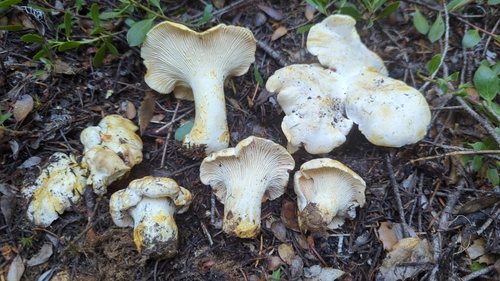
White chanterelles refer to pale or albino variants of true chanterelle species, most commonly Cantharellus subalbidus (the Pacific white chanterelle) or unusually pale specimens of Cantharellus cibarius.
Cantharellus subalbidus (Pacific white chanterelle):
- Appearance: Creamy white to pale buff caps with blunt, forking ridges (not true gills) underneath
- Size: Caps 5-15cm across, often chunky and thick-fleshed
- Habitat: Found primarily under Douglas fir and western hemlock in the Pacific Northwest, from British Columbia through Oregon
- Season: Fall, typically September-November
- Flavor: Mild, fruity, and delicate — considered by many to be more refined than golden chanterelles
Pale Cantharellus cibarius specimens:
- Occasionally, golden chanterelles produce very pale, nearly white fruiting bodies due to genetic variation or growing conditions (deep shade)
- These are the same species and equally edible
Identification caution: White chanterelles could be confused with white-spored toxic species in dim forest conditions. Always confirm the characteristic blunt, forking, decurrent ridges (not thin, blade-like gills) and the fruity apricot aroma before consuming.
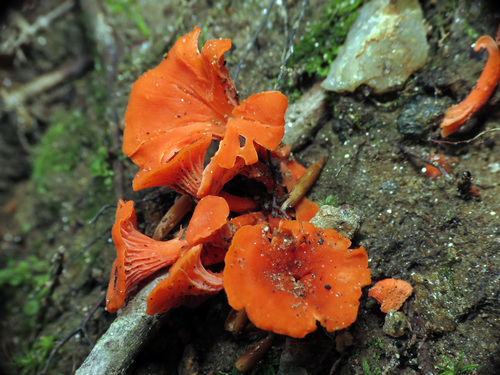
The winter chanterelle (Craterellus tubaeformis), also called yellowfoot or funnel chanterelle, is a small, thin-fleshed chanterelle relative that fruits later in the season than golden chanterelles, extending the foraging window into late fall and early winter.
Identifying winter chanterelles:
- Cap: Small (2-6cm across), thin, funnel-shaped with a wavy, irregular margin. Brown to grey-brown on top
- Underside: Pale grey with blunt, forking ridges (not true gills), similar to golden chanterelles
- Stem: Distinctive bright yellow to orange, hollow, and relatively long compared to the small cap
- Size: Much smaller than golden chanterelles — typically 5-10cm tall
Where and when to find them:
- Fruit in mossy, wet conifer and mixed forests among decaying wood and leaf litter
- Season extends from late September through December in temperate regions, sometimes even into January during mild winters
- Often grow in large troops of dozens to hundreds, making up in quantity what they lack in individual size
Winter chanterelles are excellent edibles with a delicate, slightly smoky flavor. They dry exceptionally well, concentrating their flavor, and rehydrate beautifully in soups and risottos.
Morel mushrooms must always be cooked before eating — raw morels contain hydrazine-related compounds that can cause serious illness including vomiting, cramps, and dizziness. Proper preparation eliminates these toxins.
Essential preparation steps:
- Soak in cold salt water (1 tablespoon salt per liter) for 20-30 minutes to drive out insects hiding in the hollow chambers
- Drain and gently pat dry with paper towels
- Slice large morels in half lengthwise; leave small ones whole
The classic cooking method:
- Melt butter in a skillet over medium-high heat — morels and butter are one of the great culinary pairings
- Add morels in a single layer (do not crowd the pan)
- Sauté for 4-5 minutes per side until golden brown and slightly crispy on the edges
- Season with salt, pepper, and a squeeze of lemon
- Optional: deglaze with white wine or cream
Never eat morels with alcohol on the first try. Some people experience adverse reactions when combining morels with alcohol, particularly with certain species. Test your tolerance with a small portion before eating a full serving.
Morels are best fresh, but they also dry exceptionally well. Dehydrate at 45°C until cracker-dry and store in airtight jars for up to a year.
The distinction between early morels (Verpa species) and true morels (Morchella species) is critical for foragers because they differ in edibility, safety, and culinary value.
The hollow stem test:
- True morels: Cut in half lengthwise and the entire mushroom — cap and stem — is completely hollow with a single continuous chamber
- Early morels (Verpa): The stem is stuffed with cottony, wispy fibers rather than being cleanly hollow
Cap attachment test:
- True morels: The cap is fused to the stem along its full length — the bottom edge of the cap connects seamlessly to the stem
- Verpa bohemica: The cap is attached only at the very top and hangs freely like a skirt. You can lift the cap edge and see it is not connected to the stem
- Verpa conica: Similar free-hanging cap, but with a smooth surface rather than wrinkled
Why it matters:
- True morels (Morchella) are universally regarded as choice edibles when cooked
- Verpa bohemica is edible for most people but causes GI distress in some individuals, especially in large quantities
- False morels (*Gyromitra*) are a separate and more dangerous look-alike — they have brain-like, lobed caps rather than honeycomb pits
When in doubt, always apply both the hollow stem test and the cap attachment test.
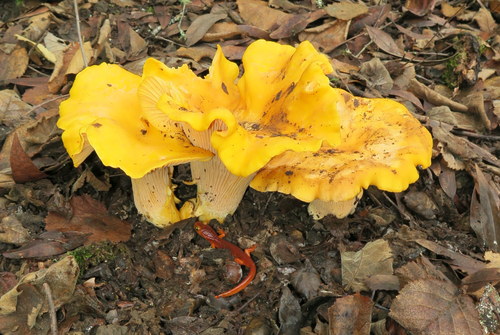
Distinguishing golden chanterelles (Cantharellus cibarius) from false chanterelles (Hygrophoropsis aurantiaca) is one of the most important identification skills for mushroom foragers. While false chanterelles are not deadly, they can cause significant GI distress.
The ridge vs gill test (most reliable):
- Golden chanterelle: Undersurface has blunt, forking, shallow ridges that look like raised veins. They are rounded on top, fork irregularly, and run down the stem (decurrent). They feel waxy and smooth
- False chanterelle: Undersurface has thin, blade-like, closely spaced true gills that are deeper, sharper, and more uniform. They look like the gills of a standard grocery store mushroom
Additional distinguishing features:
- Color: True chanterelles are egg-yolk yellow throughout (flesh, exterior, ridges). False chanterelles are often more orange, especially on the gills, with duller or darker cap surfaces
- Smell: True chanterelles have a distinctive fruity, apricot-like aroma. False chanterelles have little to no smell
- Flesh: True chanterelles have solid, dense, white flesh when cut. False chanterelles have thin, soft, orange flesh
- Habitat: True chanterelles grow from soil near trees (mycorrhizal). False chanterelles often grow on decaying wood or woody debris (saprotrophic)
When in doubt, check the ridges. If the undersurface has thin, sharp, closely spaced gills, it is not a chanterelle.
Morchella esculenta is the scientific name for the common yellow morel, one of the most sought-after wild edible mushrooms in the world. The species name "esculenta" literally means "edible" in Latin, reflecting its long culinary history.
Taxonomy and classification:
- Kingdom: Fungi
- Phylum: Ascomycota (spore-bearing sac fungi, unlike most gourmet mushrooms which are Basidiomycota)
- Order: Pezizales
- Family: Morchellaceae
- Modern understanding: Recent DNA analysis has revealed that what was called M. esculenta is actually a complex of multiple cryptic species that look nearly identical but are genetically distinct
Key identification features:
- Honeycomb cap: Covered in deep, irregular pits and raised ridges, pale yellow to tan
- Completely hollow: Both cap and stem form a single continuous hollow chamber when sliced lengthwise
- Cap fused to stem: The cap connects to the stem along its entire lower edge
- Size: Typically 5-15cm tall, sometimes larger in ideal conditions
Edibility: Morchella esculenta is choice edible when cooked — it must never be eaten raw due to hydrazine compounds that are destroyed by heat. It is commercially valued at $30-60 per pound dried and is one of the few wild mushrooms that cannot be reliably cultivated at commercial scale.
Need more help? Dr. Myco can answer follow-up questions about morel & chanterelle varieties based on thousands of real growing experiences.
Ask Dr. MycoMore in Foraging & Wild ID
Foraging Basics & Safety
10 tips
Choice Edible Species
12 tips
Deadly & Toxic Species
14 tips
Regional Foraging Guides
9 tips
Visual Identification Guide
17 tips
Chaga Identification & Harvesting
10 tips
Morel Foraging Guide
10 tips
North American Foraging by Region
14 tips
European Foraging Guide
12 tips
Southern Hemisphere & Tropical Foraging
10 tips
Foraging Species by Season
12 tips
Where to Find Wild Mushrooms
15 tips
Mushroom Habitats & Tree Associations
12 tips
Chanterelle Species by Region
12 tips
Morel Species by Region
12 tips
Chicken of the Woods & Turkey Tail by Region
10 tips
Deadly Mushrooms — Where They Actually Grow
10 tips
Wild Lion's Mane, Hedgehog & Lobster Mushrooms
10 tips
Porcini, Black Trumpet & Other Choice Edibles
10 tips