Visual Identification Guide
17 tips in Foraging & Wild ID
By Andrew Langevin · Founder, Nature Lion Inc · Contributing author, Mushroomology (Brill, 2026)
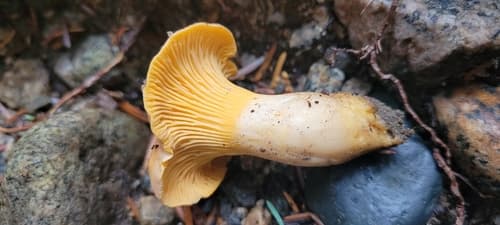
Chanterelles are among the most recognizable wild mushrooms, but proper identification still requires checking multiple features. The key identifier is their false gills — blunt, forking ridges that run down the stem rather than the thin, blade-like true gills found on most mushrooms. These ridges feel smooth and waxy when you run your finger across them.
Visual identification checklist:
- Color: Golden yellow to egg-yolk orange on the cap and ridges, though color can fade in older specimens or after heavy rain
- Shape: Vase or funnel-shaped when mature, with a wavy, irregular cap margin
- False gills: Shallow, blunt ridges that fork and run partway down the stem — not thin, crowded, detachable blades
- Flesh: White to pale yellow when sliced open — never orange throughout
- Smell: Fruity, apricot-like aroma that is distinctive once you learn it
- Habitat: Growing singly or in scattered groups on forest floor soil near hardwoods or conifers — never in dense clusters on wood
The jack o'lantern mushroom is the primary dangerous look-alike. It has true gills, grows in clusters on wood or buried roots, and is orange throughout when cut. Always check all three features — false gills, solitary soil growth, and white flesh — before eating any chanterelle.
The false chanterelle (Hygrophoropsis aurantiaca) is a common look-alike that confuses many foragers. While not deadly, it can cause gastrointestinal distress and is far less pleasant to eat. Learning the differences protects both your health and your dinner.
Key differences between true and false chanterelles:
- Gills: The false chanterelle has thin, crowded, forking true gills that are more orange than the cap — not the blunt, waxy ridges of a true chanterelle
- Color: False chanterelles tend toward a deeper orange-brown and often show concentric zones of color on the cap, while true chanterelles are more uniformly golden
- Cap texture: False chanterelles have a slightly fuzzy or velvety cap surface, while true chanterelles are smooth
- Flesh: False chanterelles have thin, soft, orange-tinted flesh — true chanterelles have thicker, firmer, white flesh
- Habitat: False chanterelles often grow on decaying wood or wood chips, while true chanterelles grow from soil in a mycorrhizal partnership with trees
- Smell: False chanterelles lack the distinctive fruity apricot scent
The gill structure is the most reliable single feature. Run your finger across the underside of the cap — true chanterelle ridges feel smooth and rounded, while false chanterelle gills feel thin and blade-like. When in doubt, cut the mushroom in half and check the flesh color.
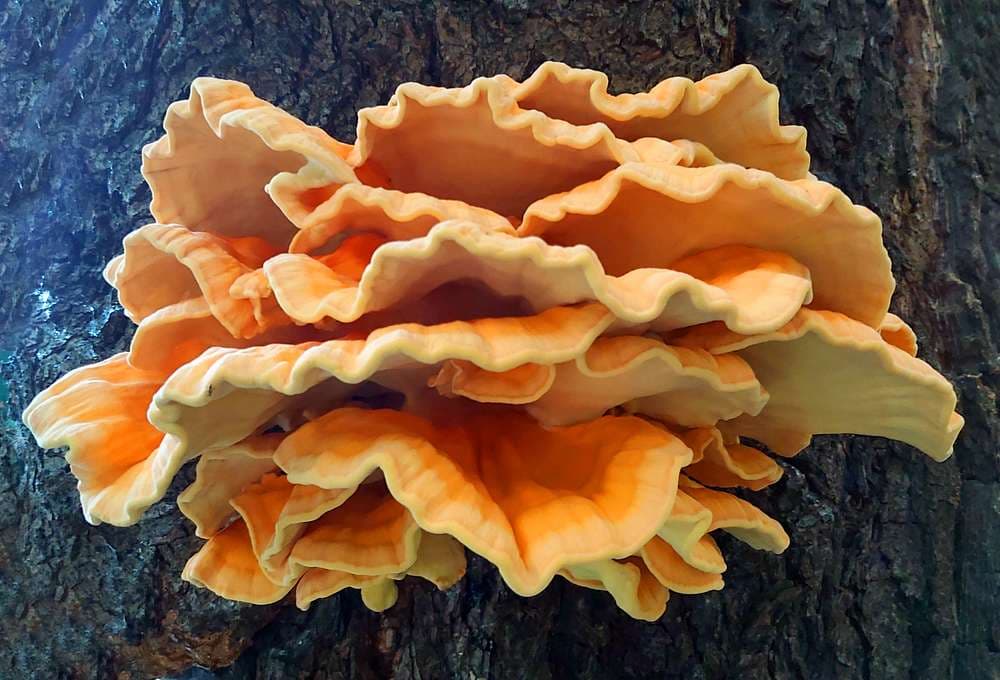
Chicken of the woods (Laetiporus sulphureus and related species) is one of the safest mushrooms for beginner foragers because its combination of features is nearly unique. Look for bright orange to salmon-colored shelf-like brackets with a sulfur-yellow pore surface underneath — no gills, no stem, just a vivid bracket growing directly from wood.
Step-by-step identification:
- Cap surface: Bright orange to salmon when fresh, fading to pale peach or white with age
- Underside: Sulfur-yellow pore surface with tiny, closely spaced pores — never gills
- Growth habit: Overlapping shelf-like brackets growing directly on dead or living hardwood trees, especially oak
- Texture when young: Moist, succulent, and flexible at the edges — this is when it is edible
- Texture when old: Dry, crumbly, chalky, and tough — past its prime
- No stem: Attaches directly to the wood surface
Important safety notes: Some people experience gastrointestinal upset, particularly from specimens growing on conifers (especially eucalyptus and yew). The eastern species (L. sulphureus) and western species (L. conifericola) differ in host tree preference and may differ in digestibility. Always cook thoroughly and try a small portion the first time you eat it. Harvest only young, tender edges with moist, flexible margins.
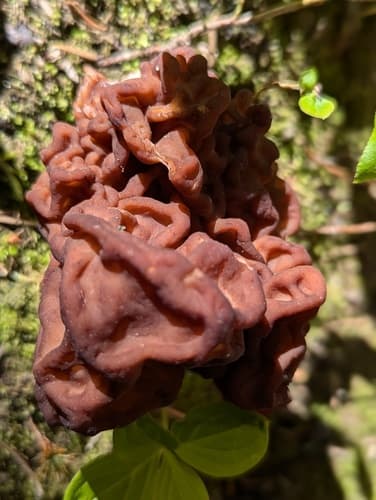
Distinguishing false morels from true morels is a life-or-death identification skill. The single most important test is to slice the mushroom lengthwise from top to bottom — a true morel is completely hollow inside, while a false morel has chambered, cottony, or solid interior tissue.
Detailed comparison:
- Cap shape: True morels have a honeycomb pattern of defined pits and ridges arranged in a relatively symmetrical pattern; false morels have a wrinkled, brain-like, or saddle-shaped cap with irregular folds
- Cap attachment: True morel caps attach to the stem at or near the bottom of the cap; some false morel species attach only at the very top, with the cap hanging freely like a skirt
- Interior: True morels are a single continuous hollow cavity from cap to stem; false morels are chambered, stuffed with cottony fibers, or partially solid
- Color: True morels range from blonde to gray to black; false morels (Gyromitra species) tend toward reddish-brown to dark brown
False morels contain gyromitrin, which metabolizes into monomethylhydrazine — literally rocket fuel. Poisoning can cause liver failure and death. Some cultures eat parboiled false morels, but this practice is dangerous and not recommended. Even the cooking vapors can cause poisoning. Always slice every morel you pick lengthwise to confirm it is completely hollow.
Turkey tail (Trametes versicolor) is one of the most common mushrooms in the world, growing on dead hardwood logs and stumps across nearly every continent. The key features are its multicolored concentric zones, thin and flexible texture, and tiny white pore surface underneath. Despite its abundance, many look-alikes cause confusion.
Positive identification requires all of these features:
- Concentric color zones: Alternating bands of brown, tan, gray, blue, and sometimes green or orange on the cap surface — colors vary but the banded pattern is consistent
- Texture: Thin, leathery, and flexible — you should be able to bend it without snapping
- Underside: A white to cream-colored pore surface with tiny pores (3-5 per millimeter) — this is critical and eliminates most look-alikes
- Growth habit: Overlapping rosettes or rows on dead hardwood
- Cap surface: Slightly fuzzy or velvety when fresh, smooth when old
Common look-alikes to eliminate:
- False turkey tail (Stereum ostrea) — Has a smooth underside with no pores; this is the most common confusion
- Violet-toothed polypore — Has purple-tinted pores and teeth
Always flip the mushroom over. If you see a smooth underside rather than tiny white pores, it is not turkey tail.
The winter chanterelle (Craterellus tubaeformis, also called yellowfoot) is a small but delicious mushroom that extends the foraging season well into late fall and early winter. It has a thin, funnel-shaped brown cap with a yellow to orange stem and veined or wrinkled undersurface — quite different in appearance from the golden chanterelle but equally prized by chefs.
Identification features:
- Cap: Small (2-6 cm), thin, brown to dark brown, funnel-shaped with a wavy irregular margin, often with a central hole
- Undersurface: Forked veins or shallow ridges rather than true gills, pale gray to yellowish
- Stem: Bright yellow to orange, hollow, slender
- Size: Significantly smaller than golden chanterelles
- Habitat: Grows in large troops on mossy ground, rotting wood, and leaf litter in conifer and mixed forests
- Season: Late fall through early winter — often fruiting after the first frosts when few other edible species are available
Winter chanterelles have no dangerous look-alikes, making them an excellent species for foragers looking to extend their season. They often grow in enormous numbers — once you find a patch, you can fill a basket quickly. Look in mossy, wet areas of conifer forests, especially along streams and in old-growth or mature second-growth stands. They dry beautifully and have concentrated flavor when rehydrated.
Black morels (Morchella elata and related species) are among the earliest morels to fruit each spring and are visually distinct from their yellow and blonde cousins. They have dark gray to black ridges surrounding lighter-colored pits on the cap, giving them a dramatic appearance that stands out on the forest floor — once you learn to spot them.
Key identification features:
- Cap color: Dark ridges ranging from gray to jet black, with pits that are lighter tan or gray, creating strong contrast
- Cap shape: More conical and elongated than yellow morels, tapering to a point at the top
- Size: Often slightly smaller than yellow morels, typically 5-10 cm tall
- Interior: Completely hollow from cap to stem base — the same as all true morels
- Season: Typically fruits 1-2 weeks before yellow morels in the same region
Differences from yellow morels:
- Black morels fruit earlier in the spring, often before trees have fully leafed out
- They prefer conifer and mixed forests rather than the river bottoms and old orchards favored by yellow morels
- Fire morels — the massive fruitings that occur in burned forests — are predominantly black morel species
- Flavor is slightly more intense and earthy compared to the nuttier yellow morel
The same hollow-interior test applies. Always slice lengthwise to confirm the interior is one continuous hollow cavity. Black morels pair with the same false morel look-alikes as other morels.
While chicken of the woods is often called beginner-friendly, there are a few species that can cause confusion. The most common source of error is Laetiporus cincinnatus, which has a white to pale pinkish pore surface instead of the bright sulfur-yellow of the classic L. sulphureus. This species is actually edible and some foragers prefer it, but the difference matters for positive identification.
Species that cause confusion:
- Laetiporus cincinnatus: White to pinkish pore surface (not yellow), often grows at the base of trees or from buried roots rather than directly on the trunk — edible and choice
- Laetiporus huroniensis / conifericola: Grows on conifers rather than hardwoods — more likely to cause GI upset in some people
- Berkeley's polypore (Bondarzewia berkeleyi): Large, whitish to tan rosettes at the base of oaks — can superficially resemble a faded chicken of the woods but lacks bright orange coloring
- Sulphur shelf aging: Old, faded chicken of the woods loses its bright colors and becomes pale, crumbly, and unrecognizable
The key safety rules remain:
- Confirm a bright orange cap surface with a yellow or white pore surface underneath
- Verify growth on wood — never on soil
- Note the host tree — avoid specimens on conifers, especially eucalyptus and yew, until you have experience
- Harvest only young, moist, flexible edges
- Always cook thoroughly and try a small portion your first time with any new Laetiporus species
The terms black chanterelle and black trumpet cause significant confusion because they are used inconsistently across regions and field guides. In most of North America, "black trumpet" refers to Craterellus cornucopioides, while "black chanterelle" can refer to either Craterellus cornucopioides or Craterellus cinereus — two closely related but visually distinguishable species.
Craterellus cornucopioides (black trumpet / horn of plenty):
- Deeply funnel-shaped, hollow from top to bottom
- Dark gray to jet black, sometimes with brown tones
- Smooth to slightly wrinkled outer surface with no distinct veins or ridges
- Thin, fragile flesh
- Smoky, rich flavor often compared to truffles
Craterellus cinereus (black chanterelle):
- Similar funnel shape but slightly more structured
- Dark gray to brown-black coloring
- Distinct veined or ridged outer surface resembling the false gills of golden chanterelles
- Slightly thicker flesh than C. cornucopioides
Both species are excellent edibles with no dangerous look-alikes, so the distinction matters more for culinary precision than safety. Both grow in similar habitats — hardwood forests, especially under oaks and beeches, in moist mossy areas. Both are notoriously difficult to spot against dark leaf litter. If you find dark, trumpet-shaped mushrooms in hardwood forests, you can safely enjoy either species.
Chaga (Inonotus obliquus) is not a typical mushroom — it is a sterile conk, a mass of mycelium that erupts through the bark of living birch trees and forms a hard, irregular growth. It looks like a chunk of burnt charcoal stuck to the tree — a rough, deeply cracked black exterior that reveals a rusty orange-brown interior when broken open.
Identification features:
- Exterior: Jet black, deeply cracked, hard, and irregular — resembling burnt charcoal or a cancerous growth on the tree
- Interior: Rich golden to dark orange-brown color, with a corky to woody texture — this orange interior is the key confirmation
- Host tree: Almost exclusively on living birch trees in northern temperate and boreal forests
- Size: Ranges from fist-sized to basketball-sized, growing slowly over many years
- Height: Can appear anywhere on the trunk, from near the ground to high up
- Texture: Extremely hard — requires a hatchet or heavy knife to harvest
Critical identification points:
- Always confirm the host tree is birch — chaga on other tree species is a different organism and should not be harvested
- Check the interior color — the orange-brown interior distinguishes chaga from simple burls, cankers, or other tree growths
- Do not confuse with birch burls, which are solid wood throughout with no orange coloring, or with other polypore conks that have visible pore surfaces
Harvest sustainably by taking no more than one-third of the conk and never harvesting from dead trees, as the beneficial compounds decline rapidly after the host dies.
The cinnabar chanterelle (Cantharellus cinnabarinus) is a small, brilliant red-orange chanterelle found in eastern North American hardwood forests. Its vivid cinnabar red color makes it one of the most visually striking wild edibles, and its small size means you need to collect many for a meal — but the peppery, fruity flavor is worth the effort.
Identification features:
- Color: Bright cinnabar red to flamingo pink-orange — significantly more red than golden chanterelles
- Size: Small, typically 1-4 cm across — much smaller than golden chanterelles
- Shape: Convex when young, becoming funnel-shaped with a wavy margin when mature
- Undersurface: False gills — blunt, forked, widely spaced ridges that are the same red-orange color as the cap and run down the stem
- Flesh: Thin, pale pinkish to white when cut
- Stem: Solid, smooth, same color as cap
- Habitat: Forest floor in hardwood forests, especially near oaks, in eastern North America
- Season: Summer through early fall, often during hot, humid weather
Cinnabar chanterelles have no dangerous look-alikes at their size and color. The vivid red-orange combined with false gills and terrestrial growth is a unique combination. They often grow in troops of dozens, so once you spot one, look carefully nearby for more. Their small size makes them ideal for sauteing whole as a garnish or mixed into pasta dishes.
The king bolete (Boletus edulis) is one of the world's most prized wild mushrooms, and correct identification requires checking several features together. The combination of a brown cap, white-to-yellow pore surface, thick white stem with fine net-like reticulation, and firm white non-staining flesh is diagnostic.
Step-by-step identification:
- Cap: Brown, smooth, slightly tacky when wet, 7-30 cm across, convex to flat with age
- Pore surface: White when young, aging to yellow then greenish-yellow — sponge-like with tiny round pores, never gills
- Stem: Thick, bulbous, club-shaped, white to pale brown, with a fine white reticulation (net-like raised pattern) especially on the upper portion
- Flesh: Firm, white, does not change color when cut — this is critical
- Spore print: Olive-brown
- Habitat: Mycorrhizal with spruce, pine, birch, and some hardwoods — grows from soil, never from wood
Safety rules for boletes:
- Avoid any bolete with a red or orange pore surface — some red-pored species are toxic
- Be cautious with any bolete that stains intensely blue when the flesh is cut — while not all blue-stainers are toxic, avoiding them eliminates dangerous species
- King boletes have white flesh that stays white when cut
- Check for the stem reticulation — many similar brown-capped boletes lack this distinctive netting
Insects love porcini as much as humans do. Check for worm holes by slicing the stem — slightly buggy specimens are still edible if you trim the affected areas, but heavily infested ones should be left in the field.
The smooth chanterelle (Cantharellus lateritius) is a close relative of the golden chanterelle found primarily in eastern North America. Its defining feature is a nearly smooth to very faintly veined undersurface — where the golden chanterelle has prominent forking ridges, the smooth chanterelle has a surface that is almost flat with only the faintest hint of shallow wrinkles or veins.
Identification features:
- Color: Rich orange to golden-orange, often slightly more intensely orange than Cantharellus cibarius
- Undersurface: Smooth to very faintly wrinkled — no prominent ridges or false gills, sometimes described as looking like the surface of an orange peel
- Shape: Vase to funnel-shaped, similar to golden chanterelles
- Smell: Fruity, apricot-like aroma — the same pleasant scent as other chanterelles
- Flesh: Pale yellowish to white when sliced
- Habitat: Forest floor in hardwood forests, especially under oaks, in eastern North America
- Season: Summer through early fall, often alongside golden chanterelles
The smooth chanterelle is an excellent edible with a flavor and texture comparable to the golden chanterelle. It is considered by some foragers to be even more flavorful. The nearly smooth undersurface makes it easier to clean than ridged chanterelles, as debris does not get trapped in gill-like structures. Its lack of prominent false gills can initially confuse foragers who expect the classic chanterelle ridging, but the color, shape, habitat, and apricot aroma confirm the identification.
Confirming a golden chanterelle requires systematically checking every key feature rather than relying on any single characteristic. No single feature is sufficient — the combination of false gills, golden color, white flesh, apricot aroma, and solitary soil growth together make a positive identification.
The complete identification protocol:
- Check the gills: Turn the mushroom over and examine the undersurface closely. Chanterelles have blunt, forking, vein-like ridges that feel waxy and smooth when you run a finger across them — not thin, crowded, blade-like true gills that you could slide a fingernail under
- Check the flesh: Cut the mushroom in half from top to bottom. The flesh should be white to pale cream — never orange throughout. If the flesh is orange, you may have a jack o'lantern
- Check the smell: Hold the cut mushroom near your nose. Golden chanterelles have a distinctive fruity, apricot-like aroma that is unmistakable once you learn it
- Check the growth habit: The mushroom should be growing singly or in scattered groups from the soil — not in dense clusters on wood or at the base of a tree
- Check the cap: The cap should be golden yellow, smooth, and irregularly wavy at the edges when mature
Eliminating the two main look-alikes:
- Jack o'lantern: Has true sharp gills, grows in clusters on wood, orange flesh throughout
- False chanterelle: Has thin true gills, often grows on decaying wood, velvety cap, no apricot smell
If all five features check out — false gills, white flesh, apricot smell, solitary soil growth, golden color — you have a chanterelle.
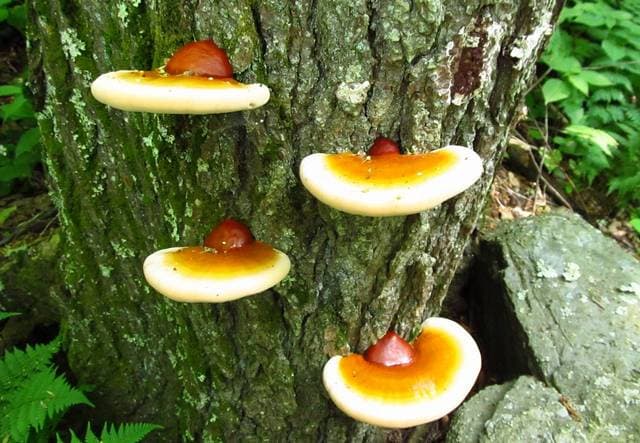
Wild reishi in North America most commonly refers to Ganoderma tsugae (hemlock varnish shelf) or Ganoderma sessile, depending on the region. These are kidney-shaped to fan-shaped polypore mushrooms with a distinctive shiny, lacquered-looking cap surface that looks as if it has been coated in red-brown varnish.
Identification features:
- Cap surface: Glossy, varnished appearance with concentric zones of red, red-brown, orange-brown, and sometimes yellow at the growing margin
- Shape: Kidney-shaped, fan-shaped, or semicircular, 5-30 cm across
- Underside: White to cream pore surface that bruises brown when pressed — this bruising reaction is a useful field test
- Stem: May be present or absent; when present, it is lateral (attached to the side) and has the same varnished appearance as the cap
- Texture: Woody, corky, and tough — not fleshy
- Spore deposit: Brown spore dust often coats surrounding surfaces during active sporulation
- Habitat: G. tsugae grows almost exclusively on hemlock trees; G. sessile grows on hardwoods, especially oaks and maples
Distinguishing from artist's conk and other polypores: The varnished, shiny cap surface is the most distinctive feature — artist's conk (Ganoderma applanatum) is similar in shape but has a dull, brown, unvarnished cap. Other woody shelf fungi lack the glossy lacquered finish entirely. Wild reishi is used medicinally as a tea or tincture, not eaten directly due to its woody texture.
There is no single trick to identify edible mushrooms — safe identification requires learning multiple features and cross-referencing with reliable field guides. With 2,160+ combined monthly searches worldwide for this query, it's the most important skill in foraging.
The identification process (every time, no shortcuts):
- Observe the habitat — what trees are nearby? Is it on wood, soil, or dung? Habitat narrows your options dramatically
- Examine the cap — shape, colour, texture (smooth, scaly, slimy), size
- Check the underside — does it have gills, pores, teeth, or a smooth surface? Gill attachment (free, adnate, decurrent) matters
- Examine the stem — solid or hollow? Ring present? Cup (volva) at the base? A volva suggests Amanita — proceed with extreme caution
- Take a spore print — place the cap gill-side down on paper for 4-12 hours. Spore colour is one of the most reliable ID features
- Note the smell — anise, almond, radish, fishy, or no smell are all diagnostic clues
- Check for bruising — does the flesh change colour when cut? Some boletes bruise blue, Agaricus xanthodermus bruises yellow
Rules that will keep you alive:
- Never eat based on a single feature
- Never rely on an app alone
- Learn the deadly species in your area before learning the edibles
- When in doubt, throw it out — no meal is worth the risk
Honey mushrooms (*Armillaria* species) are among the most common edible wild mushrooms worldwide — but they require careful identification because they have a dangerous look-alike in deadly Galerina (Galerina marginata).
Key identification features:
- Growth habit: Dense clusters (often 20-50+ mushrooms) at the base of dead or dying trees, or from buried roots
- Cap: 3-15cm across, honey-yellow to tawny-brown, often with small dark scales in the centre
- Gills: White to cream, becoming pinkish-brown with age. Attached to the stem (adnate to slightly decurrent)
- Stem: Tough, fibrous, with a prominent white ring (annulus) that sometimes disappears with age
- Spore print: White to pale cream — this is CRITICAL for distinguishing from deadly Galerina which has a rusty brown spore print
- Rhizomorphs: Black, shoestring-like cords visible under bark or in soil near the cluster
- Season: Primarily autumn (September-November in the Northern Hemisphere)
The deadly Galerina confusion:
Galerina marginata can grow on the same logs and looks superficially similar, but grows in small clusters or individually (not massive clusters), has a rusty brown spore print (not white), and has a thinner, more fragile stem. Always take a spore print when collecting honey mushrooms.
Several *Armillaria* species exist — A. mellea, A. gallica, A. tabescens (ringless honey), A. ostoyae. All are edible when cooked thoroughly. Never eat raw — they cause GI distress uncooked.
Need more help? Dr. Myco can answer follow-up questions about visual identification guide based on thousands of real growing experiences.
Ask Dr. MycoMore in Foraging & Wild ID
Foraging Basics & Safety
10 tips
Choice Edible Species
12 tips
Deadly & Toxic Species
14 tips
Regional Foraging Guides
9 tips
Chaga Identification & Harvesting
10 tips
Morel Foraging Guide
10 tips
Morel & Chanterelle Varieties
10 tips
North American Foraging by Region
14 tips
European Foraging Guide
12 tips
Southern Hemisphere & Tropical Foraging
10 tips
Foraging Species by Season
12 tips
Where to Find Wild Mushrooms
15 tips
Mushroom Habitats & Tree Associations
12 tips
Chanterelle Species by Region
12 tips
Morel Species by Region
12 tips
Chicken of the Woods & Turkey Tail by Region
10 tips
Deadly Mushrooms — Where They Actually Grow
10 tips
Wild Lion's Mane, Hedgehog & Lobster Mushrooms
10 tips
Porcini, Black Trumpet & Other Choice Edibles
10 tips