Morel Foraging Guide
10 tips in Foraging & Wild ID
By Andrew Langevin · Founder, Nature Lion Inc · Contributing author, Mushroomology (Brill, 2026)
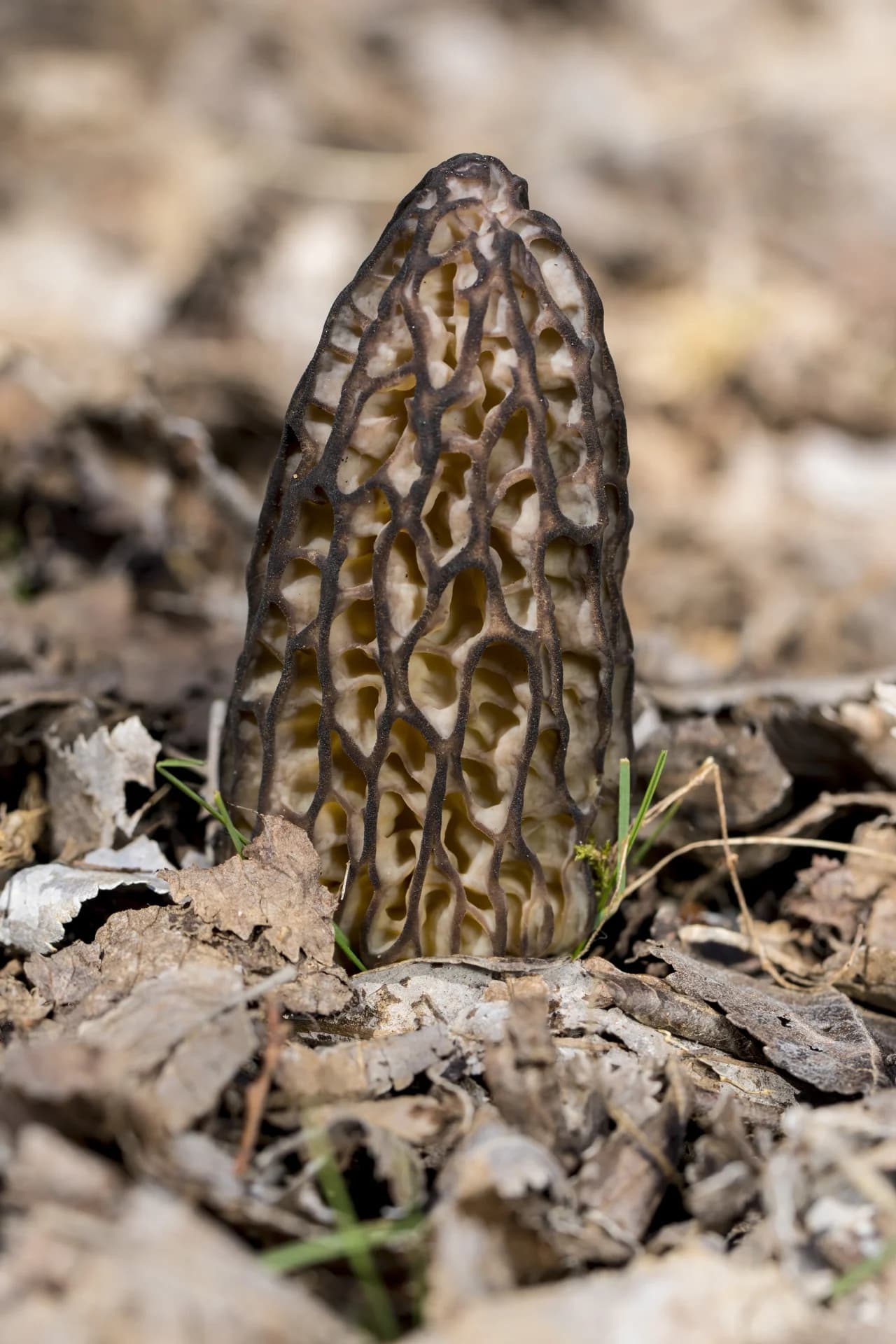
Identifying morels in the wild comes down to checking a few unmistakable features. True morels have a honeycomb-patterned cap with clearly defined pits and ridges, and their interior is completely hollow from cap to stem base. No other common mushroom shares this exact combination.
Key identification steps:
- Look for a conical or egg-shaped cap covered in a network of pits and ridges — the pattern resembles a natural honeycomb or sponge
- The cap should be attached directly to the stem at or near the base of the cap, not hanging freely from the top
- Slice the mushroom lengthwise from top to bottom — the single most important test. A true morel reveals one continuous hollow cavity with no internal chambers, cottony filling, or solid tissue
- Color ranges from blonde and grey to dark black depending on species and age
The false morel is the primary dangerous look-alike. It has a wrinkled, brain-like cap rather than a honeycombed one, and its interior is chambered or stuffed rather than cleanly hollow. False morels contain gyromitrin, a compound that can cause liver failure. Always perform the hollow-interior test on every morel you pick — this single check eliminates the most dangerous confusion.
Morels form strong associations with specific tree species, and learning these tree partnerships is one of the most effective ways to find productive hunting grounds. Different morel species favor different trees, so knowing what grows in your forest narrows your search dramatically.
Top tree associations:
- Dying and dead elms — one of the strongest and most reliable associations, especially for yellow morels. Look for elms losing bark or with bracket fungi on the trunk
- Ash trees — another top producer, particularly as the emerald ash borer kills trees across eastern North America
- Tulip poplar (tulip tree) — a favorite of yellow morels in the Appalachian and Mid-Atlantic regions
- Old apple orchards — a classic morel habitat. Even abandoned orchards with just a few remaining trees can produce heavily
- Cottonwood trees — especially in river bottoms and flood plains across the Midwest
- Sycamore — often overlooked but productive, particularly along streams
Conifers matter too. Black morels and fire morels associate with pine, fir, and spruce, especially in burned forests. In the Pacific Northwest, old-growth Douglas fir stands produce natural black morels annually.
The practical approach is to learn your local tree species first, then scout for morels near dying or stressed specimens of the associated trees during the spring fruiting window.
Morel season is a narrow spring window typically lasting 2-4 weeks in any given location, though the overall season moves across the continent over several months. Timing depends entirely on soil temperature — morels fruit when soil reaches 10-15°C (50-60°F) at a 4-inch depth.
General timing by region:
- Southern US (Gulf states, Ozarks): Late February through March
- Mid-Atlantic and lower Midwest: April through early May
- Upper Midwest and Northeast: Late April through late May
- Pacific Northwest (lowlands): March through April for natural morels
- Mountain West and northern BC: May through July, depending on elevation
Seasonal progression within a region:
- Black morels appear first, typically 1-3 weeks before yellow morels
- Yellow morels follow as temperatures warm further, often coinciding with lilac bloom and oak leaves reaching "squirrel-ear" size
- Half-free morels may appear between the black and yellow morel flushes
The window is short because morels are extremely sensitive to heat. Once daytime temperatures consistently exceed 27°C (80°F), the season ends abruptly. Experienced foragers track soil temperature with a probe thermometer and watch weather patterns to time their outings precisely.
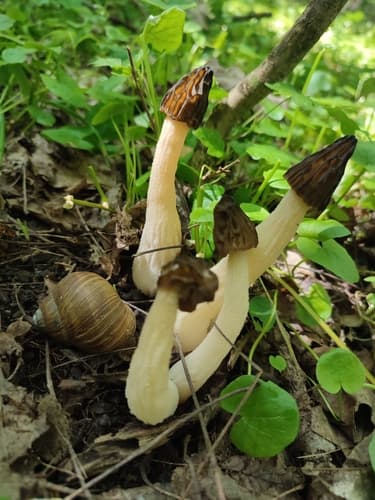
The half-free morel (Morchella punctipes) is a true morel species that looks and tastes similar to other morels but has one distinctive structural difference — the cap is attached to the stem only at the very top, leaving the lower half of the cap hanging freely like a skirt around the stem.
Key identification features:
- Cap attachment: The cap connects to the stem only at its apex. If you lift the cap edge, you can see the stem running freely inside — in full morels, the cap is fused to the stem along its entire length
- Cap size relative to stem: Half-free morels typically have a small cap and a disproportionately long stem, giving them a top-heavy, elongated appearance
- Hollow interior: Like all true morels, half-free morels are completely hollow when sliced lengthwise
- Cap pattern: Honeycombed pits and ridges, though often more loosely arranged than in yellow morels
Are they edible? Yes. Half-free morels are safe to eat and considered good edibles, though many foragers find their flavor slightly less intense than yellow or black morels. The thin flesh and long stems mean there is less meat per mushroom.
The important distinction is between half-free morels and false morels. A half-free morel is hollow inside and has a honeycombed cap. A false morel has a wrinkled, brain-like cap and a chambered or cottony interior. Always slice lengthwise to confirm the hollow cavity.
Yes — burned forests are among the most productive morel habitats on earth. Fire morels (primarily Morchella sextelata and Morchella exuberans) can fruit in extraordinary quantities the spring following a wildfire, with experienced foragers harvesting 10-50+ pounds per day in a good burn.
Why fire zones produce so many morels:
- Nutrient release from burned organic matter floods the soil with minerals and carbon
- Ash raises soil pH toward the slightly alkaline conditions morels prefer
- Canopy removal exposes the forest floor to direct sunlight and temperature fluctuations that trigger fruiting
- Elimination of competing fungi gives morel mycelium a head start in the post-fire environment
How to hunt fire morels effectively:
- Target moderate-severity burns — areas where trees are charred but the ground is not completely incinerated. Lightly burned or completely scorched areas produce fewer morels
- Focus on conifer stands (pine, fir, spruce) rather than hardwood burns
- Scout north-facing slopes and areas near water features where moisture retention is best
- Timing is the spring after the fire — morels fruit once the following spring, rarely in the same year as the fire
Fire morel hunting has become a major seasonal activity in the western US and Canada. Commercial pickers follow fire maps from the previous summer to plan their spring foraging routes. Check local regulations — some burned areas may have access restrictions or require permits.
Morels are found across a wide elevation range, but specific terrain features dramatically increase your odds of finding them. Understanding these preferences turns random wandering into targeted hunting.
Elevation patterns:
- Low elevations (under 500m / 1,600ft): Morels fruit earliest here, often in river bottoms, flood plains, and around dying elms and cottonwoods
- Mid elevations (500-1,500m / 1,600-5,000ft): The sweet spot for many regions, especially in hardwood and mixed forests on mountain slopes
- High elevations (1,500-3,000m / 5,000-10,000ft): Fire morels in western mountain burns can fruit at surprisingly high elevations, with the season extending into July
Terrain features to target:
- South-facing slopes warm fastest in spring and produce morels before north-facing slopes in the same area
- River bottoms and stream drainages where moisture accumulates and cottonwood, elm, and ash grow
- Ridgeline edges where hardwood forests transition to open meadow — these ecotones often produce well
- Disturbed ground including old logging roads, skid trails, and areas where soil has been turned over
- Gentle slopes with good drainage — morels dislike waterlogged or swampy ground
The practical strategy is to follow the season uphill. Start hunting at the lowest elevations when soil temperatures first reach 10°C, then move progressively higher over the following weeks as warmth climbs the mountainside. This can extend your personal morel season by several weeks.
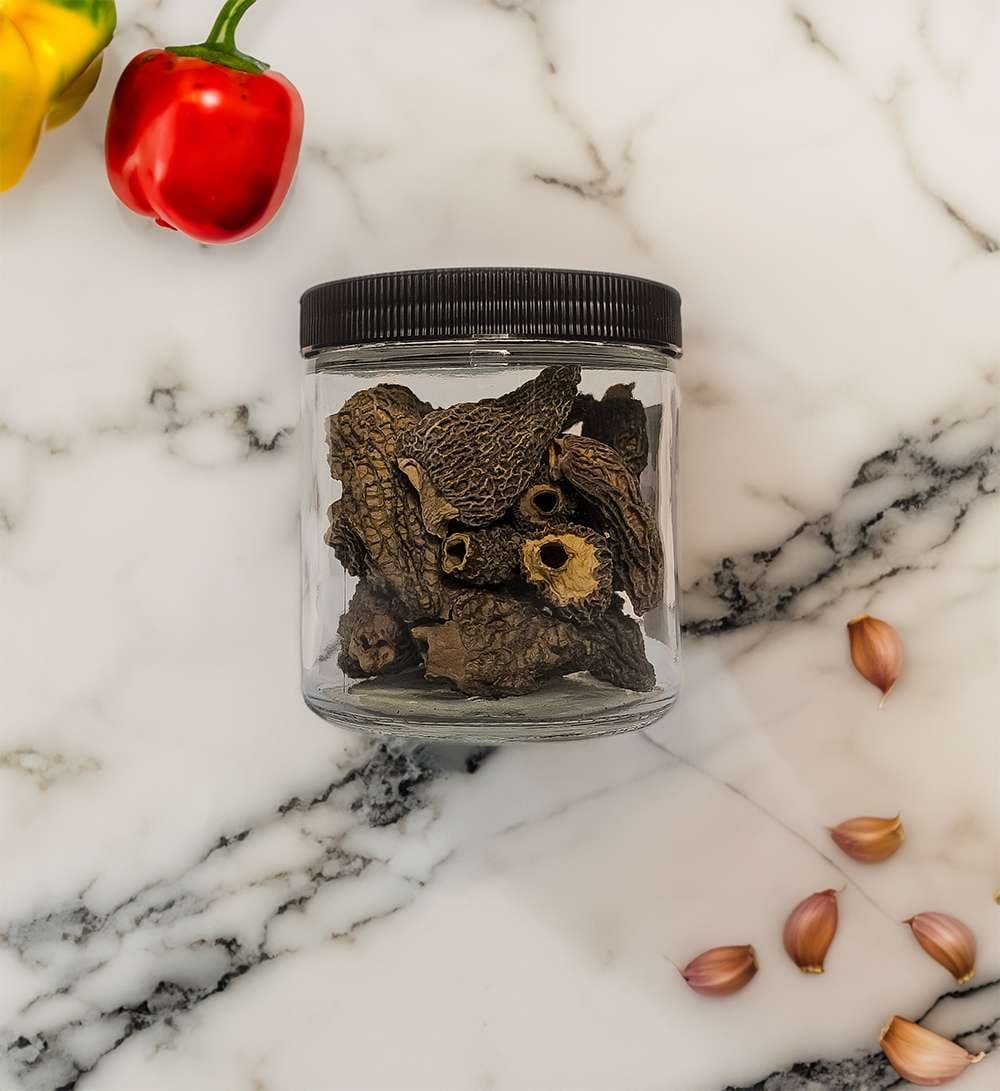
Fresh morel mushrooms are highly perishable and begin deteriorating within 2-3 days of harvest. Drying is the preferred preservation method because morels retain their flavor exceptionally well when dehydrated and can be stored for years in airtight containers.
Preservation methods ranked by effectiveness:
- Dehydrating (best method): Slice morels lengthwise and dry at 35-45°C (95-115°F) in a food dehydrator for 6-10 hours until cracker-dry. They should snap cleanly, not bend. Store in airtight mason jars with a silica gel packet in a cool, dark place. Properly dried morels last 1-2 years or longer
- Freezing after sautéing: Sauté sliced morels in butter for 3-5 minutes, cool completely, then freeze flat on a sheet pan before transferring to freezer bags. This preserves texture better than freezing raw. Lasts 6-12 months
- Freezing raw: Not recommended — raw frozen morels become mushy when thawed due to ice crystal damage
Field handling tips:
- Carry morels in a mesh bag or basket, never sealed plastic bags where they sweat and deteriorate rapidly
- Process within 24 hours of picking for best flavor and texture
- Soak briefly in salted water (5 minutes) to dislodge insects hiding in the honeycomb pits, then pat dry before preserving
To rehydrate dried morels, soak in warm water for 20-30 minutes. Save the soaking liquid — it is intensely flavorful and makes an excellent base for sauces, risottos, and soups.
The false morel (Gyromitra esculenta) is the most well-known dangerous look-alike, but several other species can cause confusion, particularly for inexperienced foragers. Knowing the full range of potential mix-ups keeps you safe beyond just the classic false morel warning.
Other species confused with morels:
- Verpa bohemica (early morel / wrinkled thimble cap): Has a cap attached only at the very top of the stem with cottony fibers inside the stem. It is not hollow throughout like a true morel. Edible for some people but causes GI issues in others — best avoided
- Verpa conica (bell morel / smooth thimble cap): Similar to Verpa bohemica but with a smoother cap. Same top-attached cap structure and cottony stem interior
- Gyromitra species beyond G. esculenta: Several Gyromitra species exist including G. caroliniana, G. brunnea, and G. infula. All contain varying levels of gyromitrin and should be treated as toxic
- Helvella species (saddle fungi / elfin saddles): While visually quite different to experienced foragers, complete beginners sometimes confuse these lobed, irregular fungi with morels
The universal safety test remains the same: Slice every morel lengthwise and confirm it is completely hollow from cap to stem base with no cottony material, chambers, or solid tissue inside. True morels also have a distinctly honeycombed cap — if the cap is wrinkled, smooth, saddle-shaped, or brain-like, it is not a morel.
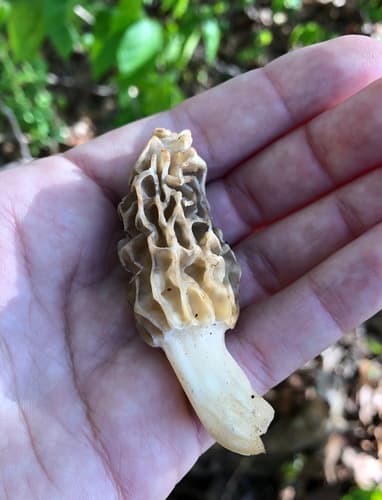
Yellow morels and black morels are both true Morchella species and both excellent edibles, but they differ in appearance, timing, habitat, and flavor in ways that matter for successful foraging. Knowing which type you are targeting changes where and when you hunt.
Yellow morels (Morchella esculenta group):
- Appearance: Pale yellow to tan ridges with cream-colored pits, rounder and more bulbous cap shape
- Size: Often larger — specimens of 10-20cm (4-8 inches) are common
- Timing: Fruit later in spring, typically 1-3 weeks after black morels in the same area
- Habitat: Strongly associated with dying elms, ash, tulip poplar, and old apple orchards. Favor river bottoms, flood plains, and rich bottomland soils
- Flavor: Milder, nuttier, and slightly sweeter
Black morels (Morchella elata group):
- Appearance: Dark brown to jet-black ridges with lighter grey-brown pits, more conical and elongated cap shape
- Size: Generally smaller, typically 5-12cm (2-5 inches)
- Timing: Fruit first in spring, often before trees have fully leafed out
- Habitat: Prefer conifer and mixed forests, disturbed ground, wood chip beds, and burned areas. Fire morels are predominantly black morel species
- Flavor: More intense, earthy, and robust
Practical foraging strategy: Start hunting black morels early in the season in conifer forests and disturbed ground. As the season progresses and temperatures warm, shift to bottomlands and hardwood forests for yellow morels. This approach effectively doubles your foraging window.
You can attempt morel cultivation from wild specimens, but success rates are extremely low and inconsistent. Unlike oyster or shiitake mushrooms, morels have complex life cycle requirements that make reliable cultivation one of mycology's greatest challenges.
Methods people try with wild specimens:
- Spore slurry: Soak fresh morels in non-chlorinated water with a pinch of salt and a tablespoon of molasses for 24-48 hours. Pour the slurry over a prepared outdoor bed of hardwood chips, ash, and composted soil. This distributes spores but fruiting is unpredictable
- Stem butt planting: Place the trimmed base of fresh morels directly into a prepared outdoor bed at a depth of 2-3cm and cover with mulch
- Tissue culture to agar: Take an interior tissue sample from a fresh morel and transfer to agar media. Morel mycelium grows readily on agar, but getting it to fruit is an entirely different challenge
Why cultivation is so difficult:
- Morel mycelium colonizes substrates easily, but the transition from vegetative growth to fruiting requires conditions that are poorly understood
- A cold stratification period of several weeks at 4-8°C appears necessary
- The soil microbial community may play a critical role that cannot be replicated in sterile culture
- Sclerotia (hardened survival structures) must form before fruiting can occur
The most realistic approach for home growers is creating an outdoor morel bed in a shaded area with hardwood chips, wood ash, and garden soil, then inoculating with a spore slurry. Some growers report fruiting after 1-3 years, but many beds never produce. Treat it as a long-term experiment with no guarantees.
Need more help? Dr. Myco can answer follow-up questions about morel foraging guide based on thousands of real growing experiences.
Ask Dr. MycoMore in Foraging & Wild ID
Foraging Basics & Safety
10 tips
Choice Edible Species
12 tips
Deadly & Toxic Species
14 tips
Regional Foraging Guides
9 tips
Visual Identification Guide
17 tips
Chaga Identification & Harvesting
10 tips
Morel & Chanterelle Varieties
10 tips
North American Foraging by Region
14 tips
European Foraging Guide
12 tips
Southern Hemisphere & Tropical Foraging
10 tips
Foraging Species by Season
12 tips
Where to Find Wild Mushrooms
15 tips
Mushroom Habitats & Tree Associations
12 tips
Chanterelle Species by Region
12 tips
Morel Species by Region
12 tips
Chicken of the Woods & Turkey Tail by Region
10 tips
Deadly Mushrooms — Where They Actually Grow
10 tips
Wild Lion's Mane, Hedgehog & Lobster Mushrooms
10 tips
Porcini, Black Trumpet & Other Choice Edibles
10 tips