Choice Edible Species
12 tips in Foraging & Wild ID
By Andrew Langevin · Founder, Nature Lion Inc · Contributing author, Mushroomology (Brill, 2026)
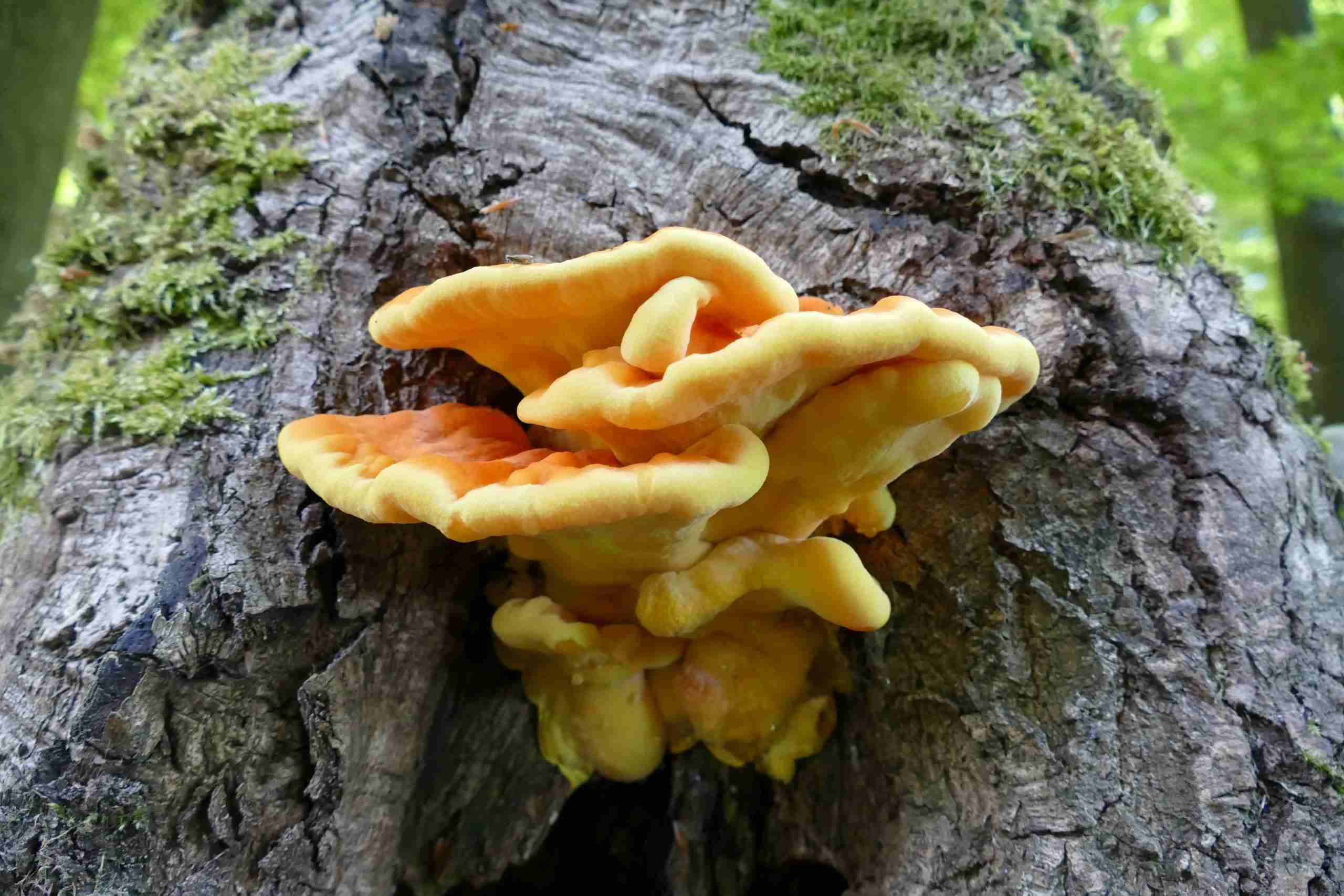
Chicken of the woods (Laetiporus sulphureus and related species) is one of the safest mushrooms for beginners because its bright orange and yellow shelf-like brackets are virtually unmistakable. It grows on dead or dying hardwoods, especially oak, and fruits from late spring through fall.
Key identification features:
- Bright orange to salmon top surface with a yellow margin
- Sulfur-yellow pore surface underneath (no gills)
- Grows in overlapping shelf-like brackets on trees or stumps
- Firm, succulent flesh when young that resembles cooked chicken in texture
- No stem — attaches directly to wood
Harvest only young, tender specimens with moist, flexible edges. Older specimens become tough, dry, and crumbly. Use a knife to cut the outer edges, leaving the tough inner portions attached to the tree. Some people experience GI upset, particularly with specimens growing on conifers or eucalyptus, so try a small amount the first time.
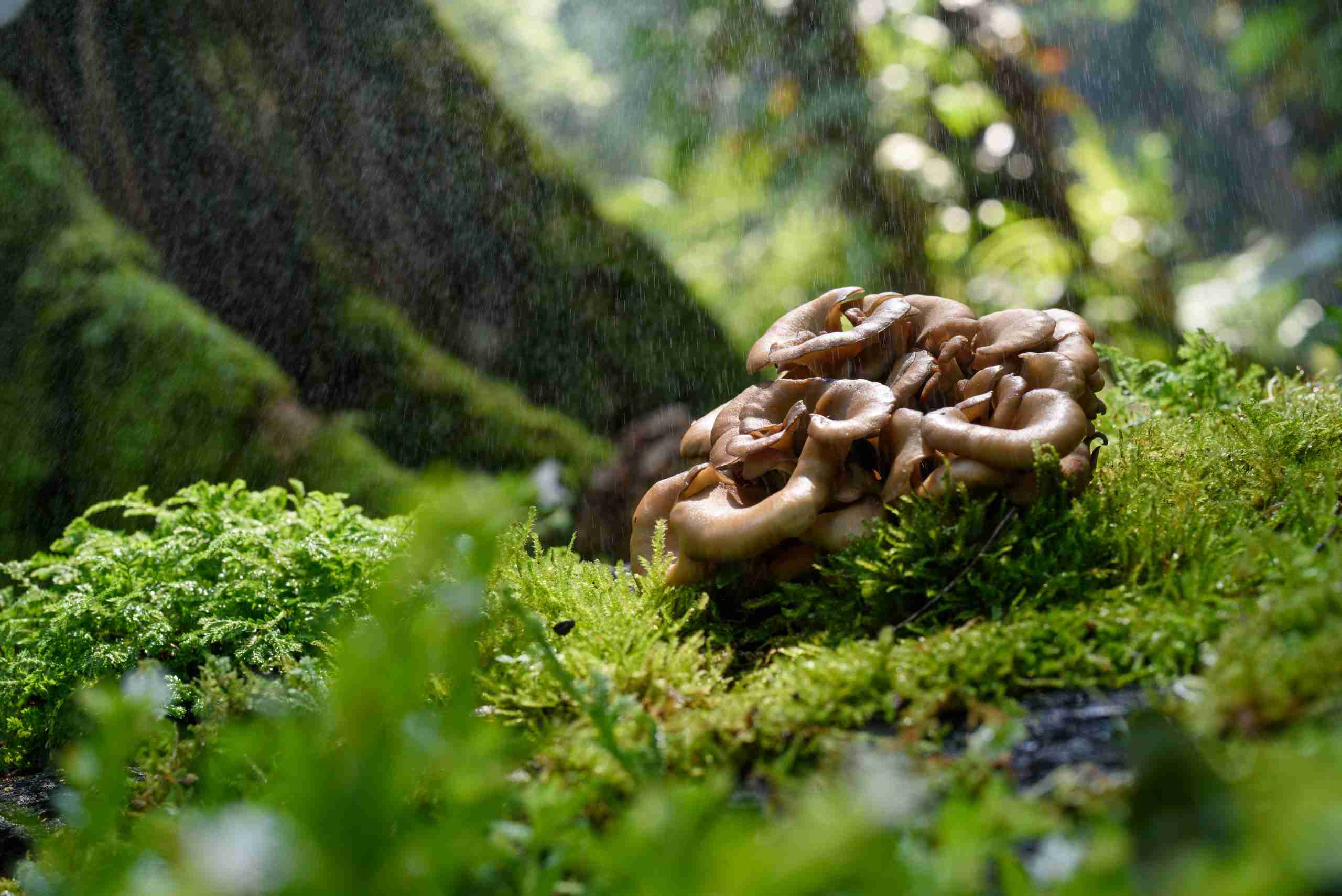
Hen of the woods (Grifola frondosa), also called maitake, is a highly prized edible that grows at the base of living and dead oaks. It forms large, layered rosettes of gray-brown overlapping caps that can weigh 5-50 pounds and resemble a ruffled hen sitting at the base of a tree.
Key identification features:
- Gray to brown overlapping fan-shaped caps growing in a rosette
- White pore surface underneath each cap
- White stem structure branching from a central base
- Grows at the base of oaks (occasionally other hardwoods)
- Returns to the same tree year after year
- Fruits in fall (September-November in most regions)
Once you find a productive tree, mark it — hen of the woods is one of the most reliably recurring mushrooms. Harvest by cutting through the base with a knife. Clean thoroughly, as the overlapping layers trap dirt and insects. This species has no dangerous look-alikes and is considered an excellent beginner mushroom.
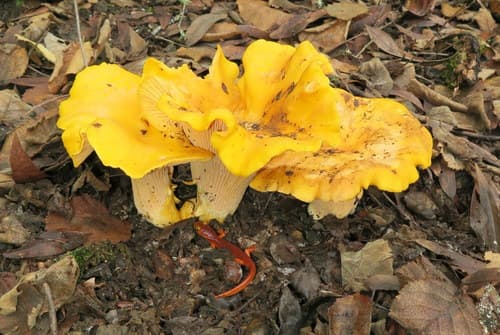
Chanterelles (Cantharellus cibarius and related species) are among the most sought-after wild mushrooms worldwide. They are golden-yellow, funnel-shaped mushrooms with false gills — ridges that fork and run down the stem rather than true blade-like gills.
Key identification features:
- Golden yellow to egg-yolk orange color
- Forked, blunt ridges (false gills) that run down the stem
- Vase or funnel-shaped when mature
- Fruity, apricot-like aroma
- White flesh when cut (not orange throughout)
- Grows singly or in scattered groups on the forest floor near hardwoods or conifers
The main look-alike is the jack o'lantern mushroom (Omphalotus olearius), which grows in clusters on wood, has true gills, and is orange throughout when cut. Jack o'lanterns cause severe GI distress but are not fatal. Chanterelles grow from the ground, have false gills, and have white flesh. Learn these distinctions well before harvesting.
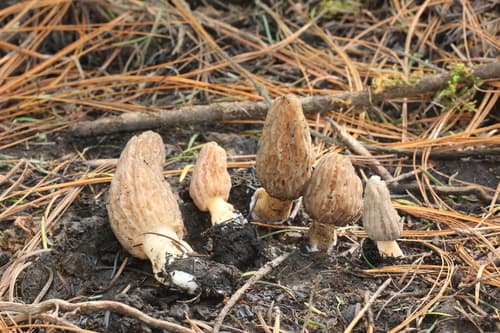
Morels (Morchella species) are the quintessential spring mushroom, prized for their honeycomb-like caps and nutty, earthy flavor. True morels have a fully hollow interior from cap to stem — this is the single most important feature separating them from toxic false morels.
Key identification features:
- Honeycomb-patterned cap with defined pits and ridges
- Cap attached directly to the stem at the base of the cap
- Completely hollow when sliced in half lengthwise
- Color ranges from blonde to gray to black depending on species and age
- Grows in spring when soil temps reach 10-15°C (50-60°F)
Morels are associated with disturbed ground, dying elms, ash, tulip poplar, old orchards, and burned areas. They fruit for a narrow window of 2-4 weeks in spring, moving from south to north as temperatures warm. The false morel (Gyromitra esculenta) has a wrinkled, brain-like cap and a chambered (not hollow) interior — never eat a morel that isn't completely hollow.
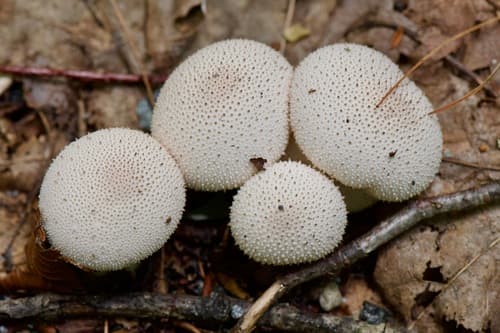
The giant puffball (Calvatia gigantea) is one of the easiest wild mushrooms to identify. It's a large, white, ball-shaped mushroom with no stem, no gills, and pure white flesh inside when edible. Specimens can range from softball-sized to over 50 cm across.
Key identification features:
- Spherical to slightly flattened white ball
- Smooth to slightly textured outer skin
- Interior must be pure white and firm — any yellow, green, brown, or purple coloration means it's too mature
- No visible gills, stem, or internal structures when sliced open
- Grows in meadows, pastures, parks, and woodland edges
The critical safety check: always slice puffballs in half from top to bottom. If the interior is uniformly white with no outline of a developing mushroom visible, it's safe. If you see the outline of a cap and stem inside, you may have a young Amanita (potentially deadly) still in its universal veil — discard immediately. This cross-section check is non-negotiable.
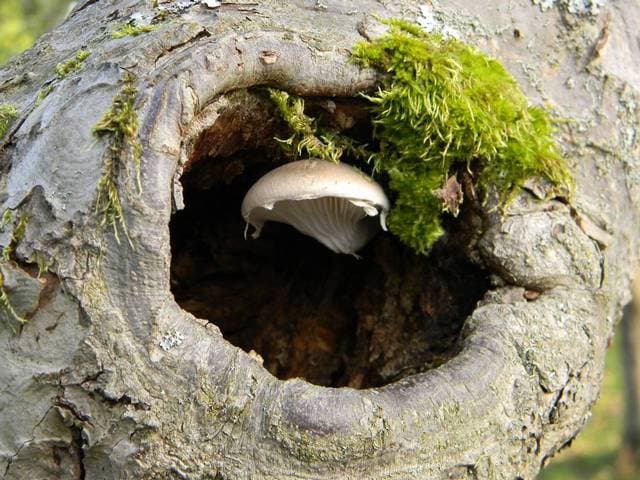
Wild oyster mushrooms (Pleurotus ostreatus and related species) are common, widespread, and relatively easy to identify. They grow in overlapping shelf-like clusters on dead or dying hardwood trees and are available from spring through late fall, even into winter in mild climates.
Key identification features:
- Fan or oyster-shell shaped caps, 5-25 cm across
- White to cream to gray-brown cap color (sometimes tan or lilac)
- White, decurrent gills that run down a short, off-center stem
- White spore print
- Grows in clusters on dead or dying hardwoods
- Pleasant, mild, anise-like smell
The main look-alike is the angel wing (Pleurocybella porrigens), which is thinner, purely white, grows on conifers, and lacks a stem entirely. Some cases of toxicity have been reported with angel wings. Stick to oysters found on hardwoods, confirm the white spore print, and check for the characteristic off-center stem and decurrent gills.
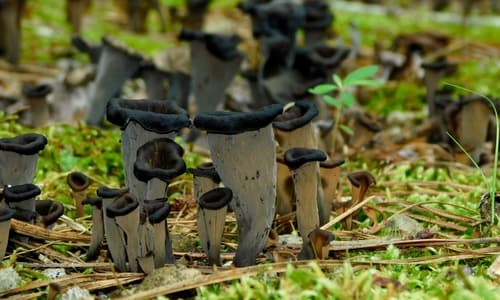
Black trumpets (Craterellus cornucopioides) are a gourmet delicacy sometimes called the "poor man's truffle" for their rich, smoky flavor. They are notoriously difficult to spot despite being relatively common, because their dark gray to black color blends perfectly with the leaf litter.
Key identification features:
- Funnel or trumpet-shaped, hollow from top to bottom
- Dark gray to black, sometimes with brown or purple tones
- Smooth to slightly wrinkled outer surface (no true gills or pores)
- Thin, fragile flesh
- Grows in clusters in hardwood forests, especially near oaks and beeches
- Fruits in summer and fall after heavy rains
Black trumpets have no dangerous look-alikes, making them safe for beginners who can learn to spot them. The challenge is entirely visual — they hide in plain sight among dark leaves. Search on slopes, near water features, and in mossy areas under oaks. Once you find one, get on your knees and scan slowly — there are almost always more nearby.
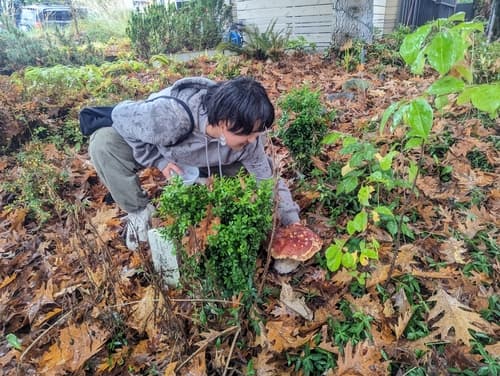
The king bolete (Boletus edulis), known as porcini in Italian cuisine, is one of the world's most prized wild mushrooms. It has a brown cap, white to yellow pore surface (no gills), a thick bulbous stem with fine white netting (reticulation), and grows in association with spruce, pine, and certain hardwoods.
Key identification features:
- Brown cap, 7-30 cm across, smooth and slightly tacky when wet
- White pore surface when young, aging to yellow-green
- Thick, club-shaped white stem with fine white net-like pattern (reticulation)
- Firm white flesh that does not change color when cut
- Grows on the ground near conifers or hardwoods (mycorrhizal)
The most important safety rule with boletes: avoid any bolete with a red pore surface or that stains blue instantly and intensely when cut. While not all blue-staining boletes are toxic, this rule eliminates dangerous species. King boletes have white flesh that does not change color, which distinguishes them from many look-alikes.
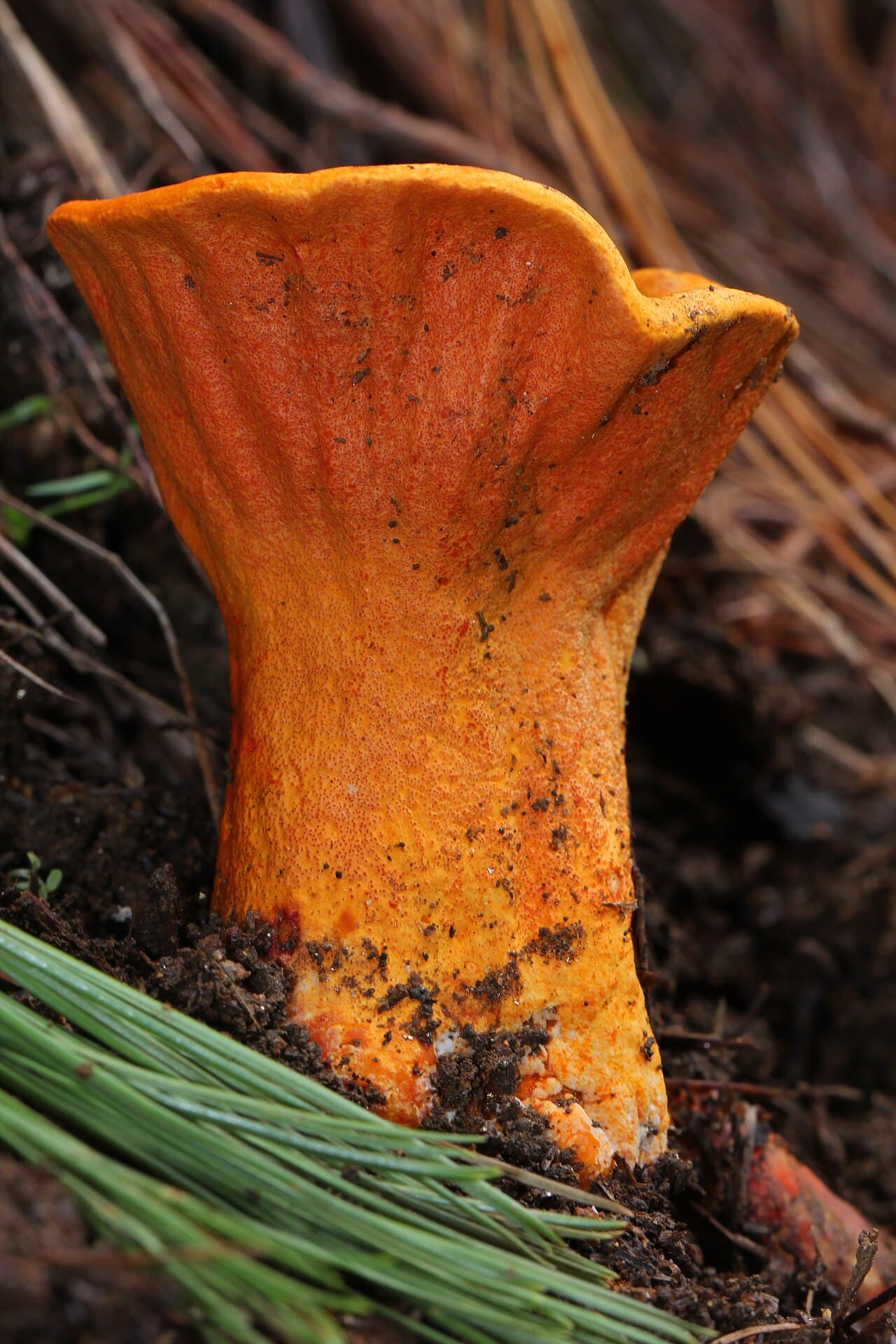
The lobster mushroom is not actually a single species — it's the result of a parasitic fungus (Hypomyces lactifluorum) that colonizes and transforms other mushrooms, typically Russula or Lactarius species. The parasite coats the host in a bright orange-red shell that resembles cooked lobster, giving it a firm texture and seafood-like flavor.
Key identification features:
- Bright orange to red exterior with a rough, pimpled texture
- Dense, firm white flesh inside
- The original mushroom shape is distorted but still roughly mushroom-shaped
- Hard outer coating that cracks when bent
- Grows on the ground in forests where Russula and Lactarius are common
- Fruits in summer and fall
Harvest only firm, fresh specimens that are bright orange-red. Avoid any that are soft, purple-tinted, or smell fishy — these are past prime. While lobster mushrooms are generally considered safe, there is a theoretical concern that the host mushroom could be a mildly toxic species, though no poisonings have been reliably documented.
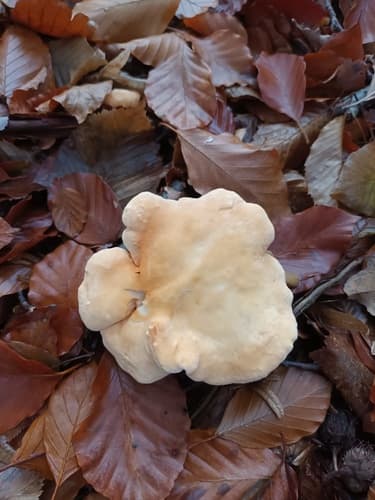
The hedgehog mushroom (Hydnum repandum), also called sweet tooth, is an excellent beginner-friendly edible with no dangerous look-alikes. Instead of gills or pores, it has tiny spines (teeth) hanging from the underside of the cap — a unique feature that makes identification straightforward.
Key identification features:
- Creamy white to pale orange irregular cap
- Tiny, soft, downward-pointing spines (teeth) under the cap instead of gills
- White to pale orange solid stem, often off-center
- Firm white flesh with a mild, sweet, nutty flavor
- Grows on the ground in hardwood and conifer forests
- Fruits in fall and early winter
The spines are the key feature — no toxic mushroom in North America has this combination of pale cap, teeth instead of gills, and terrestrial habit. Some smaller Hydnum species exist but are all edible. Hedgehog mushrooms have a mild, slightly peppery-sweet flavor and firm texture that holds up well to cooking. They are mycorrhizal and cannot be cultivated.
Matsutake (Tricholoma matsutake and related species) is one of the most expensive wild mushrooms in the world, prized in Japanese cuisine for its distinctive spicy, cinnamon-like aroma that is unlike any other mushroom. In North America, the Pacific Northwest species (T. murrillianum) is the primary target.
Key identification features:
- White cap, often with brown scales or discoloration, 5-20 cm across
- White gills with a thick, persistent partial veil
- Sturdy white stem with a sheathing ring
- Distinctive spicy-aromatic smell — often described as cinnamon, pine, or "red hots" candy
- Grows under conifers, especially pine, in sandy or volcanic soils
- Fruits in fall, often in the same spots year after year
Matsutake can resemble several white Amanita species, including the deadly Smith's Amanita in the Pacific Northwest. Key differences: matsutake has a strong spicy smell (Amanitas smell faintly sweet or like nothing), attached gills, and a fibrous veil rather than a membranous one. Do not forage matsutake until you can confidently distinguish it from white Amanitas.
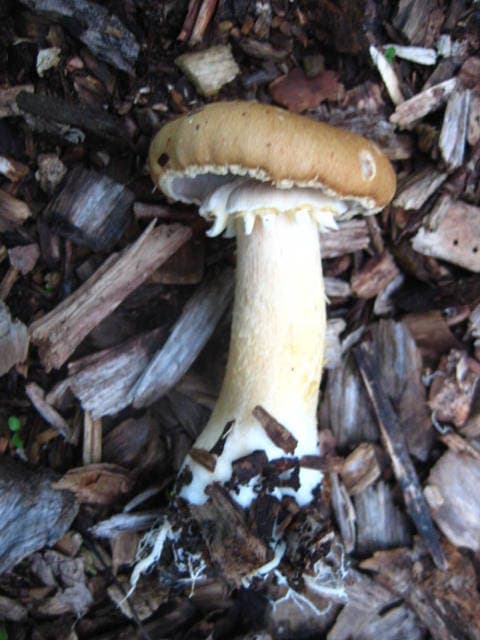
The wine cap (Stropharia rugosoannulata), also called king stropharia or garden giant, is both a choice edible and one of the easiest mushrooms to cultivate outdoors. In the wild, it grows in wood chips, garden mulch, and disturbed woody soil — you'll often find it in urban parks and landscaped areas.
Key identification features:
- Large burgundy to wine-red cap, 5-30 cm across, fading to tan with age
- Gray-lilac gills aging to dark purple-brown
- Thick white stem with a prominent, grooved ring
- Dark purple-brown to black spore print
- Grows in wood chips, mulch, straw, and composted woody debris
- Fruits in spring and fall
Wine caps are increasingly popular as a cultivated species for outdoor beds because they thrive in wood chip mulch with minimal care. Be cautious with any large mushroom found in wood chips — confirm the wine-red cap color, grooved ring, and dark spore print. The combination of these features distinguishes wine caps from potentially toxic look-alikes like certain Agrocybe or Hypholoma species.
Need more help? Dr. Myco can answer follow-up questions about choice edible species based on thousands of real growing experiences.
Ask Dr. MycoMore in Foraging & Wild ID
Foraging Basics & Safety
10 tips
Deadly & Toxic Species
14 tips
Regional Foraging Guides
9 tips
Visual Identification Guide
17 tips
Chaga Identification & Harvesting
10 tips
Morel Foraging Guide
10 tips
Morel & Chanterelle Varieties
10 tips
North American Foraging by Region
14 tips
European Foraging Guide
12 tips
Southern Hemisphere & Tropical Foraging
10 tips
Foraging Species by Season
12 tips
Where to Find Wild Mushrooms
15 tips
Mushroom Habitats & Tree Associations
12 tips
Chanterelle Species by Region
12 tips
Morel Species by Region
12 tips
Chicken of the Woods & Turkey Tail by Region
10 tips
Deadly Mushrooms — Where They Actually Grow
10 tips
Wild Lion's Mane, Hedgehog & Lobster Mushrooms
10 tips
Porcini, Black Trumpet & Other Choice Edibles
10 tips