Chanterelle Species by Region
12 tips in Foraging & Wild ID
By Andrew Langevin · Founder, Nature Lion Inc · Contributing author, Mushroomology (Brill, 2026)
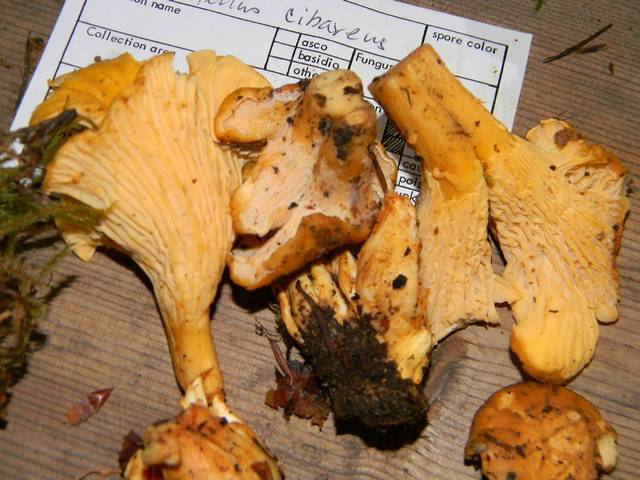
The Pacific Northwest hosts at least four distinct chanterelle species, making it the richest chanterelle region in North America. Based on verified Mushroom Observer data, the dominant species is Cantharellus formosus with 25 confirmed observations at sites including Breitenbush Hot Springs, Hoh Rainforest, Issaquah Alps, and Crescent City.
PNW chanterelle species and verified locations:
- C. formosus (25 obs) — The Pacific golden chanterelle. Found under old-growth Douglas fir and western hemlock at Breitenbush, Hoh Rainforest, Issaquah Alps, and Crescent City
- C. subalbidus (16 obs) — The white chanterelle. Verified at Gifford Pinchot National Forest and Breitenbush. Creamy white, often partially buried under duff
- C. roseocanus (7 obs) — The rainbow chanterelle. Confirmed at Gifford Pinchot NF, Salt Point State Park, and Roosevelt Beach. Pink-capped with a fruity apricot scent
- C. cascadensis (3 obs) — A Cascades endemic. Documented at Breitenbush and along Highway 12
Peak season is September through November, triggered by fall rains after summer drought. The best strategy is to return to the same productive patches year after year — chanterelle mycelium is perennial.
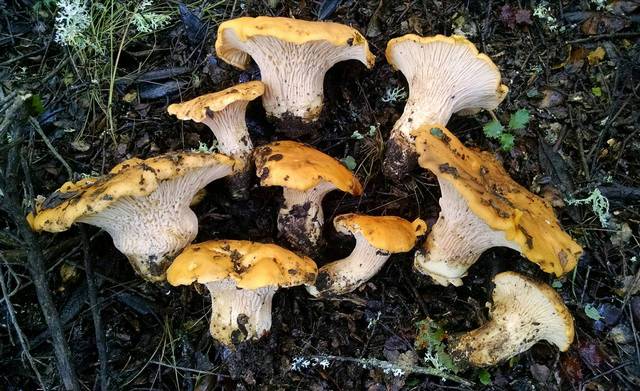
California is home to a remarkable endemic chanterelle that fruits in winter — the opposite of most North American chanterelles. Based on verified Mushroom Observer data, Cantharellus californicus dominates with 19 confirmed observations at Los Trancos Preserve, Berkeley Hills, Aptos, and Anthony Chabot Regional Park, peaking December through February.
California chanterelle species:
- C. californicus (19 obs) — California's endemic golden chanterelle. Fruits under coast live oak (Quercus agrifolia) during the rainy season, December through February. Verified at Los Trancos Preserve, Berkeley Hills, Aptos, and Anthony Chabot RP
- C. formosus — Present in northern California's conifer forests, particularly Del Norte and Humboldt counties. Peaks in fall like the PNW populations
The winter fruiting pattern of C. californicus is unique in North America. While most chanterelle hunters wait for fall rains, California foragers head out after winter storms. This species can produce enormous individual specimens — some weighing over 1 kg. It forms mycorrhizal associations exclusively with live oak, so look under mature oaks on shaded hillsides after heavy December or January rains.
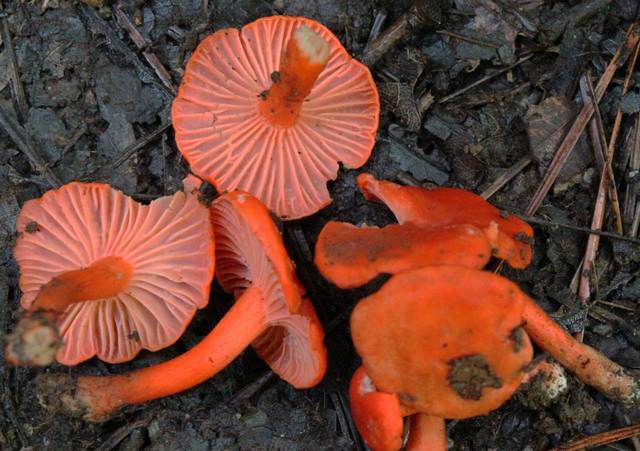
The Eastern US has a completely different suite of chanterelle species than the West Coast, with at least four well-documented species. Based on verified Mushroom Observer data, the most commonly reported is the cinnabar chanterelle, Cantharellus cinnabarinus, with 18 confirmed observations.
Eastern chanterelle species and verified locations:
- C. cinnabarinus (18 obs) — The cinnabar chanterelle. Small, bright reddish-orange. Verified at Bald Mountain Recreation Area, Forest 44, and Gainesville
- C. lateritius (11 obs) — The smooth chanterelle. Confirmed in Virginia and Ohio. Distinguished by smooth to slightly wrinkled undersurface rather than true false gills
- C. minor (10 obs) — A small yellow species. Documented at Brown County State Park and Highbanks Metro Park. Often overlooked due to tiny size
- C. appalachiensis (9 obs) — Appalachian endemic. Verified at Beaver Creek State Forest and Hocking State Forest. Yellowish with a more slender build
Eastern chanterelles peak June through August, fruiting after warm summer rains in hardwood forests. Look under oaks, beeches, and hickories on well-drained slopes.
The Midwest hosts several recently described chanterelle species that most foragers have never heard of. Based on verified Mushroom Observer data, the region's chanterelles include species only formally named in the last decade, making this an exciting frontier for citizen science.
Midwest chanterelle species and verified locations:
- C. phasmatis (5 obs) — A "phantom" chanterelle described in 2016. Verified at Metamora-Hadley Recreation Area and Pontiac Lake. Pale yellowish, easily confused with other species
- C. flavus (4 obs) — Documented at Metamora-Hadley, Pontiac Lake, and Proud Lake. A true golden chanterelle of the Midwest
- C. corallinus (3 obs) — Confirmed at Brown County, Indiana. A coral-toned species found in hardwood forests
Peak season is July through September, later than the Eastern seaboard due to the continental climate. The best Midwest chanterelle habitat is mature oak-hickory forest on ridges and slopes with good drainage. Southern Michigan and southern Indiana are particularly productive regions. Many Midwest foragers still call all golden chanterelles "C. cibarius," but DNA studies have shown that the European species does not occur in North America at all.
The Southeast US hosts chanterelle species adapted to subtropical conditions, including a remarkable tropical species found under seagrape trees in South Florida. Based on verified Mushroom Observer data, the region's chanterelles include species not found anywhere else in North America.
Southeast chanterelle species and verified locations:
- C. coccolobae (4 obs) — A tropical chanterelle mycorrhizal with seagrape (Coccoloba uvifera). Verified at Jupiter and Miami, Florida. One of very few tropical chanterelle species known
- C. flavolateritius (7 obs) — Documented in Fannin County and Walton County, Georgia. A robust golden-orange species in mixed hardwood forests
- C. lateritius — The smooth chanterelle is the dominant species across the Southeast, especially in oak-dominated forests
Southeast chanterelles peak June through July, earlier than northern populations. The warm, humid conditions mean fruiting can begin in late May after spring rains. The discovery of C. coccolobae in South Florida demonstrates that chanterelles extend much further south than most field guides suggest — look for them along coastal dune habitats wherever seagrape trees grow.
For decades, North American foragers called their golden chanterelles Cantharellus cibarius — but DNA studies have proven that the European C. cibarius does not occur anywhere in North America. The common "golden chanterelle" of the Pacific Northwest is actually Cantharellus formosus, a distinct species described by Corner in 1966 and elevated by molecular work in the 2000s.
Key differences between the species:
- C. cibarius — European species. Egg-yolk yellow throughout, stocky build. Found across Europe under spruce, pine, birch, and beech
- C. formosus — Pacific Northwest species. Cap often brownish to pale yellowish, with pinkish-salmon false gills. Mycorrhizal primarily with Douglas fir and western hemlock
Based on verified Mushroom Observer data, C. formosus has 25 confirmed observations across the PNW, from Breitenbush Hot Springs to Hoh Rainforest. No verified North American observations of true C. cibarius exist in the database. This taxonomic revision means that virtually every North American field guide published before 2010 uses the wrong name. Each region has its own native chanterelle species — C. formosus in the PNW, C. californicus in California, and several species in the East.
Chanterelle season varies dramatically across North America — spanning from June to February depending on your region. Based on verified Mushroom Observer data, the peak observation months reveal a clear pattern tied to regional climate and rainfall.
Chanterelle peak seasons by region:
- Pacific Northwest: September–November. Triggered by fall rains after summer drought. C. formosus and C. subalbidus dominate
- California: December–February. The endemic C. californicus fruits during winter rains under live oak — the latest chanterelle season in North America
- Eastern US: June–August. C. cinnabarinus, C. lateritius, and C. appalachiensis fruit after warm summer rains
- Southeast US: June–July. Earlier than northern populations due to warmer temperatures
- Midwest: July–September. C. phasmatis and C. flavus peak in mid to late summer
The key trigger in every region is rainfall followed by moderate temperatures. Plan your forays for 5–10 days after a soaking rain when temperatures are between 15–25°C. Chanterelle mycelium is perennial, so productive patches will fruit in the same locations year after year if conditions are right. Keep a log of your patches with dates and weather conditions to predict future flushes.
Cantharellus californicus is a chanterelle species found nowhere else on Earth except California. It is the only North American chanterelle that fruits in winter (December–February), and it produces some of the largest individual chanterelle specimens known — some exceeding 1 kg in weight.
Based on verified Mushroom Observer data, C. californicus has 19 confirmed observations at locations including Los Trancos Preserve, Windy Hill Open Space, and Berkeley Hills. What makes this species remarkable:
- Winter fruiting: Peaks December–February during California's rainy season, when no other North American chanterelles are active
- Endemic range: Found only in California, primarily in the coastal fog belt from Mendocino to Santa Barbara counties
- Exclusive tree partner: Forms mycorrhizal associations only with coast live oak (Quercus agrifolia)
- Massive size: Individual specimens can weigh over 1 kg and measure 30 cm across
- Slow growth: Takes 2–4 weeks to reach full size, much slower than other chanterelles
For California foragers, this species offers world-class chanterelle hunting when the rest of North America is dormant. Look under mature live oaks on north-facing hillsides after December rains.
The cinnabar chanterelle (Cantharellus cinnabarinus) is a small, brilliantly colored chanterelle with bright reddish-orange to flamingo-pink caps — one of the most visually striking wild mushrooms in Eastern North America. Based on verified Mushroom Observer data, it has 18 confirmed observations at locations including Bald Mountain Recreation Area, Birch Grove Park, and Forest 44.
Identifying features of the cinnabar chanterelle:
- Color: Vivid cinnabar red to pinkish-orange, fading to pinkish with age
- Size: Small, typically 1–5 cm cap diameter — much smaller than golden chanterelles
- False gills: Well-developed, forked, running down the stem, same color as cap
- Habitat: Hardwood forests, especially oak and beech, on well-drained slopes
- Season: June–August in the Eastern US
Cinnabar chanterelles often grow in large troops, making them worthwhile despite their small size. They have no dangerous look-alikes — the combination of small size, vivid red-orange color, and false gills is distinctive. Their flavor is milder and more delicate than golden chanterelles, excellent in pasta dishes and omelets. Look for them along trails in mixed hardwood forests after summer rains.
Each chanterelle species has evolved a mycorrhizal partnership with specific tree species, meaning you can predict which chanterelles to find by identifying the trees around you. Based on verified Mushroom Observer data, habitat associations are among the most reliable identification clues.
Chanterelle species and their preferred habitats:
- C. formosus — Old-growth and mature Douglas fir and western hemlock forests. Prefers deep duff layers on mossy slopes. Best in forests 50+ years old
- C. californicus — Exclusively under coast live oak (Quercus agrifolia) in California. North-facing hillsides in the coastal fog belt
- C. cinnabarinus — Eastern hardwood forests, especially under oak, beech, and hickory. Well-drained slopes and ridgetops
- C. lateritius — Oak-hickory forests in the Eastern and Southeastern US. Often on drier, more exposed sites than other chanterelles
- C. subalbidus — Conifer forests of the PNW. Often partially buried under deep needle duff. Prefers wetter microsites than C. formosus
- C. coccolobae — Tropical, under seagrape trees (Coccoloba uvifera) along South Florida coastlines
The tree-chanterelle relationship is obligate — these mushrooms cannot fruit without their tree partner. No tree, no chanterelles. Learning your local trees is the fastest path to finding chanterelles.
Yes — Florida has its own chanterelle species, including a tropical species found almost nowhere else in the continental US. Based on verified Mushroom Observer data, Cantharellus coccolobae has 4 confirmed observations at Carlin Park, Jupiter, and Miami — all in South Florida.
Florida chanterelle facts:
- C. coccolobae is mycorrhizal with seagrape trees (Coccoloba uvifera), a coastal tropical tree found along Florida's beaches and dunes
- Observations are concentrated in Palm Beach and Miami-Dade counties
- This species also occurs in the Caribbean islands, connecting Florida's mycological flora to the tropics
- C. lateritius (smooth chanterelle) occurs in north Florida's oak forests, following the same pattern as the broader Southeast
Finding chanterelles in South Florida requires looking in completely different habitats than anywhere else in the country. Instead of forest trails, search under seagrape trees along coastal parks and nature preserves after summer rains. The season runs June through September, coinciding with Florida's wet season. This is one of the most surprising and underreported foraging opportunities in the Eastern US — most Florida foragers don't even know to look for chanterelles.
At least 16 distinct chanterelle species have been documented in North America through Mushroom Observer data and modern DNA taxonomy — far more than the single "chanterelle" most foragers think of. Before molecular studies, nearly all North American golden chanterelles were incorrectly called C. cibarius, a European species that does not occur here.
Documented North American Cantharellus species:
- C. formosus — Pacific golden chanterelle (PNW)
- C. californicus — California winter chanterelle
- C. cascadensis — Cascades chanterelle
- C. roseocanus — Rainbow chanterelle (PNW)
- C. subalbidus — White chanterelle (PNW)
- C. cinnabarinus — Cinnabar chanterelle (Eastern)
- C. lateritius — Smooth chanterelle (Eastern/Southeast)
- C. minor — Small chanterelle (Eastern)
- C. appalachiensis — Appalachian chanterelle
- C. phasmatis — Phantom chanterelle (Midwest)
- C. flavus — Midwest golden chanterelle
- C. corallinus — Coral chanterelle (Midwest)
- C. coccolobae — Tropical chanterelle (Florida/Caribbean)
- C. flavolateritius — Southeast golden chanterelle
- C. enelensis — Pacific Northwest species
- C. tenuithrix — Thin-veined chanterelle
This diversity means that identification guides calling everything "golden chanterelle" are oversimplifying. Regional field guides and DNA barcoding are increasingly important for accurate identification.
Need more help? Dr. Myco can answer follow-up questions about chanterelle species by region based on thousands of real growing experiences.
Ask Dr. MycoMore in Foraging & Wild ID
Foraging Basics & Safety
10 tips
Choice Edible Species
12 tips
Deadly & Toxic Species
14 tips
Regional Foraging Guides
9 tips
Visual Identification Guide
17 tips
Chaga Identification & Harvesting
10 tips
Morel Foraging Guide
10 tips
Morel & Chanterelle Varieties
10 tips
North American Foraging by Region
14 tips
European Foraging Guide
12 tips
Southern Hemisphere & Tropical Foraging
10 tips
Foraging Species by Season
12 tips
Where to Find Wild Mushrooms
15 tips
Mushroom Habitats & Tree Associations
12 tips
Morel Species by Region
12 tips
Chicken of the Woods & Turkey Tail by Region
10 tips
Deadly Mushrooms — Where They Actually Grow
10 tips
Wild Lion's Mane, Hedgehog & Lobster Mushrooms
10 tips
Porcini, Black Trumpet & Other Choice Edibles
10 tips