Starting a Mushroom Farm
15 tips in Getting Started
By Andrew Langevin · Founder, Nature Lion Inc · Contributing author, Mushroomology (Brill, 2026)
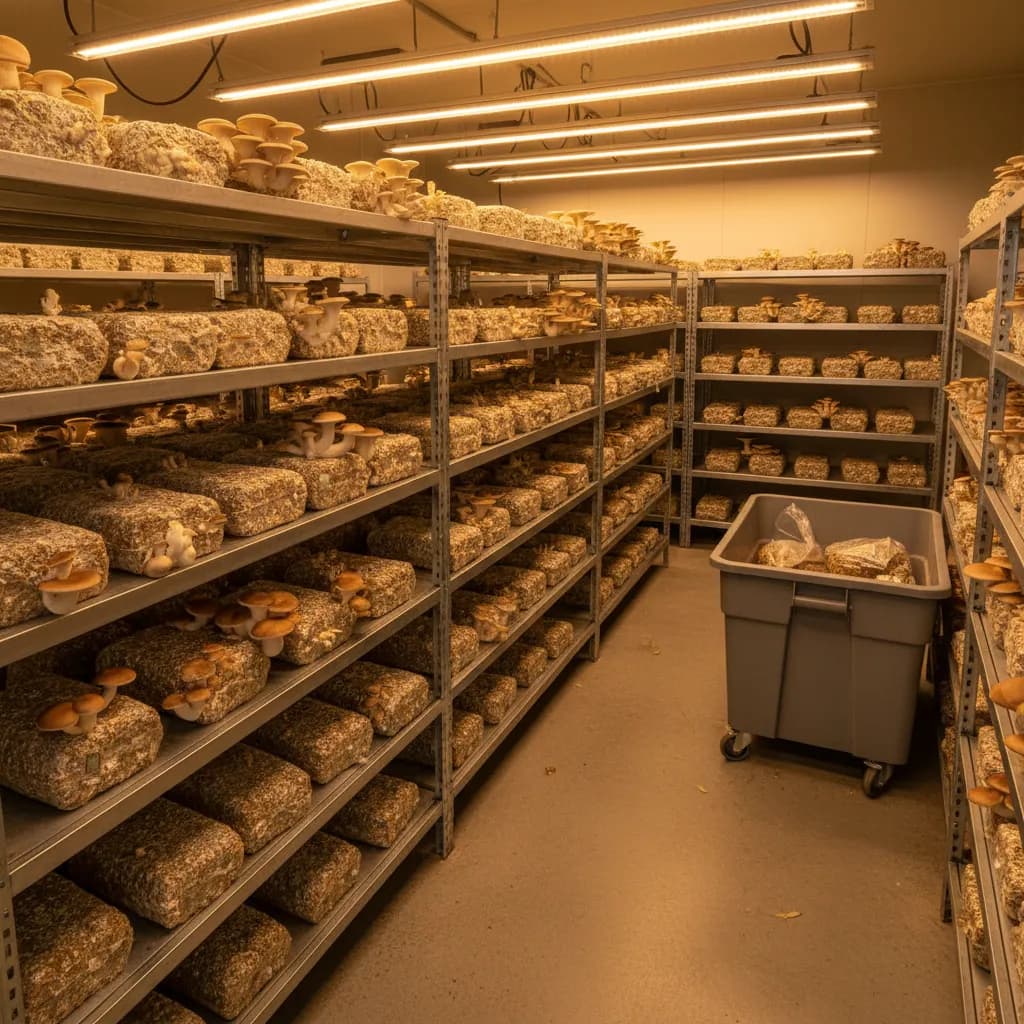
Starting a small mushroom farm at home is one of the most accessible agricultural businesses you can launch. Most successful small farms begin as hobby grows that scaled up gradually, and the transition from growing for yourself to growing for profit follows a predictable path.
The essential steps to get started:
- Master one or two species first — oyster mushrooms are the best starting point because they grow fast, tolerate imperfect conditions, and sell well at farmers markets
- Dedicate a space — convert a spare room, garage, or shed into a grow room with basic environmental controls for humidity, temperature, and fresh air exchange
- Establish a production rhythm — stagger your inoculations so you have blocks fruiting every week rather than all at once
- Start selling locally — farmers markets, restaurants, and word of mouth are the easiest first channels
You do not need to quit your day job to start. Many small farms operate part-time on ten to twenty hours per week and generate meaningful supplemental income. The key is building consistent production before chasing customers — reliability is what earns repeat buyers and restaurant accounts.
A small mushroom farm can be started for as little as one thousand to five thousand dollars, though costs vary widely depending on scale, species, and whether you already have a suitable space.
Typical startup costs for a small operation:
- Flow hood or laminar flow cabinet — $300 to $800 for a DIY build, $1,000 to $2,500 purchased
- Pressure cooker or autoclave — $100 to $400 for a large stovetop model
- Fruiting room setup — $200 to $1,000 for humidifier, fan, controller, and shelving
- Initial substrate and spawn supplies — $200 to $500
- Packaging and labeling — $100 to $300
The biggest variable is your grow space. Converting an existing room or shed costs far less than building a dedicated structure. Many growers start in a spare bedroom and upgrade only after proving demand.
Avoid the trap of over-investing before you have sales. Start with the minimum equipment needed to produce consistent, clean blocks. Reinvest early revenue into better equipment as your production scales. The most common mistake new farm owners make is spending thousands on equipment before confirming they can sell what they grow.
A commercial grow room requires environmental control equipment that maintains precise humidity, temperature, and airflow around the clock. The goal is creating conditions where mushrooms fruit reliably and consistently, batch after batch.
Core equipment for a commercial grow room:
- Humidification system — ultrasonic or high-pressure misting systems that maintain 85 to 95 percent relative humidity
- Fresh air exchange — inline fans with ducting to bring in filtered outside air and exhaust CO2-rich air
- Temperature control — air conditioning or heating depending on your climate and species
- Humidity and temperature controller — an automated controller like an Inkbird or a more advanced system like TrolMaster
- Shelving — stainless steel or plastic wire shelving rated for the weight of fully hydrated blocks
- Lighting — basic LED shop lights on a twelve-hour timer
For the lab and prep area you also need a laminar flow hood, a pressure cooker or sterilizer, and a clean workspace for inoculation. Commercial operations typically separate the lab, incubation, and fruiting areas to minimize cross-contamination and optimize conditions for each stage of the process.
Good grow room design separates your operation into distinct zones, each optimized for a different stage of production. The three essential zones are the clean lab, the incubation room, and the fruiting room.
Design principles for each zone:
- Clean lab — positive air pressure, laminar flow hood, easy-to-sanitize surfaces, minimal foot traffic. This is where you inoculate and do grain-to-grain transfers
- Incubation room — warm (75 to 80 degrees), dark, minimal airflow. Shelving to hold colonizing bags or jars. No humidity control needed
- Fruiting room — high humidity, strong fresh air exchange, indirect lighting, cooler temperatures. This room needs the most environmental control equipment
Critical design considerations:
- Airflow direction — air should flow from clean areas toward less clean areas, never the reverse
- Drainage — fruiting rooms get wet. Sloped floors with a drain prevent standing water and mold buildup
- Insulation — proper insulation reduces energy costs and makes temperature control easier
- Washable surfaces — FRP panels, epoxy-coated walls, or plastic sheeting that you can spray down and sanitize between cycles
Start simple and expand. Many successful farms began with a single room partitioned by plastic sheeting and upgraded to dedicated rooms as revenue grew.
Yes, small-scale mushroom farming can be profitable, but margins depend heavily on your species selection, sales channels, and operational efficiency. Mushrooms command premium prices compared to most produce, and the production cycle is fast — many species go from inoculation to harvest in four to six weeks.
Typical pricing and economics:
- Oyster mushrooms sell for $8 to $16 per pound at farmers markets and $6 to $10 wholesale to restaurants
- Lion's mane commands $10 to $20 per pound retail
- Shiitake typically sell for $8 to $14 per pound
- Cost of production for a five-pound fruiting block runs roughly $2 to $4 in materials, yielding one to two pounds of mushrooms over multiple flushes
The math works when you keep overhead low and sell direct to consumers or chefs. Where small farms struggle is when they try to sell through distributors or grocery stores, where wholesale prices cut deeply into margins.
Profitability also depends on consistency. Restaurants want a reliable weekly supply. Farmers market customers expect you to show up every week. Building a production schedule that delivers steady harvests is more important than maximizing any single batch.
A dedicated small-scale grower can realistically earn $500 to $2,000 per market day depending on the market size, your product variety, and your local customer base. Farmers markets are the highest-margin sales channel available to small mushroom farms because you sell direct to consumers at full retail pricing.
Factors that affect your market revenue:
- Market size and foot traffic — a busy urban market with hundreds of shoppers per day will outsell a small rural market significantly
- Product variety — offering three to five species plus value-added products like dried mushrooms or grow kits increases your average sale
- Presentation — clean, attractive packaging with clear labeling and species information builds trust and repeat customers
- Consistency — showing up every week builds a loyal customer base that plans their shopping around your booth
Realistic weekly production for a one-person operation is twenty to fifty pounds of fresh mushrooms across multiple species. At $10 to $16 per pound retail, that translates to $200 to $800 in gross revenue per market.
The biggest advantage of farmers markets is the direct customer relationship. You get immediate feedback, build brand loyalty, and can test new species or products with minimal risk.
The most profitable species balance strong consumer demand with reasonable production difficulty. Not every gourmet mushroom is worth growing commercially — some species are too finicky, too slow, or too niche to generate reliable revenue.
Top species ranked by commercial viability:
- Blue or pearl oyster mushrooms — fastest production cycle, easiest to grow, strong demand, moderate pricing. The best species to start with commercially
- Lion's mane — commands premium pricing ($12 to $20 per pound), growing consumer awareness driven by wellness trends, moderate difficulty
- Shiitake — established market demand, excellent shelf life compared to oysters, slightly longer production cycle
- King oyster (king trumpet) — high value, excellent shelf life, popular with chefs, but requires supplemented hardwood substrate and more precise fruiting conditions
- Pioppino and chestnut mushrooms — niche species that command premium prices and face almost no competition at local markets
Species to avoid as a beginner commercial grower:
- Maitake and reishi — very long production cycles tie up space and capital
- Morels — extremely difficult to cultivate reliably
- Chanterelles and porcini — not commercially cultivable with current technology
Grow what sells in your market. Talk to local chefs and visit farmers markets before choosing your species lineup.
Licensing requirements for selling mushrooms vary significantly by country, state, and province, but most jurisdictions require some form of food handling permit or business license. The requirements are generally less burdensome than many new growers fear.
Common requirements in the United States:
- Business license — register your farm as a business entity with your state or county
- Cottage food or food handler's permit — many states allow direct sales of fresh produce (including mushrooms) under cottage food laws with minimal licensing
- Health department inspection — some jurisdictions require an inspection of your growing and packing facility
- Farmers market vendor permit — individual markets often require proof of insurance and local permits
In Canada, requirements include:
- CFIA registration if selling across provincial lines or to retailers
- Provincial food safety certification for direct sales
- Municipal business license in your operating jurisdiction
Start by contacting your local health department and your state or provincial agriculture department. They can tell you exactly what permits you need. Many small growers are surprised to learn that selling fresh, whole mushrooms at a farmers market requires minimal paperwork compared to selling processed or value-added food products.
The jump from hobby growing to commercial farming is less about technique and more about systems, consistency, and volume. The actual mushroom-growing skills transfer directly — the challenge is doing everything reliably at scale, week after week.
Key differences between hobby and commercial growing:
- Production schedule — hobbyists grow when they feel like it. Commercial growers run on a strict weekly cycle with staggered inoculations to ensure continuous harvests
- Contamination tolerance — a hobbyist can shrug off a contaminated jar. A commercial grower losing ten percent of production to contamination is losing real revenue
- Equipment — hobbyists use still air boxes and stovetop pressure cookers. Commercial growers need flow hoods, large sterilizers, and automated environmental controls
- Record keeping — tracking spawn dates, substrate recipes, yields per block, and contamination rates becomes essential for optimizing a commercial operation
- Sales and marketing — you need reliable sales channels and the ability to deliver consistent quality and quantity on a schedule
The transition usually happens gradually. Most successful commercial growers spent six to twelve months as serious hobbyists, mastering their technique and building confidence before selling their first pound.
A small, one-person mushroom farm typically produces twenty to fifty pounds of fresh mushrooms per week, depending on the grow room size, species selection, and how efficiently the operation runs. Some well-optimized small farms push seventy-five to one hundred pounds weekly.
Production estimates by grow room size:
- Single spare room (100 to 150 square feet) — 15 to 30 pounds per week with standard shelving
- Dedicated grow room (200 to 400 square feet) — 30 to 75 pounds per week
- Small commercial space (500+ square feet) — 75 to 150+ pounds per week
Factors that affect weekly output:
- Species — oyster mushrooms produce more weight per block than lion's mane or shiitake
- Block size and density — standard five-pound supplemented sawdust blocks yield one to two pounds over their lifetime
- Flush timing — staggering your inoculations so blocks reach fruiting stage on a rolling schedule is the key to consistent weekly production
- Biological efficiency — the percentage of substrate dry weight converted to fresh mushroom weight. Oysters can exceed 100 percent BE on good substrate
Start by calculating backwards from your sales capacity. There is no point producing fifty pounds per week if you can only sell thirty. Match production to demand and scale up as your customer base grows.
From first decision to first sale, most small mushroom farms take three to six months to launch. Rushing this timeline leads to expensive mistakes, while taking too long risks losing momentum and burning through capital before generating revenue.
A realistic startup timeline:
- Month 1 — research species selection, identify your target market, and visit local farmers markets and restaurants to assess demand. Order equipment and begin setting up your grow space
- Month 2 — build out your grow room and lab space. Start your first test batches to dial in your substrate recipes and environmental controls
- Month 3 — run full production cycles with your chosen species. Track contamination rates, yields, and timing. Begin conversations with potential buyers
- Month 4 to 5 — start selling at farmers markets or to restaurants with small, consistent quantities. Refine your packaging and pricing based on customer feedback
- Month 6 — establish a regular production schedule matched to your sales volume
The most common mistake is skipping the test phase. Growers who invest in equipment and commit to market booths before they can reliably produce clean, consistent mushrooms end up stressed and losing money. Prove your process works before making financial commitments.
The best way to find buyers is to show up with a sample and let the mushrooms sell themselves. Chefs and produce managers are always interested in high-quality, locally grown mushrooms — the challenge is proving you can deliver consistently.
Strategies for finding buyers:
- Restaurants — visit during off-peak hours (2 to 4 PM), ask to speak with the chef, and bring a small sample of your freshest product. Follow up weekly with availability lists
- Farmers markets — apply to local markets and build a direct-to-consumer customer base. This is the easiest channel to start with and provides the highest margins
- Grocery stores and co-ops — local and natural food stores are often eager to carry locally grown mushrooms. Start with small independent stores before approaching chains
- Online and social media — post your harvests on Instagram, join local food groups on Facebook, and consider offering subscription boxes or CSA-style shares
Building lasting buyer relationships:
- Be reliable — deliver what you promised, when you promised it
- Communicate proactively — let buyers know your weekly availability in advance
- Offer variety — restaurants love growers who can supply multiple species
Start with two or three accounts and grow from there. It is better to fully supply a few loyal buyers than to stretch yourself thin across many.
The biggest challenges are not growing the mushrooms — they are managing the business around them. Most failed mushroom farms had great growers who underestimated the operational and sales demands of running a food business.
Top challenges commercial mushroom farmers face:
- Contamination at scale — a contamination rate that was tolerable as a hobby becomes devastating when you are relying on production for income. Maintaining sterile technique across hundreds of blocks per month requires discipline and good systems
- Perishability — fresh mushrooms have a shelf life of five to ten days. You cannot stockpile inventory, and unsold product is lost revenue
- Inconsistent demand — restaurant orders fluctuate seasonally, farmers markets have slow weeks, and building reliable sales takes time
- Environmental control costs — heating, cooling, and humidifying a grow room year-round adds up, especially in extreme climates
- Physical labor — mixing substrate, loading pressure cookers, harvesting, and delivering product is physically demanding work
How successful farms overcome these challenges:
- Track everything — contamination rates, yields per batch, revenue per species, and labor hours per pound
- Diversify sales channels — do not depend on a single restaurant or market
- Build systems — standard operating procedures, checklists, and routines reduce errors and contamination
The farms that survive the first year are the ones that treat it as a business from day one, not just a scaled-up hobby.
Scaling up is a gradual process of replacing manual tasks with systems and upgrading equipment as your production volume justifies the investment. The jump from a closet grow to a dedicated room does not have to happen all at once.
Progression from hobby to dedicated grow room:
- Closet stage — shotgun fruiting chamber or monotub, still air box for inoculation, stovetop pressure cooker. Production: one to five pounds per week
- Spare room stage — multiple shelves with a humidifier on a timer, upgraded to a flow hood, larger pressure cooker. Production: five to twenty pounds per week
- Dedicated grow room stage — separated incubation and fruiting areas, automated humidity and fresh air exchange, commercial-grade sterilization. Production: twenty to seventy-five pounds per week
Key upgrades at each stage:
- Still air box to flow hood — the single most impactful upgrade for reducing contamination rates and increasing production speed
- Manual misting to automated humidification — frees up your time and provides more consistent conditions
- Single tub to shelving system — maximizes vertical space and increases capacity without needing more floor area
- Stovetop pressure cooker to large autoclave or multiple cookers — substrate preparation becomes the bottleneck as you scale
Only upgrade when your current setup is genuinely limiting your ability to meet demand. Premature upgrades waste money that could be reinvested in supplies and production.
Food safety certification requirements depend on where you sell and how you process your mushrooms. Selling fresh, whole mushrooms directly to consumers at a farmers market has the lightest requirements, while selling processed products through retail stores involves the most regulation.
Certification landscape by jurisdiction:
- United States — the FDA regulates mushroom farms under the Food Safety Modernization Act (FSMA), but small farms with less than $25,000 in annual sales are often exempt from the Produce Safety Rule. Many states have cottage food exemptions for direct sales. A food handler's certificate is typically required and involves a short course and exam
- Canada — CFIA (Canadian Food Inspection Agency) oversees food safety at the federal level. Provincial regulations vary, but most provinces require Safe Food Handling certification and may require facility inspections for commercial operations
- Local health departments — regardless of federal or state rules, your local health department may have additional requirements for food businesses
Best practices regardless of legal requirements:
- Keep detailed production records — dates, substrate batches, species, and harvest weights
- Maintain a clean facility — even if not legally required, a clean operation prevents issues before they start
- Get liability insurance — most farmers markets require it, and it protects your business
Contact your local agricultural extension office or health department first. They will walk you through exactly what you need for your specific situation and sales channels.
Need more help? Dr. Myco can answer follow-up questions about starting a mushroom farm based on thousands of real growing experiences.
Ask Dr. Myco