Troubleshooting Decision Guides
15 tips in Tools & Calculators
By Andrew Langevin · Founder, Nature Lion Inc · Contributing author, Mushroomology (Brill, 2026)
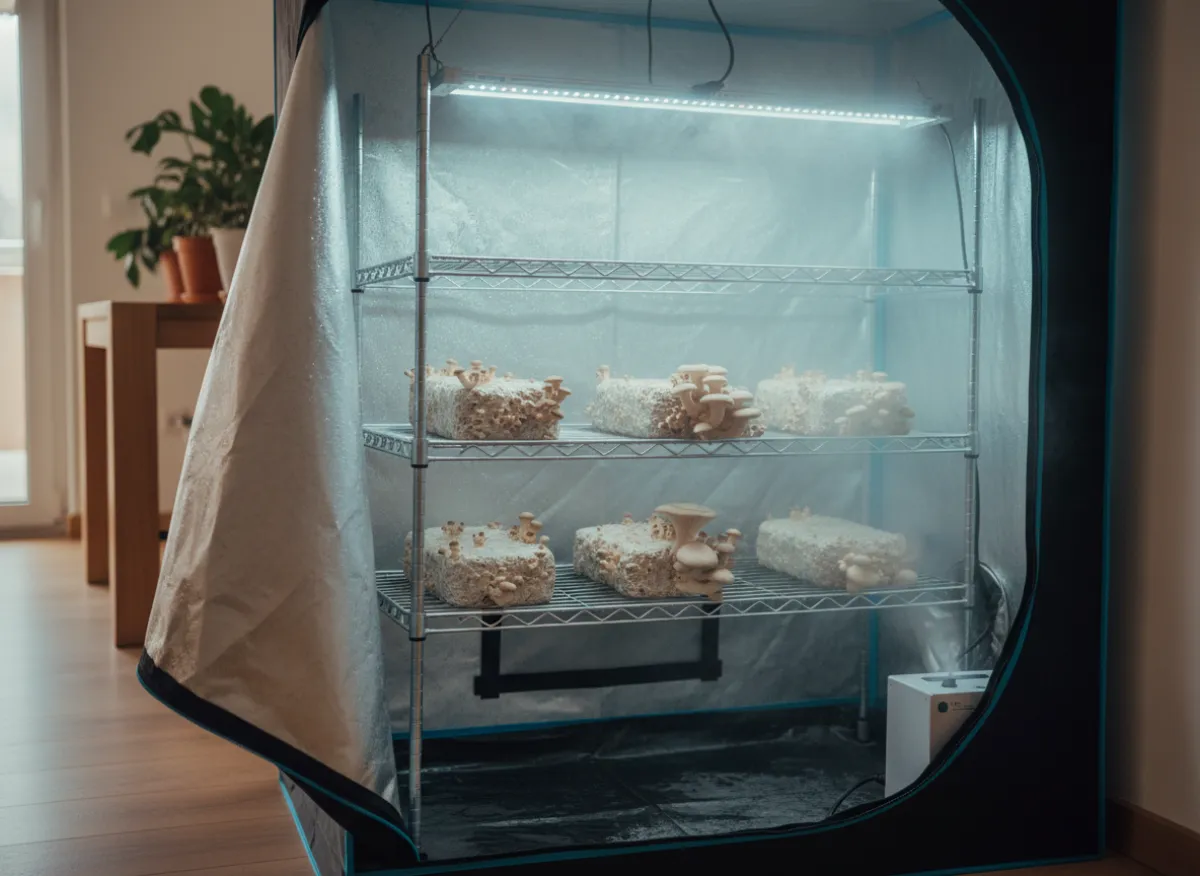
When colonization stalls, work through this decision tree to identify the problem. Start with the most common causes and rule them out one by one.
Check temperature first:
- Is your substrate stored at the correct colonization temperature for your species? Most gourmet species need 21-24C (70-75F). Too cold slows growth dramatically; too hot can kill mycelium.
Check moisture:
- Is the substrate at field capacity? Squeeze a handful — you should get 1-2 drops of water. Too wet causes bacterial contamination that outcompetes mycelium. Too dry stalls growth entirely.
Check your spawn:
- Was the spawn healthy and fully colonized when you used it? Old, weak, or contaminated spawn cannot colonize effectively.
- Did you use enough spawn? A spawn rate below 10% can lead to very slow colonization.
Check for hidden contamination:
- Smell the container — sour, sweet, or chemical odors indicate bacterial or mold contamination even if you cannot see it yet.
Check gas exchange:
- Are your filter patches or micropore tape intact and unblocked? Mycelium needs oxygen to grow. A completely sealed container with no gas exchange will stall.
Long stems with undersized caps is one of the most recognizable problems in mushroom cultivation. The cause is almost always elevated CO2 levels — your mushrooms are not getting enough fresh air exchange (FAE).
Why this happens:
- Mushrooms are aerobic organisms that consume oxygen and produce CO2
- When CO2 builds up in the fruiting environment, the mushroom "reaches" upward with an elongated stem, trying to find fresh air for spore dispersal
- The cap stays small because the mushroom is investing energy in stem growth instead
How to fix it:
- Increase fresh air exchange immediately — fan more often, open more holes, or increase fan speed
- Target CO2 levels below 800 ppm for most gourmet species
- If using a monotub, crack the lid more or remove polyfill from holes
- If using a Martha tent, increase fan-on time or add a second fan
Other possible causes:
- Insufficient light — mushrooms use light to orient growth direction. Provide 12 hours of indirect light
- Genetics — some strains naturally produce longer stems (especially king oyster, where this is desirable)
Mushrooms already showing this deformity will not correct themselves. Fix the environment and wait for the next flush.
Healthy grain spawn should smell earthy, mushroomy, or have no strong odor at all. Any off-smell is a warning sign that needs immediate attention.
Decision guide by smell type:
- Sour or vinegary smell — bacterial contamination, most commonly from wet grain or insufficient sterilization. Discard the jar. Bacteria are nearly impossible to eliminate once established in grain.
- Sweet or yeasty smell — yeast contamination. Discard. Yeast competes directly with mycelium for sugars.
- Alcohol smell — fermentation from anaerobic conditions. Your grain was likely too wet or packed too tightly with no gas exchange. Discard.
- Mild earthy or mushroomy smell — this is normal and healthy. No action needed.
- No smell at all — also normal, especially early in colonization.
Prevention for future batches:
- Ensure grain is properly dried after soaking — surface should be matte, not shiny
- Do not overfill jars — leave 1-2 inches of headspace
- Verify your pressure cooker reaches 15 PSI and maintain it for the full sterilization time
- Shake jars after sterilization to prevent grain from clumping into an anaerobic mass
When in doubt, trust your nose. If it smells wrong, it is wrong.
Green is the color cultivators dread most. Trichoderma is the most common green contaminant, but not all green growth is Trichoderma. Here is how to tell what you are dealing with.
Trichoderma identification:
- Starts as white mycelium that turns bright green within 24-48 hours as it sporulates
- Has a powdery, dusty texture when mature
- Spreads aggressively — can overtake a plate or substrate in days
- Often appears at the substrate surface near areas of poor colonization
Other green contaminants:
- Penicillium — blue-green with concentric rings, powdery texture, slower spreading than Trichoderma
- Aspergillus — olive green to dark green, powdery, can appear in dense colonies
What to do:
- If it is on grain spawn — discard immediately. Do not open the jar indoors.
- If it is on a fruiting block or monotub — discard the entire container. Do not try to cut out the green section; invisible spores have already spread throughout.
- If it is on an agar plate — you may be able to rescue clean mycelium from the opposite edge by transferring to a fresh plate.
After any Trichoderma encounter, deep-clean your workspace with a 10% bleach solution. Trichoderma spores are persistent and can contaminate future grows.
Cloudiness in liquid culture can indicate either healthy growth or contamination. The key is understanding what type of cloudiness you are seeing.
Healthy signs:
- Wispy, cotton-like clouds or floating clumps of mycelium suspended in otherwise clear broth — this is normal mycelial growth
- Slight haziness immediately after shaking — this is just disturbed mycelium settling
- Visible strands or balls of white growth attached to the bottom or sides of the jar
Contamination signs:
- Uniform cloudiness throughout the entire liquid with no visible mycelial structures — this strongly suggests bacterial contamination
- Yellow, orange, or off-colored liquid
- Any slimy film on the surface
- Foul or sour smell when the lid is cracked briefly
- Bubbles forming without agitation (gas-producing bacteria)
What to do if you are unsure:
- Test on agar before using. Drop a small amount of the LC onto an agar plate and wait 3-5 days. Clean mycelium will grow outward from the drop. Bacterial contamination will show as slimy, wet, or discolored growth.
- Never inject questionable LC directly into grain — if it is contaminated, you lose the grain too.
Prevention: always sterilize LC media at 15 PSI for 20-30 minutes, use a magnetic stir plate to promote healthy mycelial growth, and test every batch on agar before deployment.
Multiple organisms on a single agar plate is common when working with clones, wild samples, or spore inoculations. Your goal is to rescue the clean mycelium and leave the contaminants behind.
Step-by-step rescue protocol:
- Identify your target mycelium — it should be white and growing outward from the inoculation point in a consistent pattern
- Locate the leading edge of the mycelium that is furthest from any contamination
- Using a flame-sterilized scalpel, cut a tiny wedge (3-5mm) from the very tip of the clean leading edge
- Transfer it to a fresh agar plate, placing it in the center
- Seal with parafilm and label with the transfer number
Decision points:
- If contamination is far from the mycelium (opposite side of the plate) — rescue is very likely to succeed in 1-2 transfers
- If contamination is close to or touching the mycelium — rescue is possible but may take 3-5 transfers to fully clean
- If contamination is growing faster than the mycelium — rescue is unlikely. Start over with a fresh sample or use antibiotic agar to slow bacterial contaminants
For tissue clones from wild or store-bought mushrooms, expect contamination on the first plate. This is normal. Plan for at least 2-3 cleanup transfers when cloning from non-sterile sources.
Pin abortion — where primordia form but then stop growing and turn brown, yellow, or black — is one of the most frustrating problems in mushroom cultivation. The cause is almost always an environmental fluctuation during the critical pinning stage.
Most common causes and fixes:
- Humidity drop — even a brief dip below 80% RH can abort pins. Mushroom pins have no protective layer and desiccate rapidly. Fix: stabilize humidity at 85-95% using a humidifier with a controller, not manual misting.
- Temperature swing — a sudden rise or fall of more than 5C can shock developing pins. Fix: maintain consistent temperature throughout the fruiting cycle.
- Insufficient FAE — pins need oxygen to develop. CO2 buildup causes selective pin abortion. Fix: increase fresh air exchange.
- Contamination — bacterial blotch or competing mold can kill pins. Look for slimy spots or off-colors near the aborted pins.
Less common causes:
- Too many pins — the mycelium cannot support all primordia and selectively aborts the weakest ones. This is actually natural and not a problem if only some pins abort.
- Substrate exhaustion — on later flushes, the substrate may lack the energy to support all pins.
Aborted pins will not recover. Remove them gently to prevent them from becoming contamination sites, maintain stable conditions, and wait for the next pin set.
Yes, in most cases you can correct overly wet substrate before it causes serious problems. The sooner you catch it, the better your chances of saving the grow.
Before colonization (during preparation):
- Spread the substrate on clean towels or a wire rack and let it air-dry for 30-60 minutes, mixing periodically
- Add dry material to absorb excess moisture — dry vermiculite, dry coir, or dry sawdust work well
- Re-test with the squeeze test after each adjustment until you get 1-2 drops
During colonization (already inoculated):
- If grain spawn is too wet, there is no reliable fix — excess moisture breeds bacteria. Prevention is key. Drain and dry grain thoroughly before loading jars.
- If bulk substrate is slightly too wet, crack the lid to allow some evaporation and check daily
- If water is pooling at the bottom of a bag or tub, tilt the container to drain excess water through a small opening
During fruiting:
- Reduce misting frequency or duration
- Increase FAE to promote evaporation from the surface
- Blot standing water with a clean paper towel if pools form on the substrate surface
Signs that wet substrate has become a lost cause:
- Sour or anaerobic smell
- Slimy, wet bacterial spots
- Mycelium turning yellow or brown in waterlogged areas
In these cases, discard and start fresh with better moisture control.
Small beads of moisture on the substrate surface are normal and healthy — they are called metabolic water or hyphal knot exudates. However, standing pools of water are a problem that needs correction.
Normal (no action needed):
- Fine mist or tiny droplets covering the surface evenly
- Small beads of clear or slightly yellow liquid forming on top of mycelium — this is mycelial exudate ("myc piss") and is a sign of active metabolism
- Light condensation on the tub walls and lid
Problematic (needs correction):
- Visible pools or puddles of water sitting on the substrate surface — this creates anaerobic conditions and invites bacterial contamination
- Water dripping heavily from the lid onto the substrate — excessive condensation
- The substrate surface looks soaked or waterlogged
How to fix pooling water:
- Increase FAE — more air exchange promotes evaporation. Crack the lid wider or fan more frequently.
- Reduce misting — you may be adding too much water during your misting routine
- Blot large pools gently with a clean paper towel
- Tilt the tub slightly to encourage drainage toward one corner, then soak up the collected water
- If condensation is dripping from the lid, wipe the lid dry and consider flipping it or propping it at a slight angle
Standing water is a breeding ground for bacteria and can cause overlay (a thick, matted mycelial layer that resists pinning). Address it promptly.
A fully colonized block that refuses to pin is a common frustration. Work through each item on this checklist systematically — the solution is usually one or two environmental adjustments.
Fruiting conditions checklist:
- Temperature — Is it within the fruiting range for your species? Many species need a drop of 5-10C from colonization temps to trigger pinning.
- Humidity — Is it consistently 85-95% RH? Low humidity is the number one reason blocks fail to pin.
- FAE — Are you providing enough fresh air? Drop CO2 below 800 ppm.
- Light — Is the block receiving at least 12 hours of indirect light? Mushrooms use light as a directional cue for fruiting.
Substrate and spawn factors:
- Is the block truly fully colonized? Partially colonized blocks may not fruit. Check for uncolonized patches.
- Spawn age — Old or senescent spawn may colonize substrate but lack the vigor to fruit.
- Overlay — Is the surface covered by a thick, matted layer of tomentose mycelium? Overlay blocks pins from forming. Fix by gently scratching the surface with a sterile fork ("fork tek") to break the mat.
Species-specific triggers:
- Shiitake — Requires a cold shock and physical stress (slapping or soaking the block in cold water for 12-24 hours)
- King oyster — Needs cold temperatures (12-16C) and high CO2 initially, then increased FAE
- Lion's mane — Needs a cut or opening in the bag to pin from. Will not fruit through a sealed surface.
Verifying that your pressure cooker reaches and maintains 15 PSI (103 kPa) is essential — understerilized substrates and grain are the leading cause of contamination. Different types of pressure cookers indicate pressure differently.
Weighted gauge (jiggle-top) pressure cookers:
- These use a weighted rocker or regulator that sits on the steam vent
- At 15 PSI, the weight should rock steadily — rocking 1-4 times per minute for most models
- If the weight is silent and not rocking, pressure has not been reached
- If the weight is rocking violently and constantly, pressure may be too high — reduce heat slightly
Dial gauge pressure cookers:
- Read the pressure directly from the dial
- Dial gauges should be tested for accuracy annually — they can drift over time. Your local agricultural extension office often tests them for free.
- If the gauge reads 15 PSI but you are still getting contamination, the gauge may be inaccurate
General verification tips:
- It typically takes 15-30 minutes for a loaded pressure cooker to reach full pressure after the water boils
- Start your sterilization timer only after full pressure is reached, not when you turn on the heat
- At high altitudes (above 300m / 1000 ft), add 5 minutes of sterilization time per 300m of elevation because the boiling point of water decreases
- Never attempt to use a pressure cooker without the sealing gasket — it will not reach pressure
A mild earthy or mushroomy smell in your grow room is completely normal — but a strong musty, moldy, or sour smell is a warning sign. Learning to distinguish between healthy and problematic smells is an important cultivation skill.
Normal smells:
- Earthy, forest-floor scent — this is healthy mycelium doing its job, breaking down substrate and producing metabolites
- Fresh mushroom smell — especially strong during active fruiting
- Slightly sweet smell — some species (like oyster mushrooms) produce a faintly sweet, anise-like aroma
Warning smells:
- Strong musty or moldy smell — may indicate mold contamination in one or more containers. Inspect all grows carefully for green, black, or off-colored growth.
- Sour or vinegary smell — bacterial contamination. Check grain spawn and substrate for wet, slimy patches.
- Ammonia smell — substrate may be too high in nitrogen or not properly composted.
Action plan if the smell is concerning:
- Inspect every container individually — open and sniff each one. Isolate or discard any contaminated grows.
- Increase ventilation in the room to prevent spore buildup
- Check your humidifier reservoir for bacterial buildup — clean it with a dilute hydrogen peroxide solution weekly
- Wear a respirator when inspecting grows if mold contamination is suspected. Mold spores can cause respiratory issues with repeated exposure.
Mushroom deformities are almost always environmental in origin. Each type of deformity points to a specific problem, making diagnosis straightforward once you know what to look for.
Common deformities and their causes:
- Long stems, tiny caps — insufficient FAE (high CO2). Increase fresh air exchange immediately.
- Caps curling upward or cracking — humidity too low. The mushroom is drying out faster than it can grow. Increase humidity to 90-95%.
- Fuzzy white growth at the base of stems — insufficient FAE. The fuzzy growth is aerial mycelium trying to capture oxygen.
- Rosette or coral-like growth instead of normal caps — extreme CO2 buildup, sometimes combined with high humidity. Dramatically increase ventilation.
- Yellow or brown spots on caps — bacterial blotch, caused by water sitting on cap surfaces. Reduce misting frequency and improve air circulation.
- Splitting or cracked caps — rapid humidity fluctuations. Stabilize your environment.
- Extremely small mushrooms that mature early — substrate exhaustion, typically on later flushes. The mycelium lacks energy for full-sized fruits.
- Wavy, irregular cap margins — often genetic rather than environmental. Some strains naturally produce wavy caps.
Multiple deformities appearing simultaneously usually means multiple environmental parameters are off. Start by fixing FAE and humidity — these two factors account for the majority of deformity issues.
Fungus gnats and sciarid flies are the most common pests in mushroom cultivation, but other insects like mites and springtails can also appear. Acting quickly prevents a small problem from becoming an infestation that destroys your grows.
Identification:
- Fungus gnats — tiny (2-3mm) dark flies that hover around the substrate surface. Their larvae feed on mycelium and can devastate colonizing blocks.
- Sciarid flies — similar to fungus gnats, slightly larger. Same damage pattern.
- Mites — microscopic to barely visible dots moving on the substrate or mushroom surface. Often appear as a fine dust that moves.
- Springtails — tiny white or gray jumping insects. Generally less harmful than gnats but still unwanted.
Immediate actions:
- Yellow sticky traps — place near fruiting chambers to catch adult flies. This reduces the breeding population.
- Cover all openings with fine mesh or filter material — prevent new insects from entering.
- Harvest any mature mushrooms immediately before insects damage them.
Longer-term solutions:
- Bacillus thuringiensis var. israelensis (BTI) — a biological larvicide safe for use around mushrooms. Add to your humidifier reservoir or apply as a drench.
- Diatomaceous earth around the base of your setup (not on substrate) as a barrier.
- Screen all intake vents with fine mesh (no larger than 0.5mm).
- Maintain a clean grow space — remove spent substrate promptly, as it attracts pests.
Spawn can survive shipping stress better than you might expect, but you need to assess it carefully before committing it to substrate. Here is how to evaluate whether your spawn is still usable.
Visual assessment:
- Dry but still white and intact — likely viable. Mycelium is resilient and can recover from dehydration. Proceed with inoculation but use a slightly higher spawn rate (20-25% instead of 15%).
- Broken up or crumbly — usually fine. Grain spawn does not need to be in one solid piece. Shake it up and use as normal.
- Discolored (yellow, brown, or gray) — concerning but not necessarily dead. Yellow can indicate stress metabolites ("myc piss"), which is a survival response. Brown or gray may indicate the spawn is old or heat-damaged.
- Green, black, or orange patches — contaminated. Do not use. Contact the supplier for a replacement.
- Sour or off smell — bacterial contamination from heat damage during shipping. Do not use.
The agar test (recommended for questionable spawn):
- Place a few grains on an agar plate and wait 3-5 days
- If clean white mycelium grows outward, the spawn is viable
- If bacteria or mold appear instead, the spawn is compromised
Prevention tips:
- Order spawn during mild weather when possible — extreme heat or cold during shipping is the biggest risk
- Request express shipping and ask the supplier about their packaging practices
- Use spawn within 1-2 weeks of arrival for best results. Refrigerate at 2-8C if you cannot use it immediately.
Need more help? Dr. Myco can answer follow-up questions about troubleshooting decision guides based on thousands of real growing experiences.
Ask Dr. Myco