Uncle Ben's Tek
12 tips in Teks & Methods
By Andrew Langevin · Founder, Nature Lion Inc · Contributing author, Mushroomology (Brill, 2026)
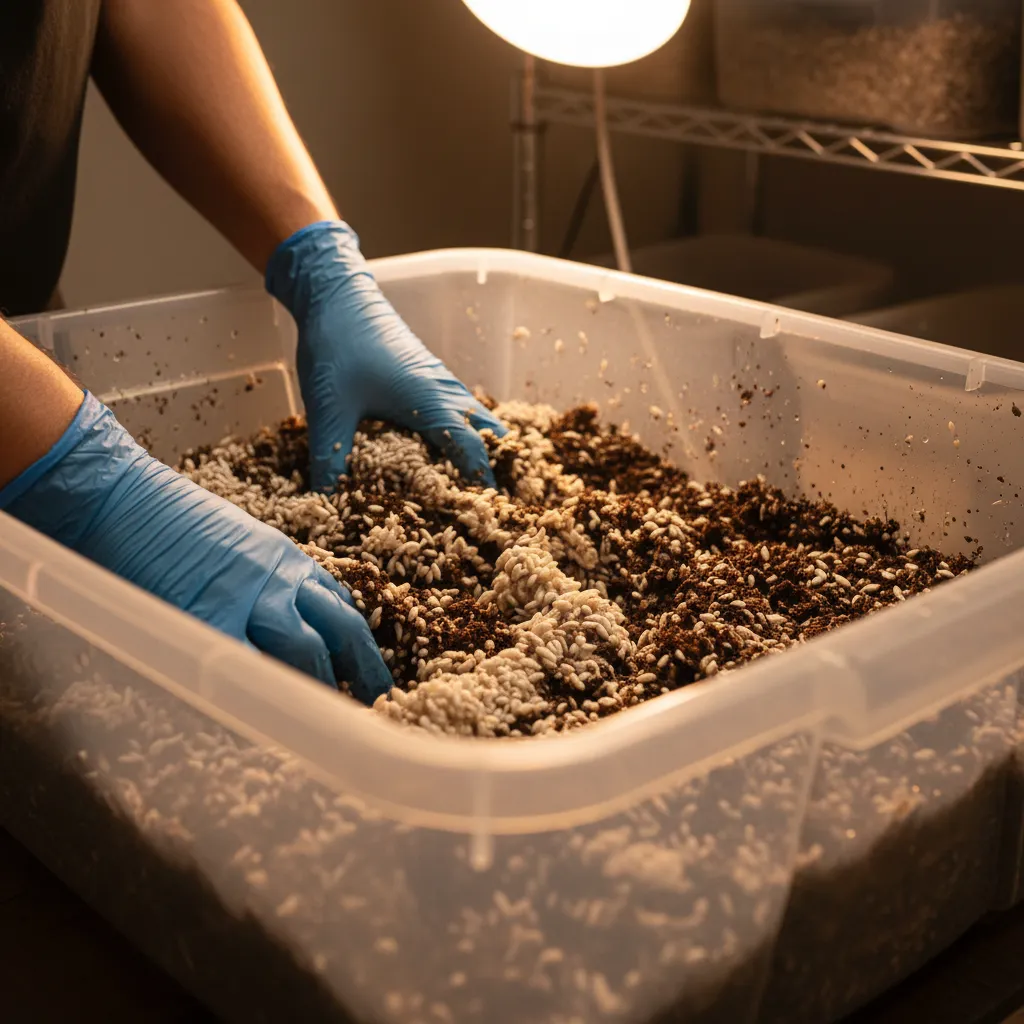
Uncle Ben's Tek (also called UB Tek or Spiderman Tek) is a mushroom cultivation method that uses pre-cooked, pre-sterilized bags of brown rice as a ready-made grain spawn substrate. Instead of preparing, hydrating, and pressure-cooking your own grain, you simply inject spore or liquid culture solution directly into the sealed rice bag through a small hole.
The method was popularized on Reddit and has become one of the most accessible entry points into mushroom cultivation because it eliminates the need for a pressure cooker entirely.
Why it works:
- The rice is already cooked and sterilized during manufacturing — the sealed bag is essentially a pre-made grain jar
- The bag provides a self-contained sterile environment once sealed with micropore tape
- The nutritional profile of brown rice supports mycelial growth well
Why beginners love it:
- No pressure cooker needed (saves $40-100)
- No grain preparation (saves hours of soaking, simmering, drying)
- Available at every grocery store for $2-3 per bag
- Minimal equipment: just a syringe, micropore tape, and a flame
- Low cost of failure — losing a $2 bag to contamination is far less discouraging than losing a batch of grain jars
The trade-off is a lower success rate compared to properly prepared grain, but the accessibility makes it worthwhile for first-time growers.
Uncle Ben's Ready Rice works for mushroom cultivation because of how it is manufactured. The rice undergoes commercial retort sterilization — the same process used for canning food. Here is what happens during manufacturing:
- Raw rice is loaded into the pouch
- The pouch is sealed completely
- The sealed pouch is heated to 121°C (250°F) under pressure — identical to what a pressure cooker does to grain jars
- This kills all bacteria, mold spores, and competing organisms inside the sealed package
The result is a sterile, pre-hydrated grain substrate in a convenient sealed package. As long as the seal remains intact, the rice inside is contaminant-free.
Why brown rice specifically:
- Brown rice retains the bran layer, which provides more nutrients (nitrogen and minerals) than white rice
- The texture is firm enough to resist turning into mush during colonization
- The moisture content is approximately 60-65% — close to ideal for mycelial growth
Important caveats:
- Only use the plain brown rice variety — not flavored, seasoned, or mixed varieties
- Off-brand versions work too — the key is pre-cooked plain brown rice in sealed pouches
- The original Uncle Ben's brand pouches have a clear window that lets you monitor colonization without opening the bag, which is a useful feature other brands may not have
Inoculation is the most critical step in Uncle Ben's Tek. Work in a still air box (SAB) for best results, though some growers succeed with just a clean room and minimal airflow.
Steps:
- Sanitize your workspace — wipe everything with 70% isopropyl alcohol.
- Prepare the bag — wipe the outside of the Uncle Ben's bag with an alcohol wipe. Let it dry.
- Shake the syringe vigorously for 10-15 seconds to distribute spores or LC evenly.
- Flame-sterilize the needle until it glows red. Let it cool for 10 seconds.
- Inject through the bag — push the needle through the top center of the bag (opposite the clear window). Inject 0.5-1cc of solution.
- Cover the injection hole immediately with a small piece of micropore tape.
- Create a gas exchange (GE) point — cut a small corner off the top of the bag (about 1/4 inch) and cover with micropore tape. This allows the mycelium to breathe.
- Wipe the injection area once more with alcohol.
Alternative capri sun method:
Instead of injecting through the top, some growers push the needle directly through the front of the bag near the bottom, similar to inserting a straw into a juice pouch. This places the spores closer to the rice. Cover the hole with micropore tape.
Process all bags in one session to minimize exposure time. A single 10cc syringe should inoculate 10-20 bags at 0.5-1cc each.
There are two main injection strategies for Uncle Ben's bags, and the choice affects contamination rates and colonization speed.
Method 1 — Top injection with corner cut GE (most popular):
- Inject through the top center of the bag (the sealed seam area)
- Cut a small corner (1/4 inch) off the top of the bag on the opposite side
- Cover the corner cut with micropore tape for gas exchange
- This separates the injection point from the GE point, reducing contamination risk
Method 2 — Capri Sun injection with corner cut GE:
- Inject through the front middle of the bag, pushing the needle straight through the plastic
- This places spores directly into the center of the rice mass
- Cut the corner for GE as above
- Faster colonization because spores contact more rice immediately
Method 3 — Hole punch method:
- Use a single hole punch to create a clean GE hole at the top of the bag
- Cover with micropore tape
- Inject through the tape-covered hole
- This creates the cleanest opening with no ragged plastic edges
Gas exchange is critical. Without adequate GE, the bag fills with CO2 and mycelium growth stalls or the bag inflates like a balloon. The corner cut covered with micropore tape provides the best balance of gas exchange and contamination protection.
Tape tip: Use genuine 3M micropore tape — generic surgical tapes vary in pore size and may either block too much air or allow contaminants through.
Gas exchange (GE) allows oxygen in and CO2 out — both essential for healthy mycelial growth. Without GE, the sealed bag becomes anaerobic and mycelium stalls or dies.
Corner cut method (standard):
- Using clean scissors wiped with alcohol, cut a small triangle off one top corner of the bag — approximately 1/4 to 1/2 inch per side.
- Immediately cover the opening with a piece of micropore tape folded over the corner. Apply tape to both front and back surfaces so the opening is completely sealed by the tape filter.
- Press the tape firmly to ensure adhesion.
How much to cut: The opening should be about the size of a pencil eraser. Bigger is not better — larger openings increase contamination risk without proportional GE benefit.
Alternative GE methods:
- Hole punch: Use a standard office hole punch to punch 1-2 holes near the top of the bag. Cover with micropore tape. Clean and precise.
- Needle holes: Poke 4-6 needle holes through the top of the bag. No tape needed if holes are small enough — the rice bag plastic self-seals slightly around needle holes. Less reliable GE.
- Chip clip with gap: Fold the top of the bag over and clip it, leaving a small gap. Crude but functional.
Common GE mistakes:
- Too many or too large openings — dramatically increases contamination risk
- Tape falling off — check bags daily for the first few days; high humidity environments can loosen adhesive
- No GE at all — bags swell with CO2, rice ferments, mycelium dies. If your bags are puffing up like balloons, GE is insufficient.
The ideal injection volume for Uncle Ben's bags is 0.5-1cc per bag. This is significantly less than what most beginners expect, and using too much is one of the most common mistakes.
Why less is more:
- Each bag contains only 250g of rice — a small amount of substrate
- Excess liquid raises the moisture content beyond what the rice can handle
- Wet rot (bacterial contamination caused by excess moisture) is the number one cause of Uncle Ben's Tek failure
- The rice is already at optimal moisture from manufacturing — adding more than 1cc pushes it over the edge
Recommended amounts:
- Liquid culture (LC): 0.5cc per bag. LC is already active mycelium and colonizes much faster than spores, so you need very little.
- Spore syringe: 0.75-1cc per bag. Spores need more volume because germination rates vary, but do not exceed 1cc.
- Spore print to syringe: If you made your own syringe from a spore print, 1cc is fine — homemade syringes tend to have lower spore density.
Syringe efficiency:
A standard 10cc syringe gives you: - At 0.5cc per bag: 20 bags (LC) - At 0.75cc per bag: 13 bags (spore syringe) - At 1cc per bag: 10 bags (spore syringe)
If bags seem too wet after injection: Stand the bag upright with the GE corner at the top. Gravity pulls excess moisture down and away from the GE opening, reducing bacterial contamination risk at the exchange point.
Uncle Ben's bags typically take 14-21 days to fully colonize, though this varies significantly based on temperature and inoculant type.
Colonization timeline:
- Days 1-5: No visible change. Spores germinate or LC mycelium recovers from injection.
- Days 5-10: First signs of white mycelium visible through the clear window (if using a brand with a window). Looks like small white patches or a faint white haze in the rice.
- Days 10-14: Mycelium spreads through the rice. When viewed through the window, 30-50% appears white.
- Days 14-21: Full colonization. The entire bag feels firm and the rice visible through the window is completely white.
Temperature range:
- Optimal: 21-26°C (70-79°F)
- Minimum: 18°C (65°F) — colonization slows dramatically below this
- Maximum: 29°C (84°F) — above this, bacterial contamination risk increases sharply
- Sweet spot: 24°C (75°F) — balances colonization speed with contamination resistance
How to check progress without opening:
- View through the clear window (Uncle Ben's brand)
- Gently squeeze the bag — colonized areas feel firm and solid, uncolonized areas feel soft and loose like individual grains
- Smell test — hold the GE corner to your nose. Healthy mycelium smells earthy or like fresh mushrooms. Sour, sweet, or yeasty smells indicate bacterial contamination.
Do not open bags to check progress. Feel and observe through the package only.
Break and shake is a technique where you physically break up the colonized rice and redistribute it throughout the bag to speed up colonization. It is effective but risky.
When to break and shake:
- At approximately 30% colonization — when about one-third of the bag feels firm through the plastic
- Never before 20% — the mycelium is not established enough to recover from the disturbance
- Never after 70% — at this point, natural colonization will finish soon and breaking up the network risks more than it helps
How to break and shake:
- Wash your hands and wipe the outside of the bag with alcohol.
- Gently massage the bag to break apart the colonized chunk into individual grains.
- Shake the bag to distribute the colonized grains evenly throughout the uncolonized rice.
- Reshape the bag so rice is spread evenly and the GE corner is positioned at the top.
- Return to your colonization area.
The trade-off:
- Benefit: Can cut remaining colonization time by 30-50% because each broken fragment becomes a new colonization point
- Risk: Every break-and-shake introduces stress and a small chance of contamination entering through the GE point or any micro-tears in the bag
Should you break and shake? For beginners, skip it. The time savings (3-5 days) is not worth the added contamination risk. For experienced growers with good technique, break and shake at 30% colonization can be a useful time-saver, especially when working with slow-colonizing genetics.
The typical success rate for Uncle Ben's Tek is 60-70% for beginners, meaning 3-4 out of every 5 bags will fully colonize without contamination. Experienced growers can push this to 80-90% with refined technique.
Why the success rate is lower than traditional grain:
- The bag material is thin and punctured during inoculation, creating potential contamination entry points
- Pre-cooked rice has higher moisture content than properly prepared grain, creating a more bacteria-friendly environment
- GE openings sealed with tape are less reliable than self-healing injection ports or micropore-filtered jar lids
- No visual inspection possible before inoculation — you cannot verify sterility like you can with clear grain jars
How to improve your success rate:
- Use liquid culture instead of spore syringes — LC colonizes 2-3x faster, leaving less time for contaminants
- Inject 0.5cc maximum — excess moisture is the number one cause of wet rot
- Work in a SAB — even a simple plastic tote reduces airborne contamination dramatically
- Use genuine 3M micropore tape — cheap alternatives have inconsistent pore sizes
- Store inoculated bags upright with GE at the top — keeps moisture away from the exchange point
- Maintain 24°C (75°F) — not too hot, not too cold
- Inoculate 50% more bags than you need — plan for losses. If you need 3 bags of spawn, inoculate 5.
The built-in failure rate is the trade-off for not needing a pressure cooker. Embrace it as part of the process rather than fighting it.
Once your Uncle Ben's bags are fully colonized (100% firm, white throughout), they are ready to be spawned to a bulk substrate for fruiting.
Step-by-step process:
- Prepare your bulk substrate — the most common is CVG (coco coir, vermiculite, gypsum). Hydrate one 650g brick of coco coir with 4 quarts of boiling water in a 5-gallon bucket. Add 2 quarts of vermiculite and 1/2 cup of gypsum. Seal the bucket and wait 2-4 hours until cooled to room temperature.
- Prepare your container — a 6-quart shoebox tub works perfectly with 1-2 Uncle Ben's bags. A 15-quart tub works with 2-3 bags. Line with a black trash bag if desired.
- Open the bags — tear or cut the top of each bag open and break the colonized rice block into individual grains into the tub.
- Add substrate — add CVG substrate and mix thoroughly with gloved hands. Target a 1:2 to 1:3 spawn-to-substrate ratio by volume.
- Level the surface to a depth of 2-4 inches.
- Add a thin casing layer of plain CVG on top (1/4 inch).
- Close the lid and place in a dark area at 21-27°C for colonization.
How many bags per tub?
- 6-quart shoebox: 1-2 bags
- 15-quart tub: 2-3 bags
- 32-quart tub: 3-4 bags
- 66-quart monotub: 5-8 bags
Colonization of the bulk substrate takes another 7-14 days before introducing fruiting conditions.
Understanding common failures helps you troubleshoot problems and improve your success rate with each subsequent attempt.
Failure 1 — Wet rot (most common): - Symptoms: Sour smell, slimy rice, yellow/brown discoloration, no mycelium growth - Cause: Too much liquid injected (over 1cc) or insufficient GE - Fix: Inject 0.5cc maximum. Ensure GE corner is open and taped properly. Store bags upright.
Failure 2 — Contamination (green, black, or orange mold): - Symptoms: Colored patches visible through the window - Cause: Poor sterile technique during inoculation or contaminated syringe - Fix: Work in a SAB. Flame-sterilize needle between every bag. Use alcohol on all surfaces.
Failure 3 — No growth after 3 weeks: - Symptoms: Rice looks unchanged, no white mycelium, no smell - Cause: Dead spores, temperature too low, or syringe was empty/contaminated - Fix: Verify syringe viability by inoculating an agar plate first. Maintain 21-26°C.
Failure 4 — Bag inflating like a balloon: - Symptoms: Bag puffs up with gas - Cause: Bacterial fermentation producing CO2, or insufficient GE - Fix: If caught early, add more GE holes with micropore tape. If the bag smells sour, discard it.
Failure 5 — Stalled colonization at 50-80%: - Symptoms: Mycelium stops advancing - Cause: GE restricted, temperature fluctuations, or weak genetics - Fix: Check GE tape for blockage. Stabilize temperature. Consider a gentle break and shake.
General rule: If a bag smells sour, sweet, or alcoholic rather than earthy, discard it immediately. Do not open contaminated bags indoors.
Several cultivation methods skip the pressure cooker. Here is how Uncle Ben's Tek stacks up against the alternatives:
Uncle Ben's Tek: - Cost per bag: $2-3 - Success rate: 60-70% - Prep time: 5 minutes per bag - Colonization: 14-21 days - Best for: Absolute beginners, small test runs
Broke Boi Tek (steam-sterilized grain): - Cost per jar: $1-2 - Success rate: 75-85% - Prep time: 3-4 hours (soaking, simmering, jarring, steaming) - Colonization: 10-18 days - Best for: Budget-conscious growers willing to invest time
Bucket Tek (pasteurized straw): - Cost per bucket: $15-20 - Success rate: 80-90% - Prep time: 2-3 hours - Colonization: 14-21 days - Best for: Oyster mushrooms only, outdoor-friendly
Oven Tek (oven-sterilized substrate): - Cost per container: $2-5 - Success rate: 50-60% - Prep time: 2-3 hours - Colonization: 14-21 days - Best for: Experimentation, not reliable for consistent production
The verdict: Uncle Ben's Tek wins on convenience but loses on reliability and cost-per-unit. Broke Boi Tek is the best no-PC method for growers willing to invest more preparation time — higher success rate and cheaper per jar. Bucket Tek is the best no-PC method for oyster mushrooms specifically.
Most growers start with Uncle Ben's Tek, graduate to Broke Boi Tek, and eventually invest in a pressure cooker for the best results.
Need more help? Dr. Myco can answer follow-up questions about uncle ben's tek based on thousands of real growing experiences.
Ask Dr. Myco