Complete Log Growing Guide
10 tips in Teks & Methods
By Andrew Langevin · Founder, Nature Lion Inc · Contributing author, Mushroomology (Brill, 2026)
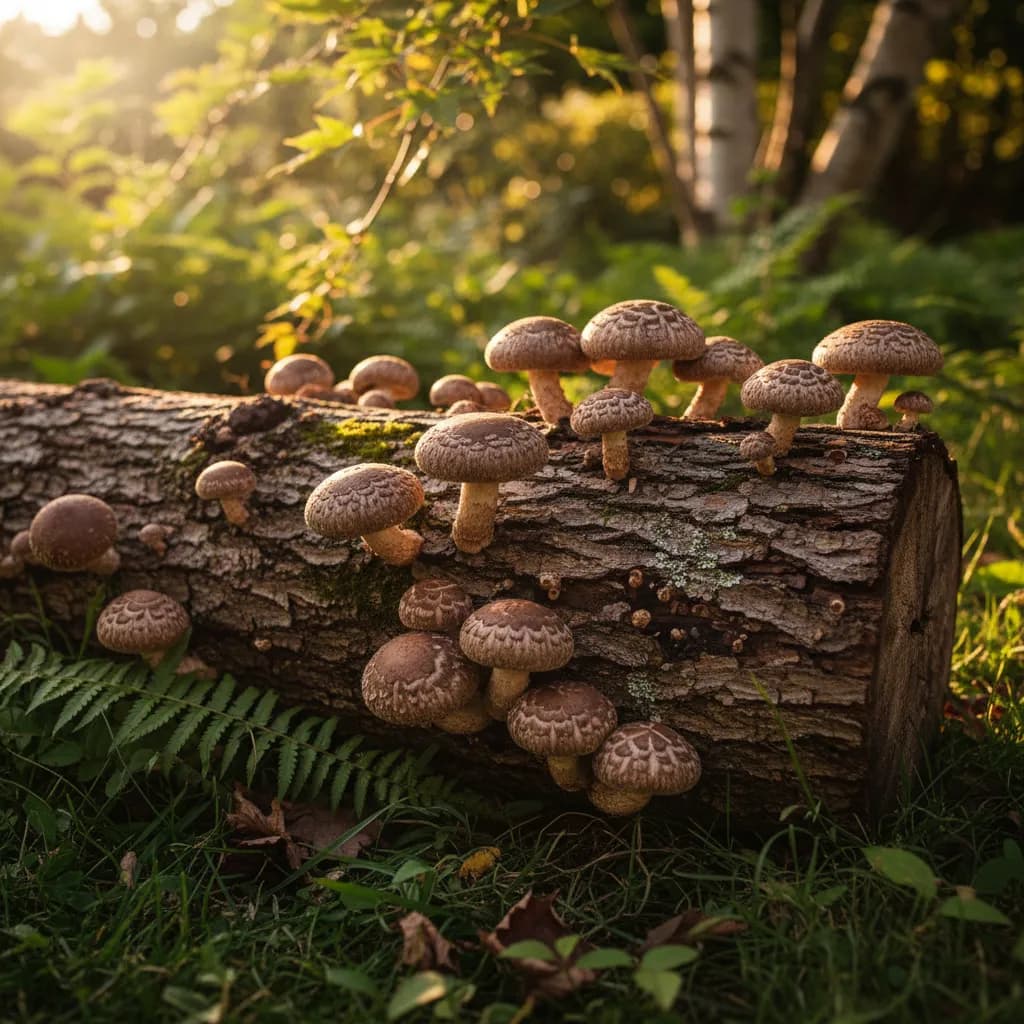
Growing shiitake on oak logs is one of the most rewarding and low-tech cultivation methods available. Oak is the gold standard host wood because its dense grain and high tannin content support strong mycelium colonization and resist competing fungi. A well-managed oak log can produce shiitake for 3-6 years.
Step-by-step process:
- Cut fresh logs in late winter or early spring when trees are dormant and bark is tight. Use logs that are 3-6 inches in diameter and 36-40 inches long
- Wait 2-3 weeks after cutting before inoculating. This allows the tree's natural anti-fungal compounds to dissipate while the bark is still intact and tight
- Drill inoculation holes in a diamond pattern using a 5/16-inch or 12mm drill bit, spacing holes 6 inches apart along the length and staggering rows around the circumference
- Insert plug spawn (hardwood dowels colonized with shiitake mycelium) into each hole using a rubber mallet — one plug per hole
- Seal every hole with food-grade cheese wax or beeswax to prevent contamination and moisture loss
- Stack logs in a shaded, humid location and keep them off the ground on pallets or rails
Colonization takes 6-12 months depending on temperature and log size. The first harvest typically occurs the following spring or fall. Once colonized, logs produce heavy flushes after soaking in cold water for 24 hours.
Log size significantly affects colonization speed, lifespan, and ease of handling. The ideal dimensions are 3-6 inches (8-15cm) in diameter and 36-42 inches (90-107cm) in length. This range balances manageable weight, reasonable colonization time, and sufficient longevity.
Diameter guidelines:
- Under 3 inches: Colonizes quickly (4-6 months) but dries out fast and produces for only 1-2 years. Best for fast turnaround species like oyster mushrooms
- 3-4 inches: The beginner sweet spot. Easy to handle, colonizes in 6-9 months, produces for 2-4 years
- 5-6 inches: Best overall balance. Heavier but holds moisture well, colonizes in 8-12 months, produces for 4-6 years
- Over 8 inches: Very slow colonization (12-18+ months), extremely heavy, difficult to soak for force-fruiting. Only practical for stationary totem-style growing
Length considerations:
- 36-40 inches is standard because it balances surface area with the ability to fit logs in a soaking tank (a standard 55-gallon drum)
- Shorter logs (24 inches) dry out faster but are easier for small-scale growers to manage
- Longer logs (48+ inches) are unwieldy and difficult to soak
Wood species matters as much as size. Oak, sugar maple, beech, and ironwood are excellent. Avoid conifers (resinous), black walnut (toxic to many fungi), and black locust (extremely decay-resistant). Use freshly cut wood — never use logs that have been on the ground long enough for wild fungi to colonize.
The number of plug spawn per log depends on log diameter and length, but the standard guideline is approximately 50 plugs per 40-inch log that is 4-6 inches in diameter. More plugs mean faster colonization and better contamination resistance, at the cost of additional spawn.
Calculating plug count:
- Drill holes 6 inches apart along the length of the log in rows
- Stagger rows around the circumference, spacing rows approximately 2 inches apart (measured around the log's surface)
- Offset each row by 3 inches so the holes form a diamond pattern — this ensures even colonization coverage
Plug counts by log diameter:
- 3-inch diameter log, 40 inches long: approximately 30-35 plugs
- 4-inch diameter log, 40 inches long: approximately 40-50 plugs
- 6-inch diameter log, 40 inches long: approximately 50-65 plugs
- 8-inch diameter log, 40 inches long: approximately 70-85 plugs
Do not skimp on plugs. Under-inoculating leaves large gaps of uncolonized wood where competitor fungi (especially Trichoderma) can establish. The cost of extra plugs is trivial compared to losing a log to contamination after months of waiting.
Plug spawn vs. sawdust spawn: Sawdust spawn inoculated with a palm inoculator tool is faster to apply for large operations. Plug spawn is easier for beginners and small-scale growers because it requires only a drill and hammer — no specialized tool.
Waxing inoculation holes immediately after inserting spawn is a critical step that seals out competitor fungi, retains moisture around the spawn, and dramatically improves colonization success rates. Skipping this step is one of the most common mistakes beginners make with log cultivation.
Wax options and setup:
- Food-grade cheese wax is the most popular choice. It remains pliable, does not crack easily, and melts at a manageable temperature
- Beeswax works well but is more expensive and harder when cool, making it prone to cracking
- Soy wax is a budget-friendly alternative that performs similarly to cheese wax
- Paraffin wax can be used but tends to crack and peel in cold weather
Application technique:
- Melt wax in a small crock pot, double boiler, or dedicated wax pot set to approximately 150-170°F (65-75°C)
- Use a foam dauber brush (available from mushroom spawn suppliers) or an inexpensive natural-bristle paintbrush
- Dab a thick layer of wax over each plug hole immediately after inserting the spawn — cover the entire hole plus a small margin of bark around it
- Also wax over any cut ends of the log and any damaged bark areas where wood is exposed — these are entry points for competitors
Work in batches: Drill and plug a section of holes, then immediately wax before moving to the next section. This minimizes the time holes are exposed to airborne contaminants. On warm, dry days, waxing becomes especially urgent because exposed plug spawn can dry out within hours.
A mushroom totem is a vertical stack of log sections with spawn sandwiched between each layer, creating a compact, space-efficient growing column. Totems are ideal for growers with limited space, heavy logs that are difficult to move for soaking, or species like oyster mushrooms that fruit well from end grain.
Building a totem step by step:
- Cut a fresh hardwood log into 12-16 inch sections. You need 3-4 sections per totem. Use oak, maple, poplar, or any suitable hardwood 6-10 inches in diameter
- Place the bottom section upright on a shaded, level area of bare ground or on a bed of wood chips. The bottom piece should sit directly on soil to wick moisture
- Spread a thick layer of sawdust spawn (about 1/4 inch) over the entire cut surface of the bottom section
- Stack the next log section on top, pressing it firmly onto the spawn layer
- Repeat with spawn layers between each section until your totem is 3-4 sections tall (36-48 inches)
- Cap the top with a piece of cardboard or a thin wood disc covered in wax to retain moisture
- Optionally wrap the entire totem loosely with burlap or shade cloth to maintain humidity
Totems require minimal maintenance — no drilling, no waxing holes, and no soaking. The ground contact provides continuous moisture from below. Mushrooms typically fruit from the spawn layers between sections and from cracks in the bark within 6-12 months.
Best species for totems: Oyster mushrooms are the most reliable. Wine caps, shiitake, and lion's mane also work but may take longer to fruit.
Force fruiting is the technique of submerging a fully colonized shiitake log in cold water for 12-24 hours to trigger a heavy flush of mushrooms. This mimics the natural stimulus of a heavy rain after a dry period and gives you control over harvest timing.
The soaking process:
- Wait until the log is fully colonized — typically 6-12 months after inoculation. Signs of full colonization include white mycelium visible on the cut ends, small bumps forming under the bark, or a previous natural fruiting
- Submerge the log completely in cold water. A 55-gallon plastic drum works perfectly for standard 40-inch logs. Use non-chlorinated water if possible (well water or rainwater is ideal)
- Soak for 12-24 hours. Shorter soaks may not trigger a full flush; longer soaks can waterlog the wood and promote competitor growth
- Remove and stand the log upright or lean it against a structure in a shaded, humid area
- Mushroom pins appear within 5-10 days of soaking and reach harvest size in another 5-7 days
Scheduling force fruitings:
- Rest the log for 6-8 weeks between force fruitings to allow the mycelium to recover and accumulate nutrients
- Most growers plan 2-4 force fruitings per year during the growing season (spring through fall)
- Rotate your logs so different batches fruit at different times, providing a continuous harvest
Cold water produces better results than warm water. Some growers add ice to the soaking tank to drop temperatures below 15°C (60°F), which enhances the temperature shock that triggers pinning.
Yes, lion's mane grows beautifully on logs and produces some of the highest quality fruiting bodies available. Log-grown lion's mane develops denser, more flavorful mushrooms compared to indoor-grown specimens on sawdust blocks, though the process takes longer and requires patience.
Best practices for log-grown lion's mane:
- Wood species: Oak, sugar maple, beech, and birch are all excellent hosts. Avoid conifers and resinous woods entirely
- Log size: Use slightly larger logs than for shiitake — 5-8 inches in diameter works well because lion's mane mycelium grows slowly and benefits from the moisture retention of bigger wood
- Inoculation method: Plug spawn or sawdust spawn works. Drill holes in the standard diamond pattern and seal with wax
- Colonization time: Expect 9-18 months for full colonization — significantly slower than shiitake or oyster on logs
Fruiting characteristics:
- Lion's mane typically fruits from large wounds, branch stubs, or cut ends rather than through intact bark
- Fruits tend to appear in late summer through fall when temperatures drop and humidity rises
- The mushrooms emerge as a single large cluster rather than multiple small ones scattered across the log
- Harvest when spines are 1-2cm long and still firm — overripe specimens become yellowish and bitter
Log-grown lion's mane is worth the wait. The flavor and texture surpass indoor-grown specimens, and a well-colonized log can produce annually for 3-5 years. Place logs in deep shade with good air circulation for best results.
Proper log storage directly affects colonization success, moisture retention, and fruiting performance. The two most common stacking methods are crib stacking and lean-to stacking, each with distinct advantages depending on your space and goals.
Crib stack (log cabin style):
- Stack logs in alternating perpendicular layers, like building a log cabin. Each layer runs at right angles to the one below
- Allows excellent air circulation around all logs equally
- Easy to access individual logs for soaking or inspection
- Takes up more ground space but keeps logs evenly exposed to humidity
- Best during the colonization phase when air exchange matters most
Lean-to stack (A-frame or fence-line):
- Lean logs at a 60-70 degree angle against a horizontal rail, fence, or between two trees
- Compact and space-efficient — you can store many logs in a small footprint
- Bark stays intact longer because rain runs off rather than pooling
- Easy to force-fruit by pulling individual logs for soaking
- Best during the fruiting phase when you want mushrooms to develop freely
Storage location requirements:
- 80% shade — direct sunlight dries logs rapidly and kills surface mycelium. Forest understory, north side of buildings, or under shade cloth are ideal
- Off the ground on pallets, rails, or cinder blocks to prevent ground contact with contaminated soil (totems are the exception)
- Protected from wind which accelerates drying
- Accessible to rainfall or supplemental watering during dry periods — logs need consistent moisture but should not be waterlogged
Water your log stack during dry spells. A sprinkler running for 30 minutes twice per week during drought keeps colonization on track.
Log-grown and indoor-grown shiitake differ significantly in flavor, texture, appearance, growing timeline, and market value. Many chefs and mushroom enthusiasts consider log-grown shiitake a premium product worth the extra time and effort.
Flavor and texture differences:
- Log-grown shiitake develop slowly in natural conditions, producing denser, meatier caps with a more complex, umami-rich flavor. The slower growth concentrates flavor compounds and produces firmer texture
- Indoor-grown shiitake (on supplemented sawdust blocks) grow quickly in controlled environments, resulting in lighter, more tender caps with a milder flavor. They are perfectly good mushrooms but lack the depth of log-grown specimens
- Log-grown caps are often thicker with deeper brown coloring and more pronounced cracking patterns on the surface (the prized "donko" or "flower" pattern)
Production differences:
- Timeline: Indoor blocks produce in 8-12 weeks from inoculation. Log-grown shiitake take 6-12 months for first harvest
- Lifespan: Sawdust blocks produce 2-3 flushes over 2-3 months. Logs produce for 3-6 years with seasonal harvests
- Inputs: Indoor growing requires supplemented sawdust, bags, pressure sterilization, and climate control. Log growing requires fresh logs, plug spawn, wax, and shade
- Labor: Indoor growing has more intensive daily management. Log growing has seasonal labor peaks with long passive periods
Market value: Log-grown shiitake command 2-3x the price of indoor-grown at farmers markets and specialty retailers. The "log-grown" label carries premium cachet similar to "pasture-raised" in the egg market.
A mushroom log is spent when the mycelium has consumed all available nutrients in the wood and can no longer produce fruiting bodies. Recognizing a spent log prevents wasted effort on soaking and managing wood that will never fruit again.
Signs a log is spent:
- Dramatically reduced or no fruiting after soaking, even during prime season with ideal temperatures and humidity
- The log feels significantly lighter than when it was fresh — pick it up and compare to a freshly inoculated log of similar size. Spent logs have lost much of their wood mass to decomposition
- Bark is falling off in large sheets, exposing soft, spongy, or crumbly wood underneath. Some bark loss is normal, but extensive shedding indicates advanced decomposition
- The wood is soft enough to dent with finger pressure — healthy producing logs are still firm and solid
- Competitor fungi appear on the log surface (Trichoderma green mold, turkey tail, or other wild species). Once the shiitake mycelium weakens, competitors colonize the remaining wood
- The log cracks or splits apart easily when handled, indicating internal wood structure has broken down
Typical log lifespans by species:
- Shiitake on oak: 3-6 years
- Oyster on poplar or birch: 1-3 years
- Lion's mane on oak: 3-5 years
- Smaller diameter logs (under 4 inches) are spent sooner than larger ones
Spent logs are excellent garden resources. Break them up and use as mulch, add to compost piles, or place in garden beds as hugelkultur material where the decomposing wood retains moisture and feeds soil biology for years.
Need more help? Dr. Myco can answer follow-up questions about complete log growing guide based on thousands of real growing experiences.
Ask Dr. Myco