What Should Mushroom Mycelium Smell Like?
10 tips in Contamination & Troubleshooting
By Andrew Langevin · Founder, Nature Lion Inc · Contributing author, Mushroomology (Brill, 2026)
Quick answer
Healthy mycelium smells mild and earthy—not sour, rotten, musty or chemical
Treat odor as one clue alongside appearance, moisture and growth behavior. Do not open a sealed suspect culture just to smell it, and never inhale directly from a jar or bag.
| Smell | What it may mean | Safest next action |
|---|---|---|
| Mild, earthy or mushroom-like | Usually healthy mycelium | Compare with a known-clean batch; continue normal observation |
| Sour, vinegary or spoiled-milk | Likely bacterial fermentation | Isolate; do not transfer or spawn; keep sealed if other warning signs appear |
| Beer, bread or fermented fruit | Possible yeast or anaerobic fermentation | Check for wet grain, poor gas exchange and stalled growth; do not expand |
| Strong sweet or fruity odor | Possible yeast or bacterial contamination | Isolate and confirm with appearance or agar before using |
| Musty, mildew or basement-like | Possible mold in a culture or the room | Keep suspect cultures sealed; inspect the room for moisture and hidden mold |
| Ammonia | Excess nitrogen or incomplete substrate conditioning | Do not inoculate until the substrate is properly conditioned and odor resolves |
| Sharp, acrid or chemical | Abnormal; possible mold or chemical residue | Isolate without deliberately sniffing; inspect visually and discard if suspect |
Healthy mushroom mycelium usually smells mild, clean, earthy and mushroom-like. Healthy grain spawn may also retain the neutral cooked-grain aroma of its substrate. Oyster cultures can have a faint anise-like note, lion's mane can smell mildly seafood-like, and shiitake can smell woody. None should smell strongly sour, rotten, fermented, musty or chemical.
Odor is supporting evidence, not a standalone identification test. Evaluate it together with color, texture, moisture, growth rate and recovery after shaking. A culture can be contaminated without producing an obvious odor, and normal substrate ingredients can have their own baseline scent.
Do not open a sealed suspect jar or bag simply to smell it, and never inhale deeply from a culture. Note odor already escaping through a filter or present in the room, isolate the container, and inspect it visually. If a sealed culture has an off odor plus slime, wet grain, unexpected color or stalled growth, keep it sealed and discard it according to local waste practices.
A sour or vinegary smell is the hallmark of bacterial contamination, specifically acid-producing bacteria like Bacillus and Lactobacillus species. These bacteria ferment the sugars and starches in your grain, producing organic acids that create that distinctive sharp, sour odor. If you crack the lid on a jar and get hit with a smell like vinegar, sauerkraut, or sour milk, the jar is bacterially contaminated.
Visually, bacterial contamination often accompanies wet, slimy-looking grain — the bacteria break down the grain surface and release moisture, creating that characteristic wet spot appearance. The smell often precedes visible signs by several days, which is why the smell check is so valuable.
Sour-smelling jars should be discarded sealed. Do not try to spawn them to bulk substrate — you will just spread the bacteria into a larger volume and waste your time.
The prevention strategy focuses on grain moisture:
- After soaking and simmering, grain should be surface-dry
- Individual kernels should not stick together
- If you press a kernel between your fingers, it should not release water
- Some growers add a tablespoon of gypsum per quart of grain, which helps grains separate and maintains a slightly alkaline pH that inhibits bacterial growth
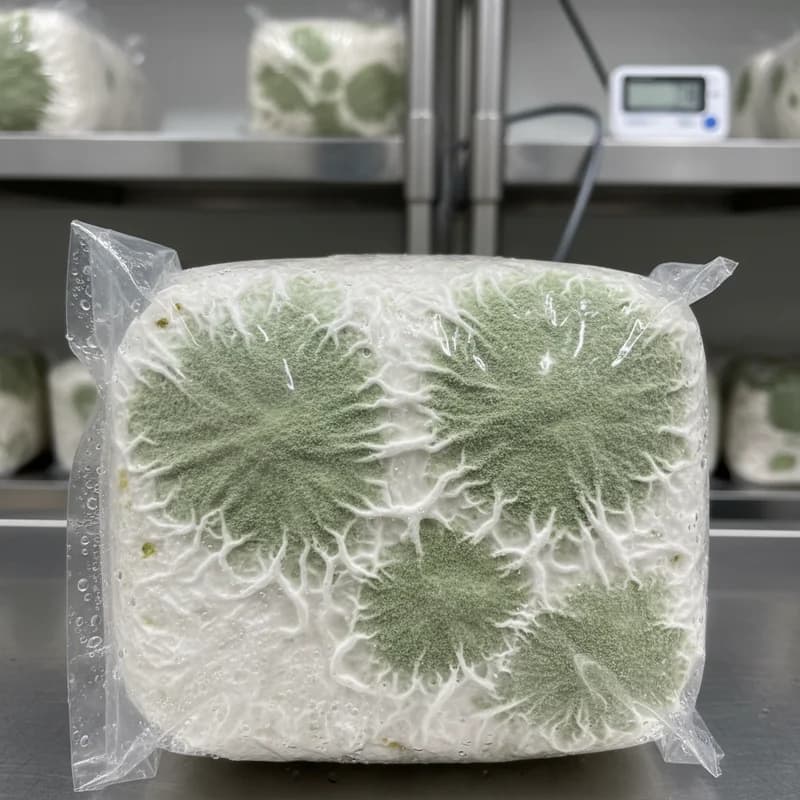
A sharp, acrid, chemical-like smell is strongly associated with Trichoderma contamination, particularly as the mold reaches its sporulation phase. The smell is often described as sharp, like chemical cleaner, acrid, or sometimes like a freshly opened can of paint. Some growers also describe it as having a slightly sweet-chemical quality.
You may notice this smell even before you see green — the volatile organic compounds Trichoderma produces during aggressive growth become detectable by nose before the mold has sporulated enough to show its signature green color. This makes smell one of the earliest possible warning signs for Trichoderma.
If you detect a chemical smell in a jar that still looks white:
- Isolate it immediately from your other jars
- Check again in 24 hours — odds are good you will see the beginning of green patches
Other molds can produce chemical or medicinal smells too:
- Aspergillus sometimes produces a musty-chemical odor
- Some Penicillium species can smell medicinal
The general rule is that any chemical, acrid, or sharp smell that is not the clean earthy scent of mushrooms means something is wrong and the container should be isolated for closer inspection.
A sweet or fruity smell in your substrate or grain jars typically indicates yeast contamination. Yeasts are single-celled fungi that ferment sugars and produce ethanol and fruity esters as byproducts — the same compounds that give beer and wine their aromas. The smell can range from a pleasant fruitiness to an almost cloyingly sweet fermented quality.
In liquid culture, yeast contamination is particularly common because the sugar-rich broth is an ideal growth medium. Signs include:
- Broth becoming uniformly cloudy with a sweet smell rather than developing distinct mycelial clumps
- On grain, kernels appearing slightly glossy or wet with a sweet fermented odor
While yeast contamination is not dangerous the way Aspergillus is, it does mean your container is compromised. Yeast outcompetes mushroom mycelium for simple sugars and creates an acidic environment that inhibits mycelial growth. The jar will stall or the mycelium will grow very slowly and weakly.
Discard yeast-contaminated containers and review your sterilization process:
- Make sure your LC is sterilized at 15 PSI for at least 20 minutes
- Ensure your injection technique is fully sterile
- Check that wild yeast spores are not entering through compromised filters
A beer-like or breadlike fermentation smell in your grain jars means anaerobic fermentation is happening, usually driven by yeast or bacteria in an oxygen-deprived environment. This is distinct from the fruity-sweet smell of aerobic yeast growth — the beer smell indicates that organisms are fermenting in conditions without adequate gas exchange.
The most common causes:
- Grain too wet when it went into the jar, creating a waterlogged environment where oxygen cannot reach all the grain
- Excess moisture settling at the bottom of the jar, where grain begins to ferment rather than colonize
- Jars packed too tightly without adequate headspace for air exchange
- Filter material sealed too tightly or not gas-permeable, making the jar anaerobic
You might notice that the top portion of the jar colonizes normally while the bottom develops the fermented smell and fails to colonize.
To prevent this:
- Leave at least an inch of headspace in your jars
- Make sure your filter material is gas-permeable
- Nail your grain moisture content — slightly too dry is always better than slightly too wet
Discard these jars and adjust your grain prep to achieve drier grain next time.
Odor can reveal microbial metabolites before contamination becomes visually obvious, but you should not crack open sealed jars or bags just to perform a smell check. Opening a suspect culture can release spores or aerosols and can also introduce contamination into a clean container.
Use a safer inspection sequence:
- Look through the container for wet or slimy grain, stalled recovery, unusual colors, powdery growth or unexpected gas
- Note any odor already escaping through the filter or present around the container without deliberately inhaling
- Isolate anything that smells sour, fermented, strongly sweet, rotten, musty or chemical
- Keep a visibly moldy or foul-smelling container sealed for disposal
- Test uncertain liquid culture on agar rather than inoculating production grain
A clean reference batch made with the same grain or broth can help establish the normal appearance and background aroma. Use sight, batch history and growth behavior with odor; never rely on smell alone.
Smell beats sight for early detection in most cases, making it the more important diagnostic tool for catching contamination before it spreads. By the time a contaminant is visible — showing colored spores, slimy wet spots, or distinct colonies — it has already been growing for days and has produced millions of spores or billions of bacterial cells.
Why smell detects contamination earlier:
- By the time you see green Trichoderma, it has been in your jar for at least three to five days in its white mycelial phase, indistinguishable from your mushroom culture
- Bacterial contamination is almost always detectable by smell before sight — the sour smell precedes visible changes by days
- Your nose picks up volatile organic compounds well before organisms reach visible mass
However, the ideal approach is to use both senses together:
- Smell first because it catches the earliest problems
- Then visually inspect for color changes, unusual growth patterns, and texture differences
- Neither sense alone catches everything — some contaminations look wrong but barely smell, and others smell terrible before anything looks off
Think of it as two overlapping nets — what one misses, the other catches. The combination of both provides the most complete monitoring.
Contaminated liquid culture has a range of smell signatures depending on what is growing in it. Healthy LC should smell mildly mushroomy, slightly yeasty, or nearly neutral — just a faint scent of warm broth and mycelium.
Common contamination smells in liquid culture:
- Bacterial contamination — Sour, acidic smell similar to spoiled food or vinegar; the most common contamination in LC because the sugar-rich broth is ideal for bacterial growth
- Yeast contamination — Sweet, fruity, or bread-like fermentation smell, like someone is making beer or bread
- Mold contamination — Musty, stale, or sharp chemical smell depending on the species; less common in LC
One challenge with LC smell diagnosis is that the sealed jar concentrates volatiles — when you open it, the first whiff can be intense even from a healthy culture. Let the initial burst of concentrated gas dissipate for a second, then smell again. The steady underlying scent is what you are evaluating.
If you are unsure, compare against an uninoculated control jar of the same broth recipe. Any significant difference — especially sour or sweet notes — is a warning sign. When in doubt, plate a small sample on agar to check for bacterial or yeast colonies before using that LC to inoculate grain.
Contaminated grain spawn has distinct smell profiles that differ from healthy spawn. Healthy grain spawn smells like a combination of cooked grain and fresh mushrooms — a pleasant, earthy, slightly starchy scent. Different grains have slightly different baselines: rye has a grainy, bread-like note, oats smell mildly sweet, and wheat berries smell nutty. Learn what your specific grain smells like when clean so you can spot deviations.
Common contamination smell profiles:
- Bacterial contamination — Sour, acidic, or like rotting vegetables; the most common smell in grain jars, often accompanied by visibly wet, glossy, or slimy grain at the bottom
- Yeast contamination — Fermented, beer-like, or fruity smell
- Trichoderma — Sharp, chemical, slightly acrid odor; some describe it as smelling like a hardware store or fresh paint
- Aspergillus — Distinctly musty, mildewy smell
One important note: grain that is just starting to colonize sometimes smells a bit yeasty or starchy from the grain itself, which is normal. The difference is intensity — normal grain has a mild background scent, while contamination produces a strong, in-your-face odor that is clearly wrong once you have experienced it.
A persistent musty smell in your growing space — not from a specific jar but in the room air itself — is a serious warning sign that airborne mold spore levels are too high for reliable cultivation. The musty smell comes from microbial volatile organic compounds produced by mold colonies growing somewhere in the environment: in walls, ceiling tiles, HVAC ducts, old carpet, or on previously contaminated substrates that were not properly disposed of.
Growing mushrooms in a space with high ambient mold counts is like trying to keep a wound clean in a dirty room. No matter how perfect your sterile technique is, you are fighting against a constant rain of contaminant spores on every surface.
Address the source before focusing on your individual jars:
- Find and remove any old contaminated substrate or spent blocks
- Clean all surfaces with a 10% bleach solution
- Check for water damage or leaks supporting hidden mold growth in walls or floors
- Run a HEPA air purifier rated for the room size for at least 24 hours before introducing clean cultures
If the musty smell is coming from the building itself — mold in walls, old carpet, or HVAC system — and you cannot remediate it, you may need to relocate your growing operation. No amount of sterile technique overcomes a fundamentally contaminated environment.
Need more help? Dr. Myco can answer follow-up questions about what should mushroom mycelium smell like? based on thousands of real growing experiences.
Ask Dr. Myco