Long-Term Storage
10 tips in Agar Work & Culture
By Andrew Langevin · Founder, Nature Lion Inc · Contributing author, Mushroomology (Brill, 2026)
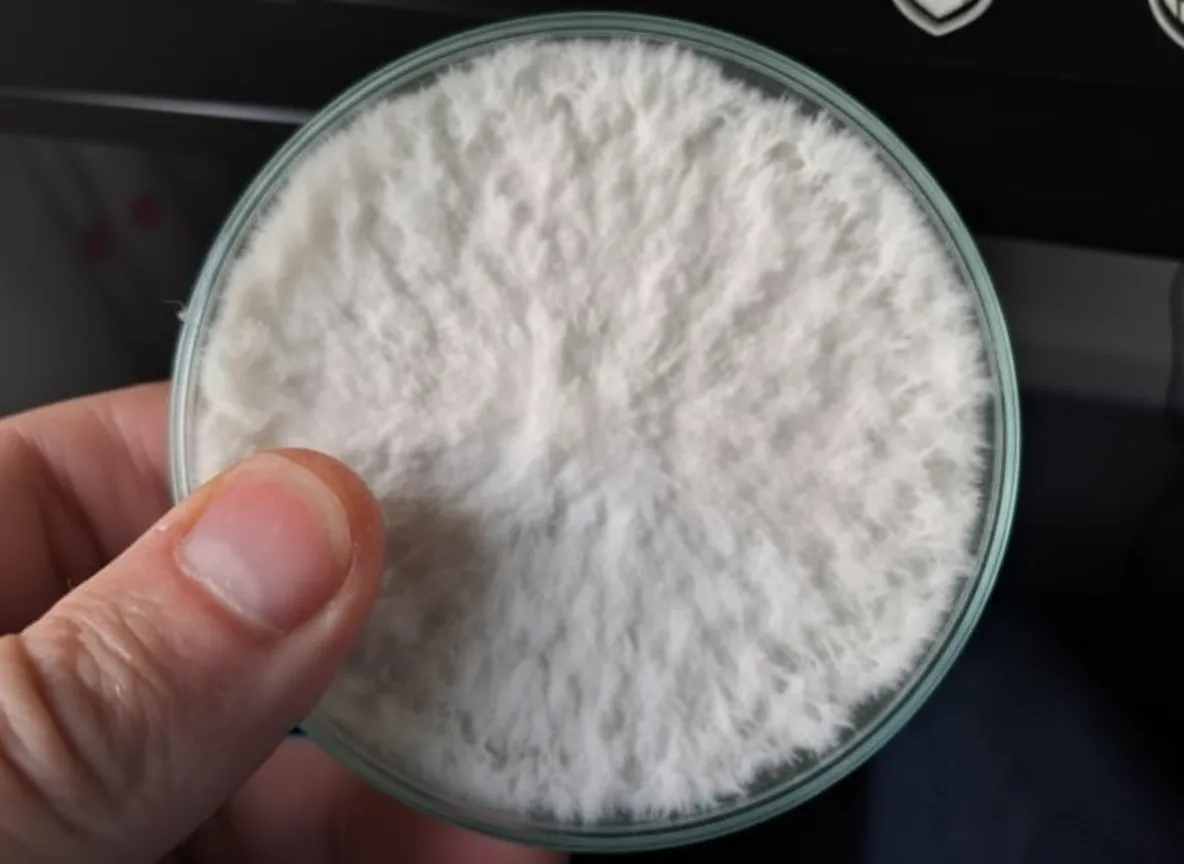
For storage lasting weeks to months, wrap colonized agar plates tightly with parafilm around the entire lid-to-base seam and refrigerate at 2-8°C. The cold slows metabolic activity, and the parafilm prevents drying. Most species remain viable for 3-6 months this way, though vigor decreases over time.
Maintenance tips:
- Check stored cultures monthly — if the agar is drying out or you see contamination developing, transfer a clean piece to a fresh plate
- For storage beyond 6 months, use slants (agar in test tubes, which dry out much more slowly) or more advanced techniques like sterile water storage or cryopreservation
- Always maintain at least two copies of important cultures in case one fails
An agar slant is a test tube or small vial containing solidified agar at an angle, creating a sloped surface for mycelium to grow on. Slants are the gold standard for long-term culture storage because the sealed tube environment minimizes drying and contamination risk.
How to make slants:
- Fill test tubes about 1/3 full with your agar recipe
- Cap loosely with foil or autoclavable caps
- Sterilize at 15 PSI for 20 minutes
- While the agar is still liquid, prop the tubes at a 20-30 degree angle (lean them against a book or rack) so the agar solidifies as a slope
- Once cool, inoculate by streaking or placing a small agar wedge on the slant surface
- Seal with parafilm and refrigerate after colonization
Slants can remain viable for 6-18 months.
Frank's method is a streamlined approach to making and maintaining slants, popularized on mycology forums. The key innovation is using 13x100mm borosilicate glass test tubes with autoclavable screw caps (not cotton plugs or foil), which provide a far better seal than traditional methods.
The process:
- Fill tubes 1/3 full with LME agar (2% LME + 2% agar)
- Autoclave with caps loosely on
- Prop at an angle to solidify
- Inoculate with a small wedge of mycelium
- Once colonized, tighten the screw cap, wrap with parafilm, and refrigerate
The screw cap + parafilm combination creates a nearly airtight seal that keeps cultures viable for 12+ months. Frank's method emphasizes using grain-based agar variants for species that prefer grain nutrients.
Viability depends on the storage method and species. Aggressive colonizers like oyster mushrooms tend to stay viable longer than slow-growing species.
Viability by storage method:
- Agar plates wrapped in parafilm and refrigerated — 3-6 months
- Agar slants with screw caps and parafilm — 6-18 months
- Sterile water storage (colonized agar pieces in sterile distilled water) — 1-5 years
- Cryopreservation (in glycerol solution at -80°C) — indefinitely, but requires specialized equipment
Signs of declining viability: very slow growth when transferred to a fresh plate, thin or wispy mycelium instead of robust growth, or failure to colonize at all. Transfer cultures to fresh media every 3-6 months to maintain vigor.
Parafilm is a stretchy, self-sealing wax film used to seal the seam between agar plate lids and bases. Cut a strip about 3 inches wide and long enough to wrap around the entire circumference of the plate (roughly 12 inches for a 90mm dish).
Application technique:
- Stretch the parafilm gently as you wrap — it should adhere to itself without any adhesive
- Overlap the starting point by about an inch
- The parafilm should cover the lid-base junction completely, creating a semi-airtight seal
- Don't wrap too tightly or you'll crack the plate
Replace parafilm if it dries out, tears, or loses its stretch (usually after 2-3 months).
Store cultures at 2-8°C (standard refrigerator temperature, around 4°C is ideal). This range slows metabolic activity without killing the mycelium. Never freeze agar cultures in a standard freezer — ice crystal formation ruptures cell walls and kills the mycelium.
Storage location tips:
- The crisper drawer is often the most stable temperature zone in a household fridge
- Keep cultures away from the back wall where temperatures can drop below freezing
- Keep them away from strong-smelling foods — while the parafilm seal is good, it's not perfect, and some growers report cultures absorbing odors over time
A small, dedicated mini-fridge is ideal if you maintain many cultures.
Not in a standard freezer (-18°C) — ice crystals destroy the cells. However, cryopreservation at ultra-low temperatures (-80°C) with a cryoprotectant like glycerol preserves cultures indefinitely.
The cryopreservation technique:
- Grow mycelium in liquid culture
- Mix 50/50 with sterile 30% glycerol solution
- Pipette into cryovials
- Freeze slowly (1°C per minute, ideally in an isopropanol cryo-container)
This is a professional-grade technique requiring a -80°C freezer, which costs thousands of dollars. For home cultivators, the more practical long-term options are:
- Slants (6-18 months)
- Sterile water storage (1-5 years)
- A regular transfer schedule on fresh agar every 3-6 months
Sterile water storage is a simple, inexpensive method for preserving cultures for 1-5 years. The mycelium enters a dormant state in the water, surviving with minimal metabolic activity. This method works well for most species and requires no special equipment beyond what you already have for agar work.
The process:
- Fill small screw-cap vials or test tubes halfway with distilled water
- Sterilize at 15 PSI for 20 minutes
- Once cool, use a flame-sterilized scalpel to cut 5-8 small squares (3-4mm) of colonized agar and drop them into the sterile water
- Seal tightly and store at room temperature in a dark location
To revive a culture, fish out one agar square with a sterile tool and place it on a fresh agar plate.
Transfer a piece of the old culture to a fresh, nutrient-rich agar plate (LME or PDA). Place the transferred piece agar-side down in the center of the fresh plate, seal, and incubate at the species' optimal colonization temperature (typically 21-24°C).
If the culture is still viable, you'll see new growth within 3-7 days. Growth may be slow and weak at first — give it time. Once new growth appears, transfer the leading edge to another fresh plate to encourage vigorous growth.
If no growth appears after 14 days, the culture may be dead. For very old or dehydrated cultures:
- Try placing the piece on an agar plate with slightly higher moisture content
- Use a plate supplemented with a small amount of activated charcoal, which can help detoxify accumulated metabolites
A culture library is a curated collection of mushroom strains stored on slants or in sterile water. Start small — 5-10 strains is plenty for a home cultivator. Focus on proven performers: your best oyster strain, a reliable lion's mane, your fastest-colonizing shiitake. Quality over quantity.
Organization essentials:
- Label every culture with the species name, strain ID (or source), isolation date, and transfer number
- Store at least two copies of each important strain (redundancy)
- Use a spreadsheet or notebook to track: strain name, storage method, date stored, and last transfer date
Maintenance schedule:
- Transfer active strains to fresh agar every 3-6 months to keep them vigorous
- For long-term reserves, use slants or sterile water storage
Need more help? Dr. Myco can answer follow-up questions about long-term storage based on thousands of real growing experiences.
Ask Dr. Myco