Grain-to-Grain Transfer
10 tips in Spawn Production
By Andrew Langevin · Founder, Nature Lion Inc · Contributing author, Mushroomology (Brill, 2026)
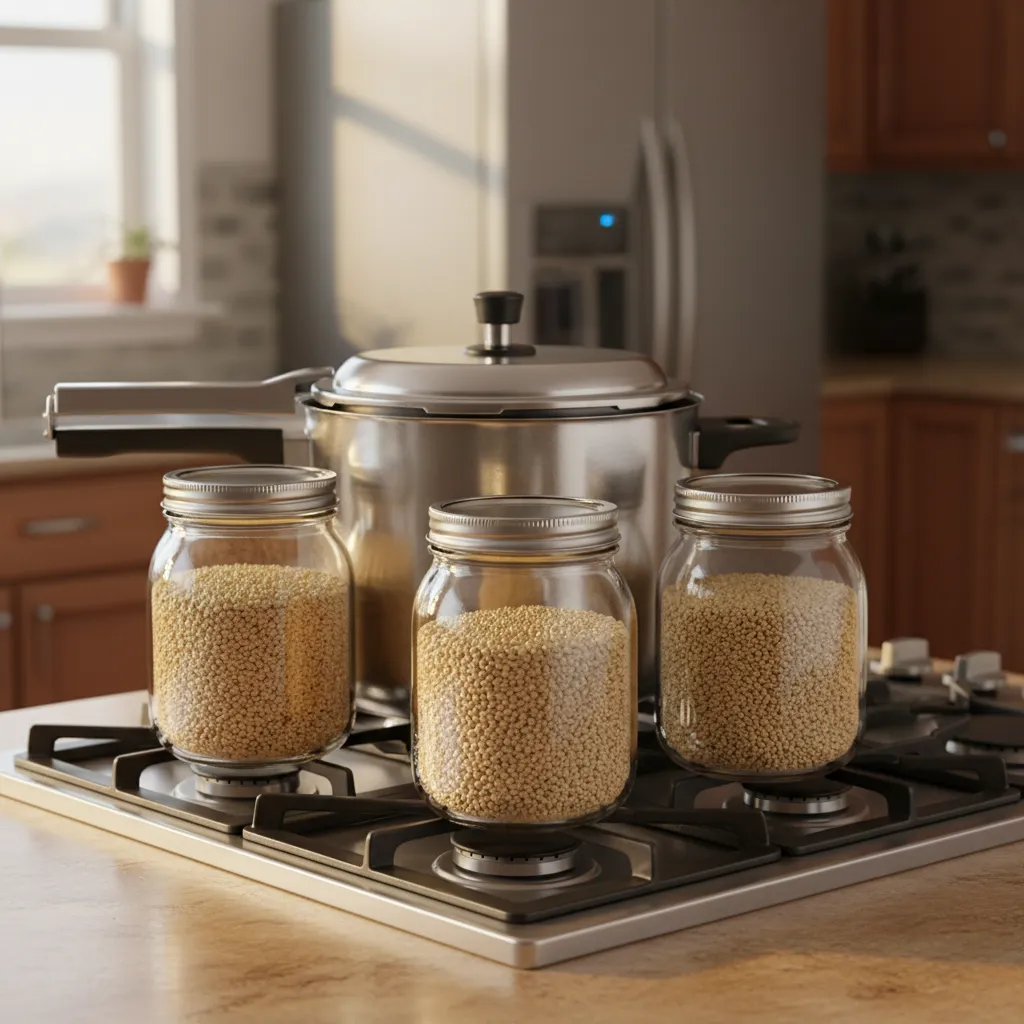
Grain-to-grain transfer is a technique for multiplying your spawn supply by transferring colonized grain into fresh sterilized grain. One fully colonized quart jar can be divided among 5-10 fresh jars, each of which will fully colonize within 1-2 weeks. This exponential multiplication is how commercial farms scale from a single culture to hundreds of pounds of spawn.
The process:
- Shake a fully colonized jar to break up the grain
- Distribute approximately 10-15% of the colonized grain into each fresh jar inside a flow hood or SAB
- The colonized kernels act as inoculation points throughout the fresh grain
G2G is dramatically more cost-effective than buying spawn. A single $15 liquid culture syringe can produce 1 jar of grain spawn, which can be G2G transferred into 5-10 jars, each of which can produce another 5-10 jars. Within 2-3 generations, you have virtually unlimited spawn for the cost of grain and your time.
G2G also colonizes faster than LC inoculation because you're adding pre-colonized grain kernels (hundreds of active growth points) rather than a few milliliters of liquid.
The downside: each generation of G2G carries contamination risk, and the mycelium can lose vigor over many generations. Most growers limit G2G to 3-5 generations before returning to agar or LC.
Prepare fresh sterilized grain jars (soak, simmer, dry, load, pressure cook at 15 PSI for 90 minutes). Let cool completely.
The transfer process (in your flow hood or SAB):
- Shake your fully colonized donor jar vigorously to break the grain into individual kernels
- Open the donor jar and each recipient jar only in front of clean air
- Pour approximately 10-15% of the colonized grain into each fresh jar — about 2-3 tablespoons per quart jar
- Close and shake each recipient jar to distribute the colonized kernels evenly throughout
- Seal with modified lids or micropore tape
Incubate at 21-24°C. Shake again at 30% colonization to redistribute growth points. Full colonization typically takes 7-14 days depending on species and spawn rate.
Most cultivators limit grain-to-grain transfers to 3-5 generations before returning to an agar culture or fresh liquid culture. Each generation carries a small risk of contamination introduction and a gradual loss of mycelial vigor through a process called senescence.
Signs of generational decline:
- Slower colonization with each transfer
- Thinner or wispier mycelium
- More tomentose growth replacing rhizomorphic growth
- Reduced yields
- Increased susceptibility to contamination
Commercial farms typically run 3-4 generations maximum and maintain master cultures on agar for fresh starts. Home growers can push further if their sterile technique is excellent, but there's diminishing returns beyond generation 5.
Senescence is the gradual decline in vigor and productivity of a mushroom culture over successive transfers or generations. Like all living organisms, mycelium ages. After many generations of vegetative growth (without sexual reproduction via spores), cultures accumulate genetic damage, lose metabolic efficiency, and become less vigorous.
Signs of senescence:
- Progressively slower colonization
- Declining yields
- Irregular growth patterns
- Thin and wispy mycelium
- Eventual failure to fruit
The solution is to periodically return to spores (which reset the genetic clock through sexual recombination) or to freshly cloned tissue from a productive mushroom. This is why maintaining a culture library with multiple backup strains is important.
Shake grain jars once, at approximately 20-30% colonization. This breaks up colonized clumps and redistributes them throughout the uncolonized grain, creating new inoculation points that dramatically speed up full colonization. Without shaking, mycelium grows from a few points and must slowly colonize outward. After shaking, you have dozens of growth points spread evenly through the jar.
The technique:
- Hold the jar firmly and shake vigorously side-to-side and up-and-down for 10-15 seconds until all the grain is broken up and mixed
- Don't shake before 20% colonization (not enough established mycelium)
- Don't shake after 70% (mycelium is well-established and shaking just creates unnecessary stress)
The ideal window is 20-30% — enough established mycelium to ensure recovery, but enough uncolonized grain to benefit from redistribution.
Too early (under 15% colonization):
- The mycelium hasn't established enough to recover from the disruption
- Small fragments may not have enough energy reserves to restart growth, potentially stalling colonization entirely
- Premature shaking can dislodge contaminant spores that the mycelium was containing, spreading contamination throughout the jar
Too late (over 70% colonization):
- The mycelium has already formed a dense, interconnected network
- Shaking just breaks this network without meaningful benefit, since most of the grain is already colonized
Contaminated grain shows several telltale signs. Any jar that smells sour, sweet, or fermented when opened is contaminated. Always smell each jar before using it for spawning.
Visual indicators by contaminant type:
- Trichoderma — bright green patches that spread rapidly through the grain
- Bacterial contamination — wet, slimy, translucent grain kernels with a sour smell
- Aspergillus — black or dark green powdery spots
- Yeast — pink or orange discoloration of the grain or liquid pooling at the bottom
- Wet spots — uncolonized grain surrounded by healthy mycelium may indicate localized bacterial contamination; the mycelium grows around but won't colonize the affected kernels
If in doubt, do not use it — one contaminated jar can ruin your entire bulk substrate batch.
Healthy mycelium on grain is bright white, grows outward in a relatively uniform front from the inoculation point(s), and produces a clean earthy smell. It appears as a web of fine white threads binding grain kernels together.
Mold contamination on grain has colors:
- Green — Trichoderma (the most common)
- Blue-green — Penicillium
- Black — Aspergillus
- Orange/pink — lipstick mold or yeast
Mold also tends to appear as isolated spots that weren't inoculation points — it pops up randomly rather than radiating from where you injected. Bacterial contamination looks different from both: wet, glossy patches where individual grain kernels look waterlogged and translucent.
The Q-tip test works on grain too: mold transfers as powder, mycelium stretches as strands.
Healthy, fully colonized grain spawn smells clean, earthy, and slightly sweet — like fresh mushrooms or damp forest floor. This is the most important quality check before using spawn.
What to watch for:
- Sour or vinegary smell — bacterial contamination (usually from excess moisture during preparation)
- Sweet, fruity, or alcoholic smell — yeast contamination or fermentation
- Chemical or sharp smell — Trichoderma
- No smell at all with white mycelium — likely fine, especially with dry grain preparations
Make it a rule: SMELL EVERY JAR OF SPAWN BEFORE OPENING IT FOR USE. This single habit will save you from contaminating your bulk substrate batches. If it smells off, discard it outside — don't open it indoors.
Need more help? Dr. Myco can answer follow-up questions about grain-to-grain transfer based on thousands of real growing experiences.
Ask Dr. Myco